

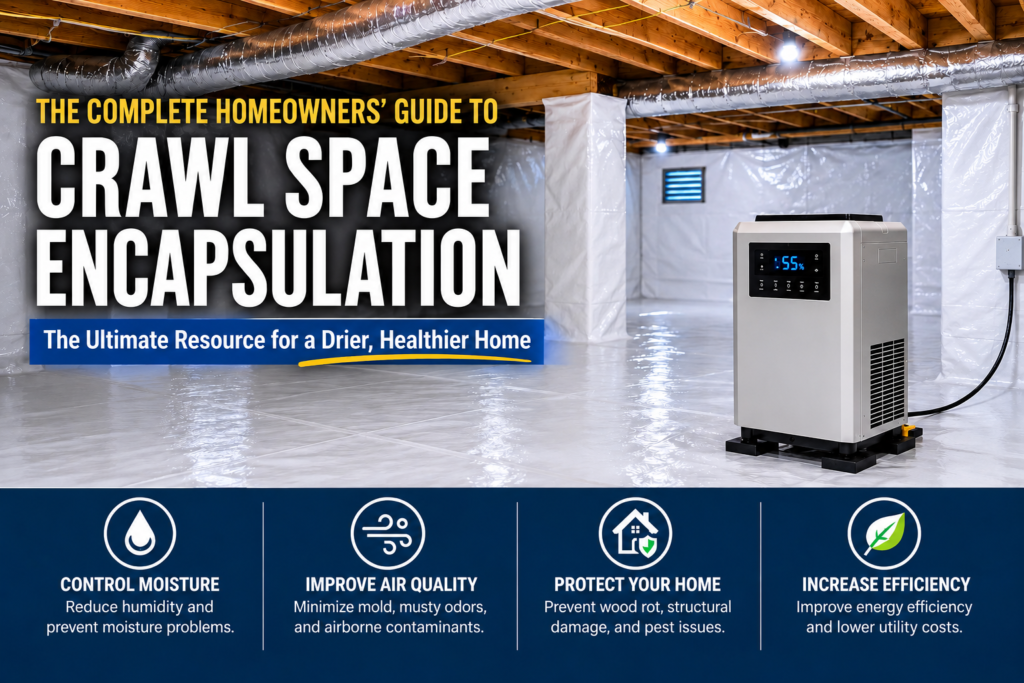
A source-first guide to crawl space encapsulation: how it works, when it makes sense, what problems it can and cannot solve, costs, vapor barriers, drainage, dehumidification, DIY risks, and professional installation.
Quick Answer
Crawl space encapsulation is a moisture-control system designed to separate the crawl space from damp soil and uncontrolled outside air. A complete system typically combines a continuous ground vapor barrier, sealed seams and penetrations, treatment of foundation vents and other air leaks, proper drainage when needed, and a method of controlling humidity.
Encapsulation can be highly effective for persistent crawl-space humidity, musty odors, condensation, damp insulation, mold-conducive conditions, and moisture-related wood deterioration. But it is not a substitute for fixing standing water, plumbing leaks, failed drainage, pest infestations, mold contamination, or structural damage.
The best approach is to diagnose the moisture source first and design the encapsulation system around the actual problem.
Not Sure if Your Crawl Space Needs Encapsulation?
Use the CrawlSpaceInfo Free Crawl Space Assessment to organize the water, humidity, odor, mold, insulation, pest, and structural symptoms you are seeing.
What Is Crawl Space Encapsulation?
Crawl space encapsulation is the process of sealing and protecting the crawl space beneath a home from excessive ground moisture, humid outside air, condensation, and other moisture pathways.
The term is sometimes used loosely to describe putting plastic over a dirt floor. A true encapsulation system goes considerably further.
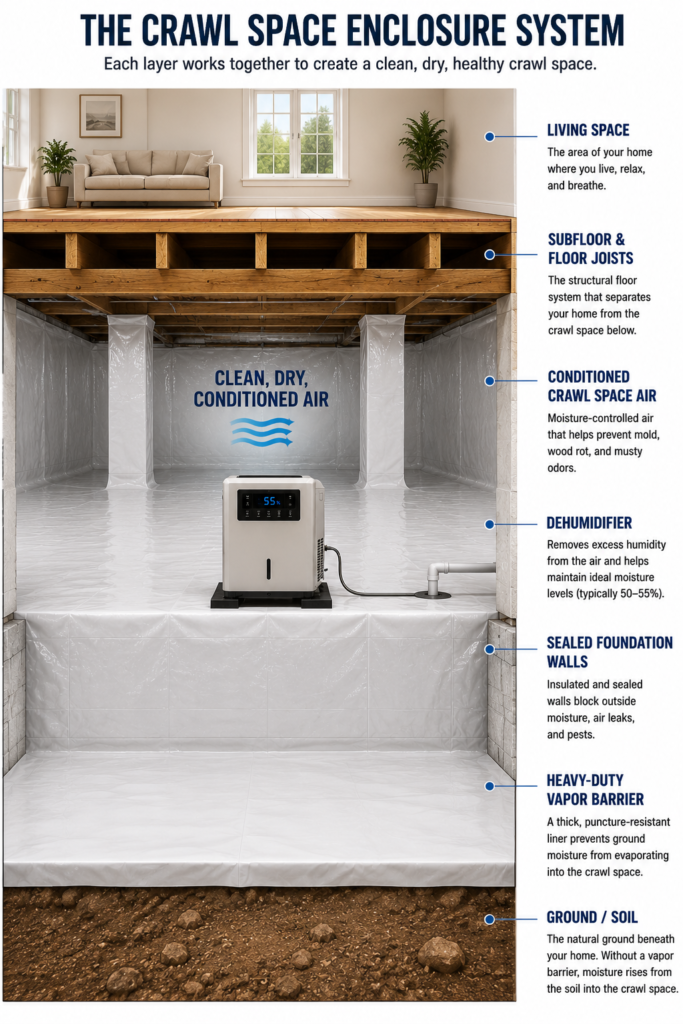
A complete system may include:
- A heavy-duty vapor barrier covering exposed soil
- Sealed seams and penetrations
- Vapor-barrier material extended and sealed at foundation walls or piers where appropriate
- Sealed foundation vents in an unvented design
- Air sealing around penetrations and openings
- A sealed or weatherstripped crawl-space access door
- Drainage improvements where liquid water is present
- A sump pump when site conditions require one
- Appropriate insulation
- A dehumidifier or another humidity-control strategy when needed
How Crawl Space Encapsulation Works
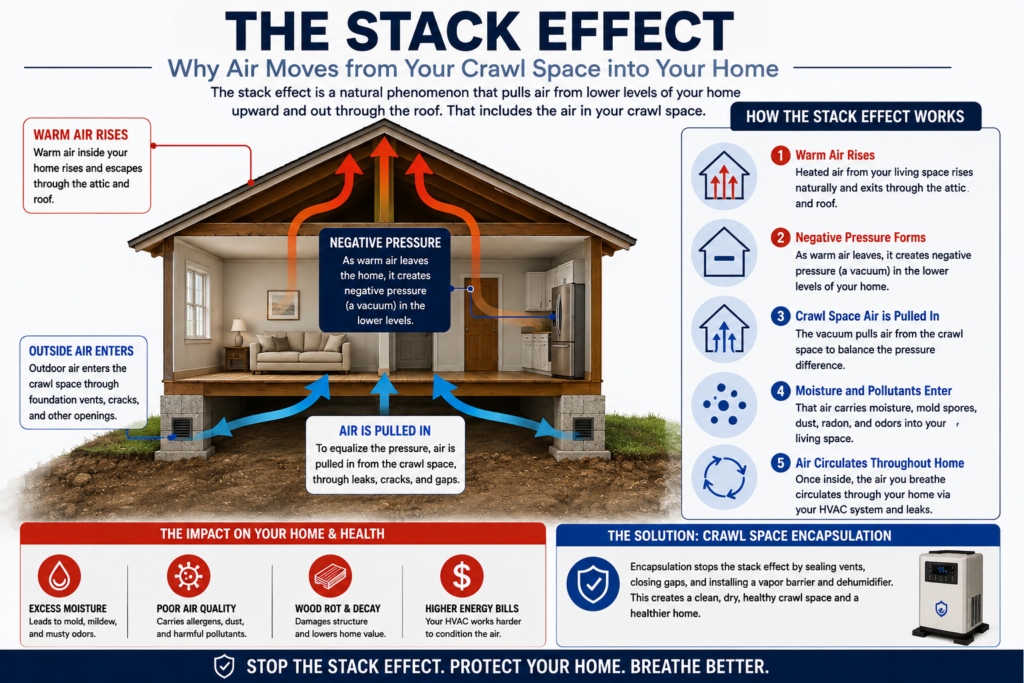
An untreated crawl space can receive moisture from several directions.
- Moisture evaporating from exposed soil
- Rainwater draining toward the foundation
- Groundwater
- Plumbing leaks
- Humid outside air
- Condensation on cold surfaces
- Improperly discharged gutters and downspouts
- HVAC condensate or ductwork problems
Encapsulation attempts to control these moisture pathways rather than repeatedly drying the crawl space after problems develop.
1. Blocks Ground Moisture
Bare soil can continuously release water vapor into the crawl space. A continuous vapor barrier creates a physical layer between the soil and the crawl-space air, reducing this moisture source.
2. Reduces Uncontrolled Outside Air
Foundation vents, gaps, and air leaks can allow warm, humid air to enter the crawl space. When humid air reaches cooler surfaces, condensation can occur.
A properly designed unvented crawl space controls these openings as part of the moisture-management system.
3. Controls Humidity
Even after the ground and air leaks are addressed, some crawl spaces still need additional humidity control.
This may involve:
- A dedicated crawl-space dehumidifier
- Conditioned air
- Mechanical ventilation or exhaust
- Another appropriate building-system strategy
A dehumidifier is therefore common in encapsulated crawl spaces, but it should not automatically be treated as the solution to every moisture problem.
4. Creates a More Stable Environment
When bulk water, ground vapor, air leakage, and humidity are properly controlled, the crawl space can remain significantly drier.
That can help protect wood framing, insulation, ducts, plumbing, fasteners, and other building materials.
Why Crawl Space Moisture Matters
The crawl space may be underneath your home, but it is still part of the building.
Persistent moisture beneath the house can contribute to:
- Mold-conducive conditions
- Wood deterioration
- Wet insulation
- Musty odors
- Corrosion
- Pest activity
- Condensation
- Higher indoor humidity
Air can also move between the crawl space and the living portions of the home through openings in floors, framing, plumbing penetrations, and ductwork.
The objective is therefore not merely to make the crawl space look cleaner. It is to control moisture at its source.
7 Signs Your Crawl Space May Need Better Moisture Control
One symptom alone does not necessarily mean you need full encapsulation. Several symptoms occurring together, however, are a strong reason to inspect the crawl space more carefully.
1. Persistent Musty Odors
A recurring musty smell can indicate damp materials, high humidity, mold growth, or another moisture-related condition beneath the home.
2. High Humidity
A crawl space that remains humid for long periods can create conditions favorable to condensation, mold growth, corrosion, and deterioration of wood and insulation.
3. Visible Mold or Fungal Growth
Growth or discoloration on joists, beams, subflooring, insulation, or other materials usually indicates that moisture conditions need attention.
4. Standing Water or Persistently Wet Soil
Possible causes include:
- Poor grading
- Overflowing gutters
- Downspouts discharging near the foundation
- Plumbing leaks
- Groundwater
- Surface-water intrusion
- Failed drainage systems
5. Wood Deterioration or Sagging Floors
Long-term moisture can contribute to deterioration of wood framing.
Warning signs may include:
- Soft or damaged joists
- Deteriorated beams
- Damaged sill plates
- Bouncy floors
- Uneven flooring
- Doors that have become difficult to close
These symptoms can have causes unrelated to crawl-space moisture, so structural concerns deserve proper evaluation rather than assumptions.
6. Wet or Falling Insulation
Fiberglass insulation hanging from floor joists can indicate moisture, poor installation, pests, or a combination of problems.
Replacing insulation without correcting the reason it became wet or damaged can lead to the same problem again.
7. Condensation on Ductwork or Other Surfaces
Condensation occurs when humid air reaches a surface that is cold enough for moisture to condense.
Cold ductwork, refrigerant lines, pipes, and framing can all become condensation surfaces in a humid crawl space.
Quick Crawl Space Self-Inspection Checklist
- Musty odors
- Standing water after rain
- Persistently wet soil
- Visible condensation
- Wet or falling insulation
- Mold or fungal growth
- Soft or deteriorating wood
- Rust or corrosion
- Pest evidence
- Water staining on foundation walls
- Plumbing leaks
- Damaged vapor barrier
- Poor exterior drainage
Benefits of Crawl Space Encapsulation
A properly designed crawl space encapsulation system can provide several benefits when the underlying moisture problem is correctly diagnosed.
Better Moisture Control
This is the primary purpose of encapsulation.
A continuous vapor barrier reduces ground moisture, while air sealing and appropriate humidity control help manage other moisture pathways.
Reduced Conditions for Mold Growth
Encapsulation does not guarantee that mold will never occur, but reducing excess moisture makes the crawl space less favorable for future fungal growth.
Protection for Structural Components
Wood joists, beams, sill plates, subflooring, and other structural materials perform better when they are protected from persistent moisture.
Potentially Fewer Musty Odors
If odors originate from damp soil, wet materials, or moisture-related microbial growth, correcting those conditions can reduce the odor.
Better Protection for Plumbing and HVAC Components
Lower crawl-space humidity may help reduce corrosion and moisture-related deterioration of metal components, duct insulation, plumbing, and equipment.
Potential Energy and Comfort Benefits
Reducing unwanted air movement and improving insulation may improve comfort and HVAC efficiency in some homes.
Actual savings vary considerably, so homeowners should be cautious of guaranteed energy-savings claims.
What Crawl Space Encapsulation Does NOT Fix
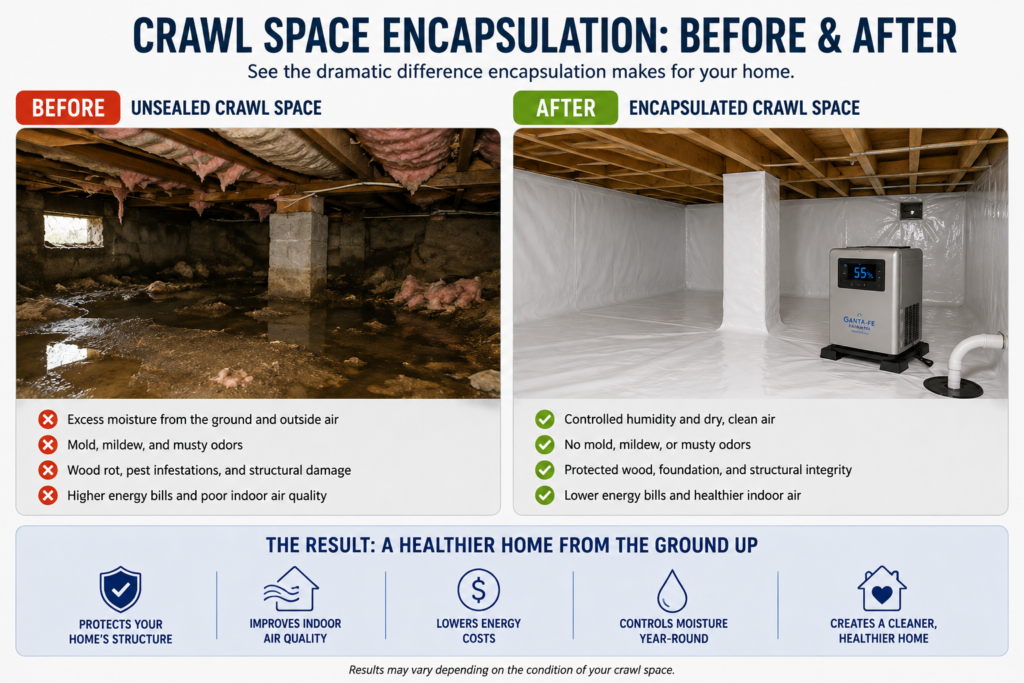
Encapsulation is a moisture-control strategy. It is not a universal home-repair system.
It does not automatically repair:
- Foundation settlement
- Major foundation cracks
- Sagging floors
- Rotted joists
- Damaged beams or support posts
- Broken plumbing
- Sewer leaks
- Active termite infestations
- Existing mold contamination
- Improper exterior grading
- Failed gutters
- Groundwater intrusion
- Flooding
Should Water Problems Be Fixed Before Encapsulation?
Yes. Bulk-water sources should be identified and managed as part of the project.
If water repeatedly enters the crawl space, simply installing a liner over the floor does not solve the underlying problem.
Depending on the source, corrective work may include:
- Repairing plumbing leaks
- Cleaning or repairing gutters
- Extending downspouts
- Correcting exterior grading
- Installing exterior drainage
- Installing an interior perimeter drain
- Installing a sump pump
- Managing groundwater
- Repairing penetrations or drainage failures
The correct repair depends on how the water is entering the crawl space.
Crawl Space Encapsulation vs. Vapor Barrier
A crawl space vapor barrier and full crawl space encapsulation are related, but they are not necessarily the same thing.
Basic Ground Vapor Barrier
A ground vapor barrier covers exposed soil and reduces water vapor entering the crawl-space air.
A vapor barrier alone generally does not:
- Stop standing water
- Repair plumbing leaks
- Seal every exterior opening
- Control all air infiltration
- Control humidity under every condition
- Repair existing mold or structural damage
Full Crawl Space Encapsulation
Encapsulation treats the crawl space more comprehensively by combining the ground liner with additional air- and moisture-control measures.
| Feature | Ground Vapor Barrier | Full Encapsulation |
|---|---|---|
| Covers exposed soil | Yes | Yes |
| Seams extensively sealed | Sometimes | Typically |
| Wall / pier detailing | Limited or varies | Typically included |
| Foundation vents addressed | Not necessarily | Yes in an unvented system |
| Air leakage addressed | Limited | More comprehensive |
| Humidity-control strategy | Not necessarily | Typically part of system design |
| Bulk-water management | Separate issue | Should be integrated when needed |
Which Option Is Right for Your Home?
If the primary problem is moisture evaporating from the ground and the crawl space otherwise performs well, a simpler vapor-barrier installation may be adequate.
If the crawl space has persistent humidity, condensation, outside-air infiltration, recurring moisture problems, or several moisture sources, full encapsulation may provide more comprehensive control.
Crawl Space Encapsulation vs. Waterproofing
Encapsulation and waterproofing solve related but different problems.
Waterproofing and drainage primarily address liquid water entering or accumulating around the crawl space.
Encapsulation primarily controls water vapor, uncontrolled air movement, and crawl-space humidity.
A home can require both.
For example, a crawl space that floods after heavy rain may need drainage and a sump pump before or as part of an encapsulation project.
Do You Need a Dehumidifier After Crawl Space Encapsulation?
Not every encapsulated crawl space automatically requires a dehumidifier.
The appropriate humidity-control strategy depends on:
- Climate
- Crawl-space size
- Moisture load
- Air leakage
- HVAC configuration
- Insulation strategy
- How thoroughly water sources have been corrected
In many humid climates, however, a dedicated crawl-space dehumidifier is a practical way to maintain controlled humidity.
A dehumidifier should not be expected to solve standing water, plumbing leaks, groundwater intrusion, or failed drainage.
DIY vs. Professional Crawl Space Encapsulation
Some encapsulation work can be completed by an experienced homeowner.
The important question is whether the crawl space has problems that should be diagnosed before anything is covered.
DIY May Be Reasonable When:
- The crawl space is accessible
- There is no recurring standing water
- There are no active plumbing leaks
- Structural framing appears sound
- There is no extensive mold problem
- Drainage is functioning properly
- You understand vapor-barrier and air-sealing details
- You are comfortable working in confined spaces
Professional Evaluation Is More Appropriate When:
- Water repeatedly enters after rain
- Mold growth is widespread
- Wood is deteriorated
- Floors are sagging or unusually flexible
- Foundation movement is suspected
- A drainage system is required
- A sump pump is required
- Electrical hazards exist
- Sewage or contaminated water is present
- Pest damage is extensive
- The crawl space is extremely confined
| Factor | DIY | Professional |
|---|---|---|
| Initial cost | Usually lower | Usually higher |
| Labor | Homeowner | Contractor |
| Diagnosis | Depends on homeowner experience | Should be part of evaluation |
| Difficult access | More challenging | Better equipped |
| Drainage systems | Can become complex | Often included or coordinated |
| Structural problems | Professional evaluation needed | Can coordinate appropriate specialists |
| Warranty | Usually material warranty only | May include workmanship and equipment |
| Best suited for | Simple, dry crawl spaces | Complex or multiple moisture problems |
How Much Does Crawl Space Encapsulation Cost?
The cost of crawl space encapsulation varies significantly because contractors may use the term encapsulation to describe very different scopes of work.
One proposal may include little more than a floor liner and basic air sealing.
Another may include:
- Drainage
- A sump pump
- Mold remediation
- Debris removal
- Insulation removal
- Structural repair
- Heavy-duty floor and wall membrane
- Air sealing
- Dehumidification
- Electrical work
- A new crawl-space access door
- Monitoring equipment
These are fundamentally different projects and should not be compared using the final price alone.
Main Factors That Affect Encapsulation Cost
| Cost Factor | Why It Matters |
|---|---|
| Crawl-space size | Larger spaces require more membrane, sealing material, and labor. |
| Height and accessibility | Very low or difficult crawl spaces require considerably more labor. |
| Cleanup | Debris, damaged insulation, contamination, or previous materials may need removal. |
| Water intrusion | Drainage, sump systems, grading, or plumbing repairs can add substantial cost. |
| Liner specifications | Material quality, reinforcement, thickness, wall coverage, and installation details affect cost. |
| Number of piers and penetrations | Every penetration requires additional detailing and sealing. |
| Humidity control | Dehumidifiers, electrical work, drains, and monitoring add equipment and installation cost. |
| Existing damage | Mold, pests, insulation damage, wood deterioration, and structural repairs are separate scopes. |
How to Compare Crawl Space Encapsulation Quotes
Do not compare quotes using price alone.
A useful proposal should clearly explain:
- What moisture problem was diagnosed?
- Where is the water or moisture coming from?
- Is drainage included?
- Is a sump pump included?
- Is existing insulation being removed?
- Is mold remediation included?
- What liner material is being installed?
- How will seams be sealed?
- How will walls and piers be detailed?
- How will foundation vents be handled?
- How will humidity be controlled?
- Is electrical work included?
- How will condensate be discharged?
- What maintenance is required?
- What warranty is provided?
- What does the warranty exclude?
Two companies may both quote “crawl space encapsulation” while proposing dramatically different systems.
Is Crawl Space Encapsulation Worth It?
It depends on the problem the system is solving.
Encapsulation may be worthwhile when a crawl space has persistent moisture problems that simpler measures have not corrected, or when several moisture pathways are occurring at the same time.
It may be unnecessary when the crawl space is dry and performing well or when the actual problem can be solved with a straightforward repair such as fixing a plumbing leak or correcting a downspout.
Can Crawl Space Encapsulation Lower Energy Bills?
Possibly, but savings should not be guaranteed.
Encapsulation can change the relationship between the crawl space and the rest of the house. When combined with appropriate insulation and air sealing, it may reduce unwanted heat transfer and air leakage.
Actual results depend on:
- Climate
- Existing insulation
- HVAC location
- Duct leakage
- Air leakage
- Home size
- Heating and cooling equipment
- Utility rates
- Previous crawl-space conditions
Be cautious of contractors promising a specific percentage reduction in energy costs without evaluating the entire house.
Does Crawl Space Encapsulation Improve Indoor Air Quality?
It may contribute to better indoor conditions when it successfully controls a significant moisture source beneath the home.
However, encapsulation should not be treated as a medical treatment or a guaranteed indoor-air-quality solution.
Indoor air quality can also be affected by:
- HVAC filtration
- Outdoor pollution
- Cooking
- Combustion appliances
- Pets
- Smoking
- Cleaning products
- Ventilation
- Indoor humidity
- Other mold or moisture sources
Encapsulation addresses the crawl-space portion of that larger system.
Does Crawl Space Encapsulation Prevent Pests?
Not by itself.
Encapsulation can reduce moisture and seal some openings, potentially making the crawl space less attractive to certain pests.
However, it does not replace proper pest treatment for termites, rodents, carpenter ants, cockroaches, or other infestations.
Existing pest problems should be identified and treated separately.
What Should Happen Before Crawl Space Encapsulation?
Step 1: Inspect the Exterior
Check:
- Gutters
- Downspouts
- Grading
- Drainage
- Foundation openings
- Low areas where water collects
Step 2: Inspect the Crawl Space
Look for:
- Standing water
- Damp soil
- Water staining
- Condensation
- Plumbing leaks
- Mold
- Damaged insulation
- Wood deterioration
- Pest evidence
- Foundation cracks
- Corrosion
Step 3: Identify the Moisture Source
Determine whether moisture is primarily coming from:
- Soil vapor
- Surface water
- Groundwater
- Plumbing
- Outdoor humidity
- Condensation
- Several sources together
Step 4: Correct Bulk-Water Problems
Stop leaks and manage water intrusion before relying on encapsulation.
Step 5: Address Existing Damage
Evaluate mold, wood deterioration, damaged insulation, pests, electrical problems, and structural concerns.
Step 6: Design the System
Determine the appropriate:
- Vapor barrier
- Drainage
- Air sealing
- Insulation
- Vent treatment
- Humidity control
- Access details
Step 7: Install and Verify
After installation, inspect seams, penetrations, drainage, equipment operation, condensate routing, and crawl-space humidity.
Crawl Space Encapsulation Maintenance
Encapsulation should not make the crawl space a forgotten part of the house.
Inspect the crawl space periodically and after unusually heavy storms.
Look for:
- New plumbing leaks
- Water beneath or above the liner
- Loose seams
- Tears or punctures
- Pest activity
- Unusual odors
- Condensation
- Dehumidifier drainage problems
- Sump-pump problems
- Changes in humidity
- Foundation or structural changes
If a dehumidifier is installed, maintain its filters, drainage, and other service items according to the manufacturer’s instructions.
If a sump pump protects the crawl space from recurring water, it should also be inspected and tested periodically.
Frequently Asked Questions About Crawl Space Encapsulation
Is crawl space encapsulation worth it?
It can be worthwhile when persistent moisture, humidity, condensation, or ground vapor is affecting the crawl space. Whether it makes financial sense depends on the source and severity of the problem. Some homes can be managed with simpler moisture-control measures.
Does every crawl space need encapsulation?
No. A dry, well-performing crawl space does not automatically need full encapsulation. The solution should match the moisture problem.
Does encapsulation stop mold?
Encapsulation can reduce the moisture conditions that support future mold growth, but it does not remove existing mold. Existing mold and its moisture source should be addressed appropriately.
Will encapsulation eliminate musty odors?
It may if the odor is caused by moisture conditions in the crawl space and those conditions are successfully corrected. Other odor sources may require separate investigation.
Do I need a dehumidifier after encapsulation?
Not always. The answer depends on climate, crawl-space conditions, system design, moisture load, and how the crawl space is conditioned. In many humid areas, a properly sized dehumidifier is a practical solution.
What humidity should an encapsulated crawl space maintain?
The goal is to avoid persistent high humidity, condensation, and moisture levels that can support mold or material deterioration. Rather than relying on a single number in every climate, monitor actual crawl-space conditions and investigate sustained high humidity.
Should crawl-space vents stay open after encapsulation?
In a true unvented crawl-space design, exterior ventilation openings are handled as part of the sealed system. Simply closing vents without addressing ground moisture, air leakage, humidity control, and other system requirements is not the same as proper encapsulation.
Can I encapsulate my crawl space myself?
Potentially. DIY work may be reasonable when the crawl space is accessible, structurally sound, and free of major water, mold, pest, drainage, and electrical problems. Complex conditions deserve professional evaluation.
Can you encapsulate a crawl space with standing water?
Recurring standing water should first be diagnosed and controlled. Encapsulation can be part of the eventual system, but it should not be used to hide an unresolved water problem.
Does encapsulation fix sagging floors?
No. Encapsulation can control moisture that may contribute to deterioration, but it does not repair damaged joists, beams, supports, or foundations.
What’s the difference between encapsulation and waterproofing?
Waterproofing primarily manages liquid-water intrusion. Encapsulation primarily controls water vapor, uncontrolled air movement, and humidity. Many wet crawl spaces require both approaches.
Does encapsulation prevent termites?
No. It may reduce some favorable moisture conditions but is not a termite treatment. Active pest problems should be treated separately.
How long does crawl space encapsulation last?
There is no universal lifespan. Longevity depends on material quality, installation, foot traffic, water conditions, pests, maintenance, drainage, and other site conditions.
How long does crawl space encapsulation take?
Project duration depends on the crawl-space size, accessibility, preparation, drainage work, contamination, structural repairs, and system complexity. A straightforward installation can be completed much faster than one requiring extensive repairs.
Can encapsulation increase home value?
A clean, dry, documented crawl space may reduce concerns during a home inspection and may be viewed positively by buyers. It should not be assumed to produce a specific dollar increase in resale value.
The Bottom Line
Crawl space encapsulation can be an effective long-term moisture-control strategy when it is used for the right problem and installed as a complete system.
The most important principle is simple:
A good project does not merely make the crawl space look clean. It identifies where moisture is coming from, controls bulk water, manages ground vapor and air movement, addresses existing damage, and provides an appropriate method of controlling humidity afterward.
That is the difference between simply installing a plastic liner and building a genuine crawl-space moisture-management system.
Ready to Find Out What Your Crawl Space Needs?
Musty odors, standing water, mold, high humidity, damaged insulation, soft floors, and condensation can have very different causes. Use the Free Crawl Space Assessment to identify which conditions deserve attention first.