

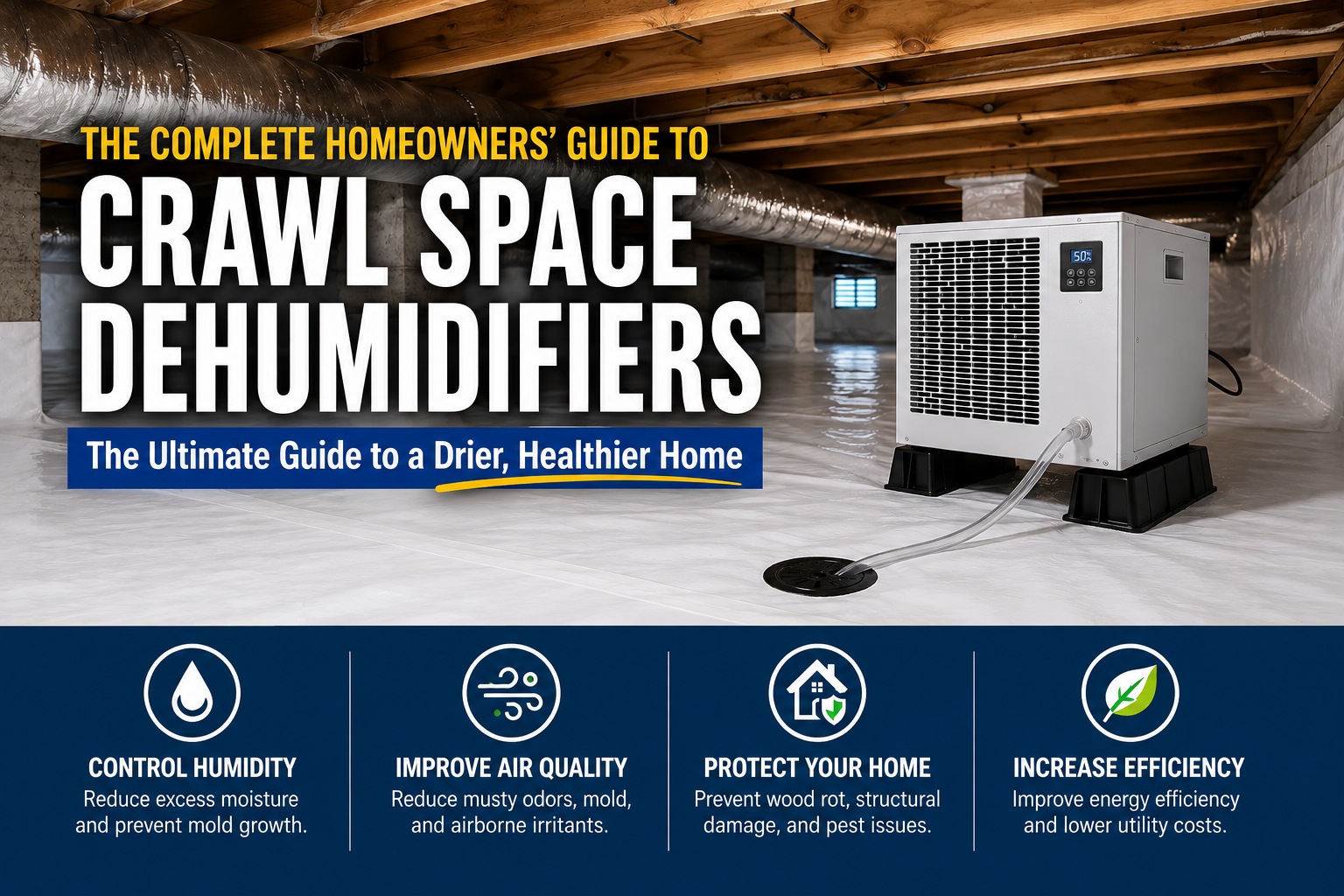
A source-first guide to deciding whether your crawl space actually needs a dehumidifier, choosing the right capacity, understanding current efficiency ratings, installing it correctly, and fixing the moisture sources that equipment alone cannot solve.
Quick Answer
A crawl space dehumidifier can be an effective way to control high airborne moisture, especially in a sealed or encapsulated crawl space. But it is not a substitute for fixing standing water, plumbing leaks, poor grading, groundwater entry, or failed drainage. Measure humidity first, correct bulk-water problems, then size the unit for the space and moisture load. EPA guidance recommends keeping indoor relative humidity below 60% and ideally around 30–50% where practical. In crawl spaces, the goal is to keep materials dry and avoid prolonged high humidity and condensation.
Not Sure Whether You Need a Dehumidifier?
Use the CrawlSpaceInfo Free Crawl Space Assessment to organize the humidity, odors, water, mold, insulation, and structural symptoms you are seeing.
What Is a Crawl Space Dehumidifier?
A crawl space dehumidifier is a moisture-control appliance designed to pull water vapor from the air and discharge the collected water through a drain. Many crawl-space models are built for continuous operation, low-clearance spaces, automatic humidity control, and permanent drainage.
The basic job is simple: keep relative humidity low enough that condensation, mold-supporting moisture, corrosion, and damp building materials are less likely to develop.
Do You Need a Crawl Space Dehumidifier?
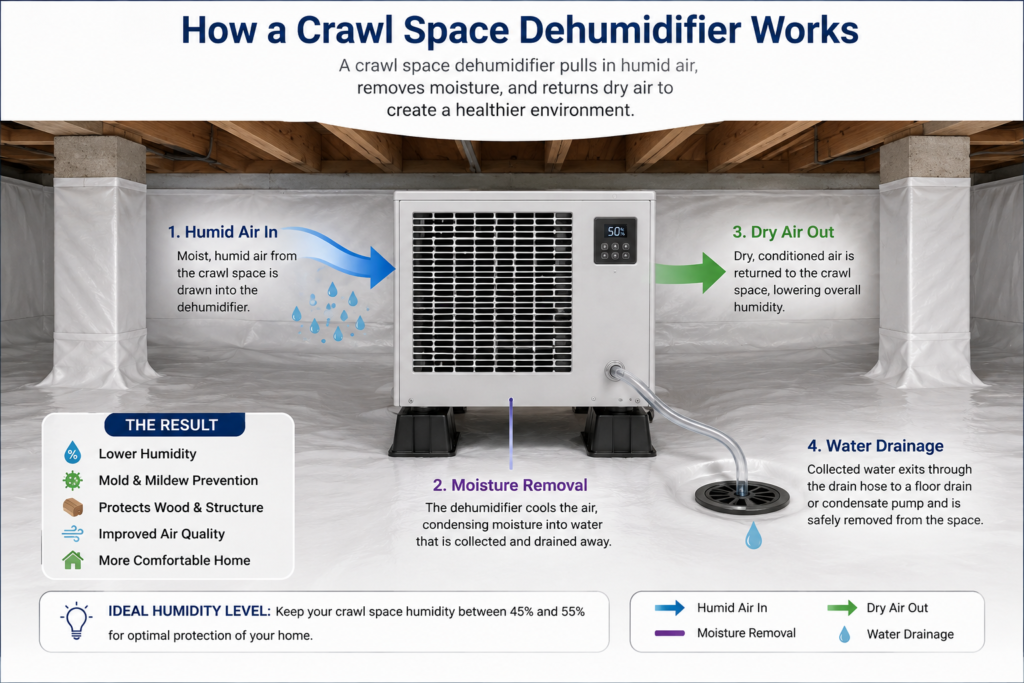
Not every crawl space needs one. A dehumidifier makes the most sense when humidity remains too high after obvious water problems have been corrected and the crawl space is being managed as a controlled or unvented space.
Signs That Humidity Deserves Attention
- Relative humidity repeatedly staying near or above 60%
- Condensation on cold pipes, ducts, metal supports, or foundation surfaces
- Persistent musty odors
- Damp or falling fiberglass insulation
- Surface mold or fungal growth
- Rust or corrosion on metal components
- Wood that remains damp or shows staining or deterioration
- A current dehumidifier that runs continuously without reaching its set point
What Humidity Level Should a Crawl Space Have?
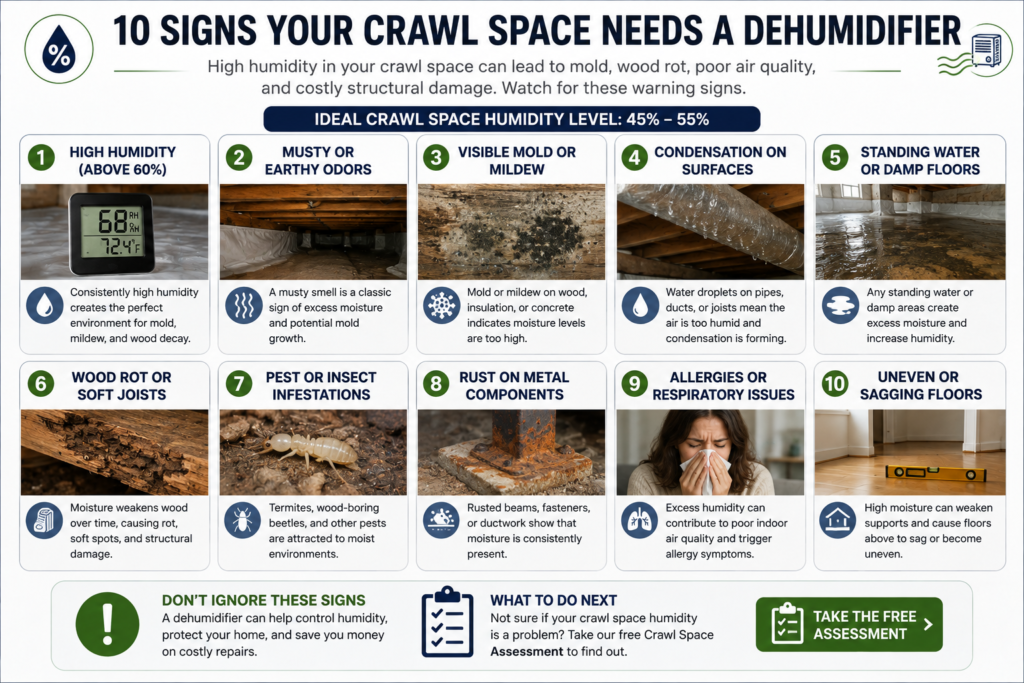
There is no single magic percentage that applies to every crawl space in every climate, but prolonged high relative humidity is a warning sign. EPA guidance for indoor environments recommends keeping relative humidity below 60% and ideally in the 30–50% range where practical.
For a crawl space, the practical goal is to keep the space dry enough that condensation does not form and wood, insulation, and other materials do not remain damp. Many dehumidifier systems are commonly set in the general 45–55% range, but the appropriate setting depends on climate, temperature, crawl-space design, and manufacturer guidance.
| Relative Humidity | How to Think About It | What to Do |
|---|---|---|
| Below ~50% | Generally dry conditions if there is no liquid-water problem | Continue monitoring |
| About 50–60% | Often manageable, but watch cold surfaces and seasonal trends | Check condensation, drainage, and air sealing |
| Above 60% for extended periods | Greater likelihood of condensation and moisture-related problems | Find the moisture source and consider active humidity control |
| Very high humidity plus wet materials | May indicate bulk water, groundwater, leaks, or major air/moisture entry | Diagnose the source before relying on a dehumidifier |
These ranges are practical homeowner guidance, not a substitute for local code, manufacturer requirements, or a site-specific moisture evaluation.
How Crawl Space Dehumidifiers Work
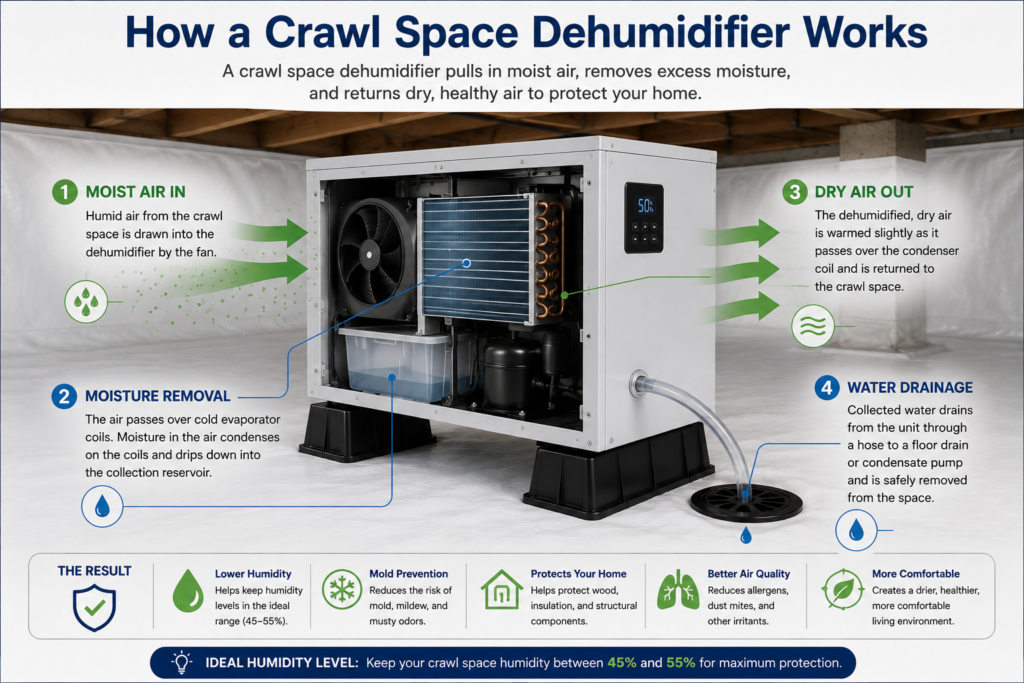
Most residential crawl-space dehumidifiers use refrigeration. A fan pulls humid air across a cold evaporator coil. When the air is cooled below its dew point, water vapor condenses into liquid water. The water drains away, and the drier air passes across the warm side of the refrigeration system before returning to the crawl space.
The Cycle in Four Steps
- Humid air enters the unit.
- Moisture condenses on the cold coil.
- Condensate drains away.
- Drier air returns to the crawl space.
A built-in humidistat or remote sensor tells the unit when to cycle on and off. Continuous drainage means there is normally no bucket to empty.
How to Size a Crawl Space Dehumidifier
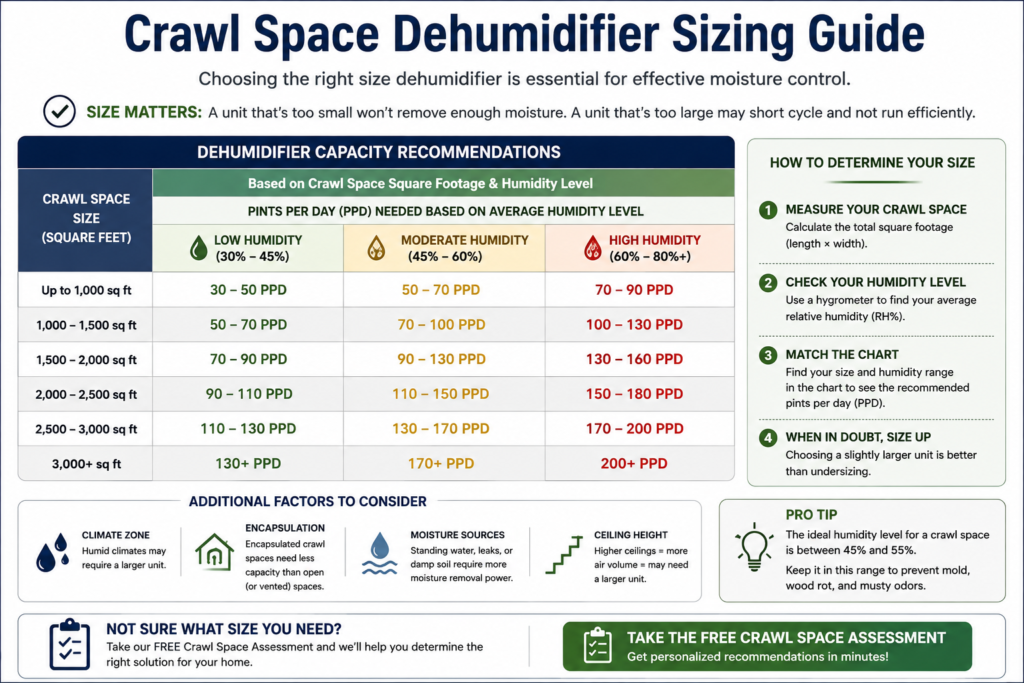
Do not size a unit by square footage alone. The moisture load depends on the crawl-space area, temperature, outdoor climate, exposed soil, vapor barrier quality, air leakage, drainage, standing-water history, and whether the space is sealed or encapsulated.
Square Footage
Start with crawl-space floor area:
Length × Width = Square Feet
If the crawl space has separate sections, measure each section and add them together.
Moisture Severity
Two 1,500-square-foot crawl spaces can require very different equipment. A sealed crawl space that occasionally reaches 60% RH is a much easier load than a vented crawl space with exposed soil, wet foundation walls, and summer humidity above 75%.
Code-Based Sizing Is Different From Product Marketing
Some residential codes include a specific dehumidification sizing pathway for unvented crawl spaces. For example, IRC provisions have used a benchmark of 70 pints per day per 1,000 square feet of crawl-space floor area when dehumidification is the selected code-compliance method. Local adoption and amendments vary, so this should not be treated as a universal equipment rule.
Features That Matter Most
| Feature | Why It Matters |
|---|---|
| Built-in humidistat | Automatically cycles the unit to maintain the selected humidity level. |
| Continuous drain | Removes condensate without a bucket. |
| Condensate pump option | Useful when gravity drainage is not available. |
| Automatic restart | Restarts the unit after a power interruption. |
| Automatic defrost | Helps protect performance when coils approach freezing conditions. |
| Washable or replaceable filter | Protects airflow and internal components. |
| Ducting capability | Can help distribute dry air in divided or irregular crawl spaces. |
| Remote sensor / Wi-Fi monitoring | Lets you check humidity and operation without entering the crawl space. |
| Energy-efficiency rating | Helps compare how much moisture a unit removes for the electricity it uses. |
| Warranty and service access | Important for equipment expected to run for many hours in a difficult environment. |
Understand Current Efficiency Ratings
ENERGY STAR and DOE use standardized testing to compare dehumidifier capacity and energy efficiency. The efficiency metric is Integrated Energy Factor (IEF), expressed as liters of water removed per kilowatt-hour of electricity consumed. A higher IEF generally means better moisture removal per unit of energy.
When comparing products, use the current rating shown for the exact model rather than older marketing material or an outdated review.
Should You Encapsulate Before Installing a Dehumidifier?
Often, the most effective sequence is to reduce moisture entry first and then use the dehumidifier to control the remaining airborne load.
That may include:
- Correcting gutters, downspouts, and exterior grading
- Repairing plumbing leaks
- Managing groundwater or drainage problems
- Covering exposed earth with an appropriate vapor retarder
- Sealing crawl-space vents and outside-air leakage when converting to an unvented system
- Air sealing penetrations between the crawl space and outdoors
- Insulating in accordance with the chosen crawl-space design and local code
Related Guide: Crawl Space Encapsulation: The Complete Homeowner Guide (2026)
Benefits of a Properly Designed System
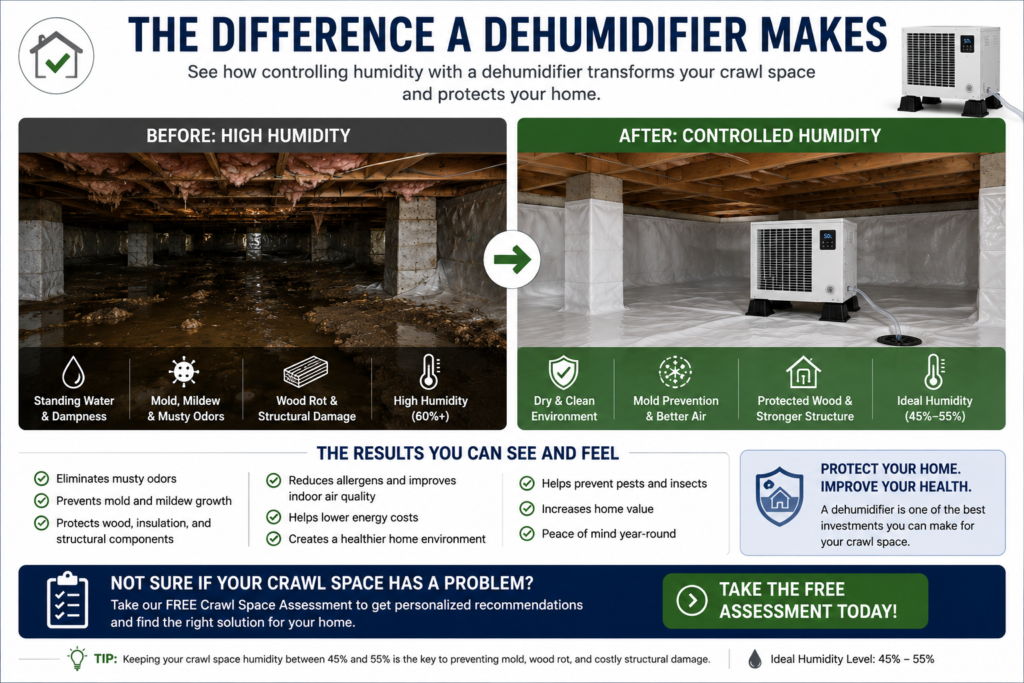
When the moisture sources are controlled and the unit is correctly sized, a crawl-space dehumidifier can help stabilize humidity and reduce the conditions that contribute to condensation, musty odors, corrosion, damp insulation, and moisture-related deterioration.
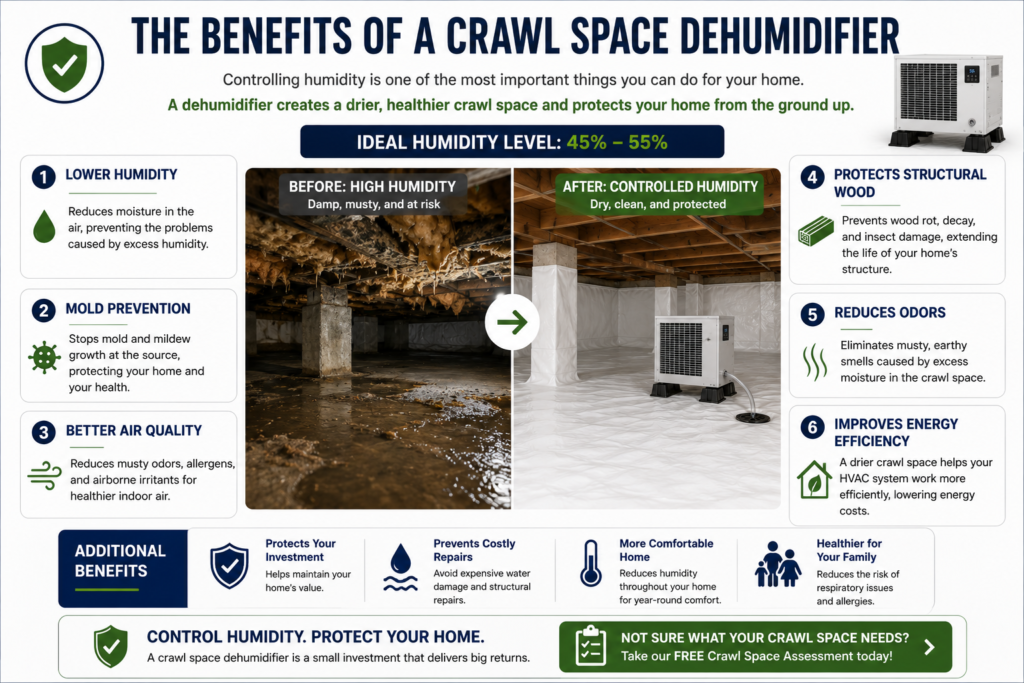
- More stable crawl-space humidity
- Less condensation on cold surfaces
- Drier wood and insulation
- Less favorable conditions for mold growth
- Reduced musty odors when moisture is the cause
- Less corrosion risk for metal components
How Crawl Space Dehumidifiers Are Installed
Installation varies by manufacturer, crawl-space layout, drainage, electrical access, and whether ducting is used. Always follow the instructions for the exact unit.
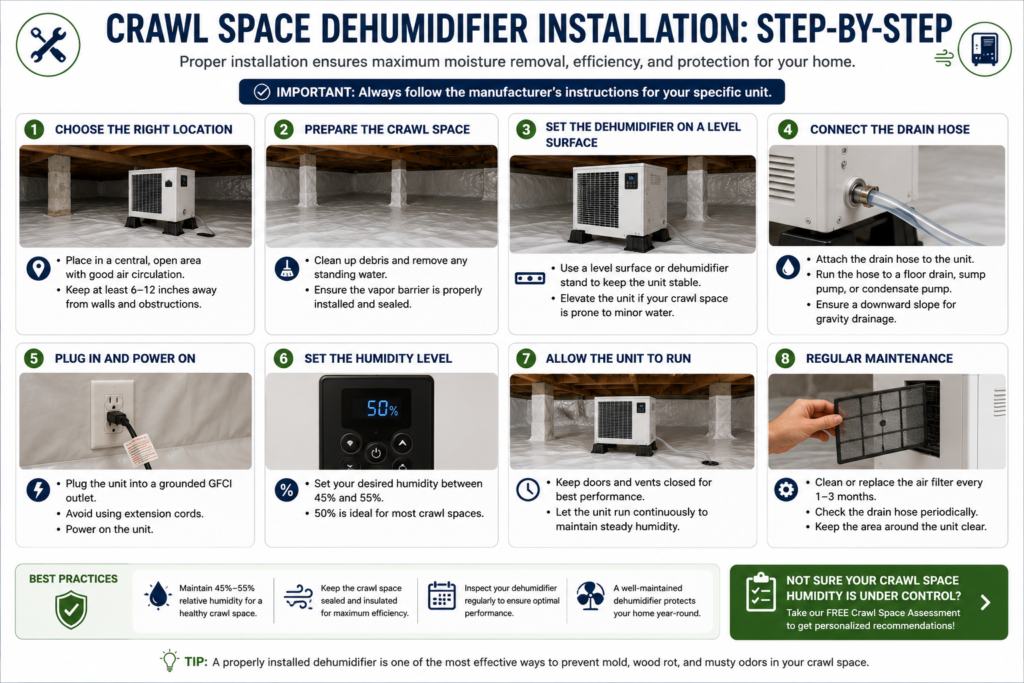
Typical Installation Sequence
- Inspect the crawl space and identify active water sources.
- Correct standing water, leaks, and drainage problems.
- Place the unit level and within the manufacturer’s clearance requirements.
- Provide suitable electrical power.
- Connect a gravity drain or approved condensate pump.
- Provide ducting if the layout requires it.
- Set the humidistat and verify sensor location.
- Run the unit and confirm condensate drainage.
- Recheck humidity over the following days and weeks.
How Much Does a Crawl Space Dehumidifier Cost?
The total cost depends on capacity, efficiency, controls, warranty, drainage, electrical work, ducting, access, and whether moisture repairs or encapsulation are also needed.
Instead of treating one national price as exact, separate the project into four cost categories:
| Cost Category | What It Can Include |
|---|---|
| Equipment | Dehumidifier, remote sensor, duct kit, condensate pump, hanging kit or stand. |
| Installation | Placement, drainage, electrical work, ducting, access-related labor. |
| Moisture corrections | Drainage, plumbing repair, grading, vapor barrier, encapsulation, air sealing. |
| Operating and maintenance | Electricity, filters, drain cleaning, service, replacement parts. |
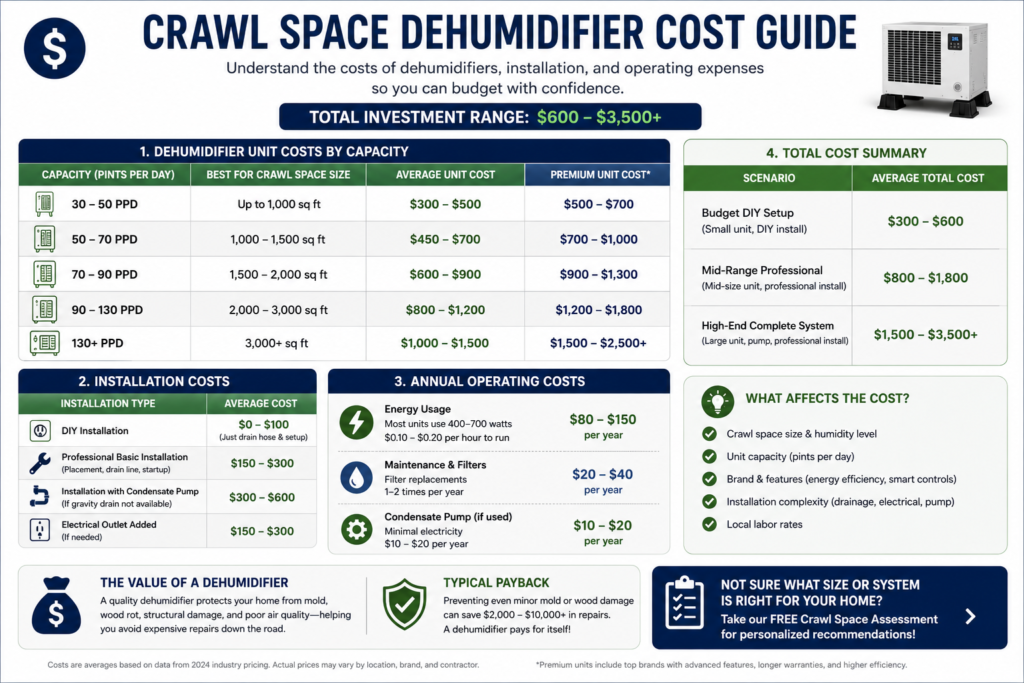
Crawl Space Dehumidifier Maintenance
Maintenance frequency varies by model and crawl-space conditions. Follow the manufacturer’s schedule rather than relying on one universal interval.
- Clean or replace the air filter as specified
- Inspect the drain hose and condensate pump
- Confirm that water is draining to the intended location
- Check the humidity reading against a separate hygrometer occasionally
- Keep air inlets and outlets clear
- Remove dust and debris around the unit
- Watch for new leaks, standing water, wet insulation, or foundation seepage
- Inspect duct connections if the unit is ducted
- Review error codes or remote alerts
A dehumidifier that suddenly runs much longer than normal may be telling you something has changed in the crawl space. Check for a dirty filter, blocked drain, failed sensor, open access door, plumbing leak, new water intrusion, or unusually humid weather before assuming the unit has failed.
Common Mistakes Homeowners Make
1. Buying a Dehumidifier Before Fixing Standing Water
A dehumidifier is not a sump pump. If water is entering the crawl space, stop or drain the water first.
2. Buying by “Coverage Area” Alone
Square-foot claims can be useful for screening products, but compare tested PPD capacity, efficiency, operating temperature, and manufacturer sizing guidance as well.
3. Leaving Foundation Vents Open in a Humid Climate While Trying to Dehumidify
If the crawl space is being converted to an unvented, mechanically controlled space, uncontrolled outside-air entry can add a large moisture load. The entire crawl-space strategy should follow local code and the chosen building-science approach.
4. Setting the Humidistat Extremely Low
A very low setting can increase runtime and electricity use without providing a meaningful benefit. Use a reasonable target and verify actual conditions.
5. Ignoring the Drain
A clogged or poorly routed drain can stop moisture removal and may create a new water problem.
6. Assuming a Dehumidifier Removes Existing Mold
Lower humidity helps prevent moisture conditions that support future growth. It does not clean mold that is already present or repair damaged materials.
Frequently Asked Questions
Do all crawl spaces need a dehumidifier?
No. Some crawl spaces remain dry through good drainage, vapor control, air sealing, ventilation or conditioning strategies appropriate to the climate and code. A dehumidifier is most useful when humidity remains too high and active moisture removal is part of the design.
What humidity should I set a crawl space dehumidifier to?
Many systems are operated around the middle of the 40–50% range, but there is no single setting for every home. EPA recommends indoor humidity below 60% and ideally around 30–50% where practical. Follow the equipment manufacturer and adjust based on actual crawl-space conditions.
Can I use a regular portable dehumidifier in a crawl space?
Sometimes a portable unit can remove moisture, but a purpose-built crawl-space unit may be better suited to low clearances, continuous drainage, ducting, remote sensing, and extended operation. Check the operating-temperature range and installation requirements of any unit you are considering.
Will a dehumidifier get rid of mold?
No. It can reduce the moisture conditions that allow mold to grow, but existing mold or contaminated materials may still need cleaning, removal, or professional remediation depending on the extent and conditions.
Should I encapsulate before installing a dehumidifier?
Often the two work well together. A sealed ground vapor retarder, water management, and air sealing can reduce the moisture load so the dehumidifier does not have to fight constant moisture entry. The correct crawl-space design depends on climate and local code.
Why does my crawl space dehumidifier run constantly?
Common causes include an undersized unit, high set point demand, dirty filter, poor airflow, open vents or access doors, a drainage or sensor problem, active water intrusion, exposed wet soil, or unusually high outdoor humidity.
How long does a crawl space dehumidifier last?
There is no reliable universal lifespan. Runtime, temperature, humidity load, maintenance, installation quality, brand design, and service conditions all affect life. Warranty length and availability of replacement parts are useful factors when comparing units.
Is ENERGY STAR certification important?
It is useful when a qualifying model exists because it provides a standardized efficiency benchmark. Also compare PPD capacity, IEF, operating temperature, drainage, controls, warranty, and whether the exact model is suitable for crawl-space use.
Final Takeaway
A crawl space dehumidifier is best viewed as one part of a moisture-control system. First stop liquid water and leaks. Then reduce ground moisture and uncontrolled air entry. After that, use a properly sized dehumidifier when active humidity control is still needed.
The best unit is not automatically the biggest or most expensive one. It is the unit that can maintain the required humidity in your actual crawl space without being forced to compensate for an unresolved water problem.
Not Sure What Your Crawl Space Needs?
Use the free CrawlSpaceInfo assessment to organize the symptoms and get a clearer idea of whether moisture control, drainage, encapsulation, or professional evaluation may be appropriate.
Related Guides
Authoritative Sources
- U.S. EPA — A Brief Guide to Mold, Moisture and Your Home
- U.S. EPA — Mold Course, Chapter 2: Humidity
- ENERGY STAR — Dehumidifiers
- ENERGY STAR — Dehumidifier Testing and Capacity
- ENERGY STAR — Dehumidifier Key Efficiency Criteria
- International Code Council — 2024 IRC, Chapter 4 Foundations
Code requirements vary by jurisdiction. Always confirm the residential code and amendments adopted where the home is located.