

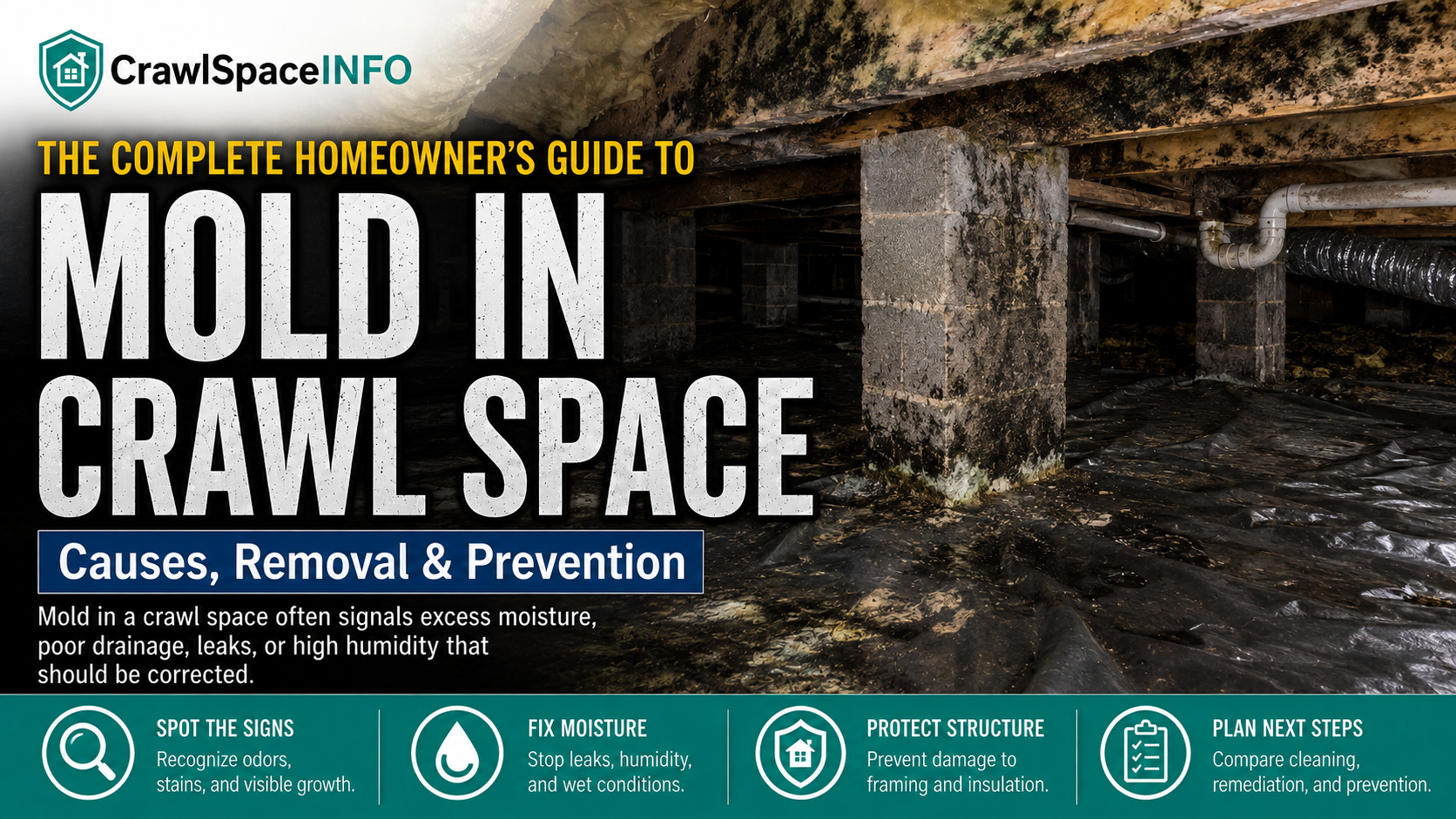
A source-first guide to identifying crawl space mold, understanding why it grows, deciding what can be cleaned safely, knowing when professional remediation makes sense, and preventing the moisture conditions that allow mold to return.
Quick Answer
Mold in a crawl space means moisture is staying on or around building materials long enough to support fungal growth. The durable fix is not simply to “kill” the mold. Find and correct the moisture source, remove or clean affected materials appropriately, dry the crawl space, and then control humidity. Visible mold does not usually need laboratory testing before action is taken. Small, limited areas may sometimes be handled by a homeowner, but extensive growth, sewage or contaminated water, HVAC contamination, structural deterioration, or unsafe access are reasons to involve qualified professionals.
Not Sure How Serious the Mold Problem Is?
Use the CrawlSpaceInfo Free Crawl Space Assessment Tool to organize the symptoms, moisture conditions, odors, and structural warning signs you are seeing.
What Does Mold in Crawl Space Mean?
Mold is a broad term for fungi that grow as colonies when spores land on a surface with enough moisture and a usable food source. In crawl spaces, those surfaces commonly include floor joists, subflooring, sill and rim areas, paper-faced insulation, dust, debris, and other organic material.
Seeing mold does not automatically tell you why the crawl space is wet. The moisture may be coming from bulk water after rain, groundwater, a plumbing leak, high outdoor humidity, condensation on cold ducts or pipes, or exposed soil continuously releasing water vapor into the crawl-space air.
What Causes Mold in Crawl Space?
Mold spores are common in indoor and outdoor air. A crawl space becomes a mold problem when the environment gives those spores sustained moisture. The most useful diagnostic question is therefore not “What mold is this?” but “Why is this material staying damp?”
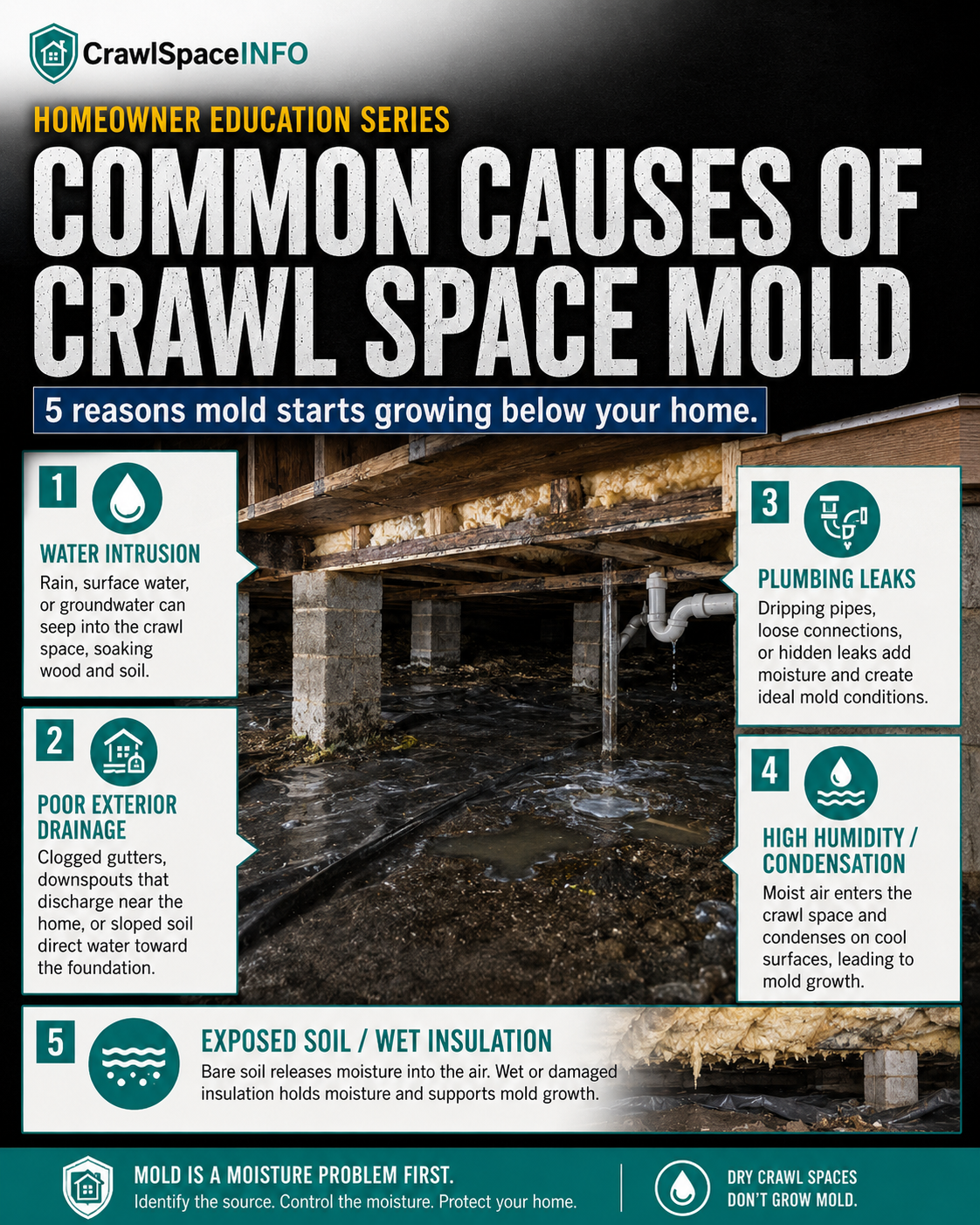
Water Intrusion and Groundwater
Standing water, repeated puddling, saturated soil, failed perimeter drainage, and groundwater can keep wood and insulation damp for long periods. Mold cleanup should not begin with cosmetic treatment while liquid water is still entering the space.
Poor Exterior Drainage
Overflowing gutters, short downspouts, negative grading, low spots beside the foundation, and runoff directed toward the house can raise the moisture load beneath the home. If mold worsens after heavy rain, start the investigation outside.
Plumbing and Mechanical Leaks
Supply lines, drain pipes, fixtures above the crawl space, water heaters, condensate drains, and HVAC equipment can leak. A crawl space that stays wet during extended dry weather deserves a close plumbing and mechanical inspection.
High Humidity and Condensation
Warm humid air can condense on cooler ducts, pipes, masonry, and framing. Elevated relative humidity can also raise the moisture content of wood even without visible standing water.
Exposed Soil and Wet Insulation
Bare earth can release substantial moisture vapor into crawl-space air. Wet or sagging fiberglass insulation can hold moisture near wood framing and can also hide fungal growth from a quick visual inspection.
Signs You May Have Mold in Your Crawl Space
Visible fuzzy, powdery, spotted, or discolored growth is the obvious clue, but homeowners often notice secondary symptoms first. These can include a persistent musty odor, damp or fallen insulation, dark staining on joists, elevated crawl-space humidity, condensation, repeated water intrusion, rust on metal components, or soft and deteriorated wood.
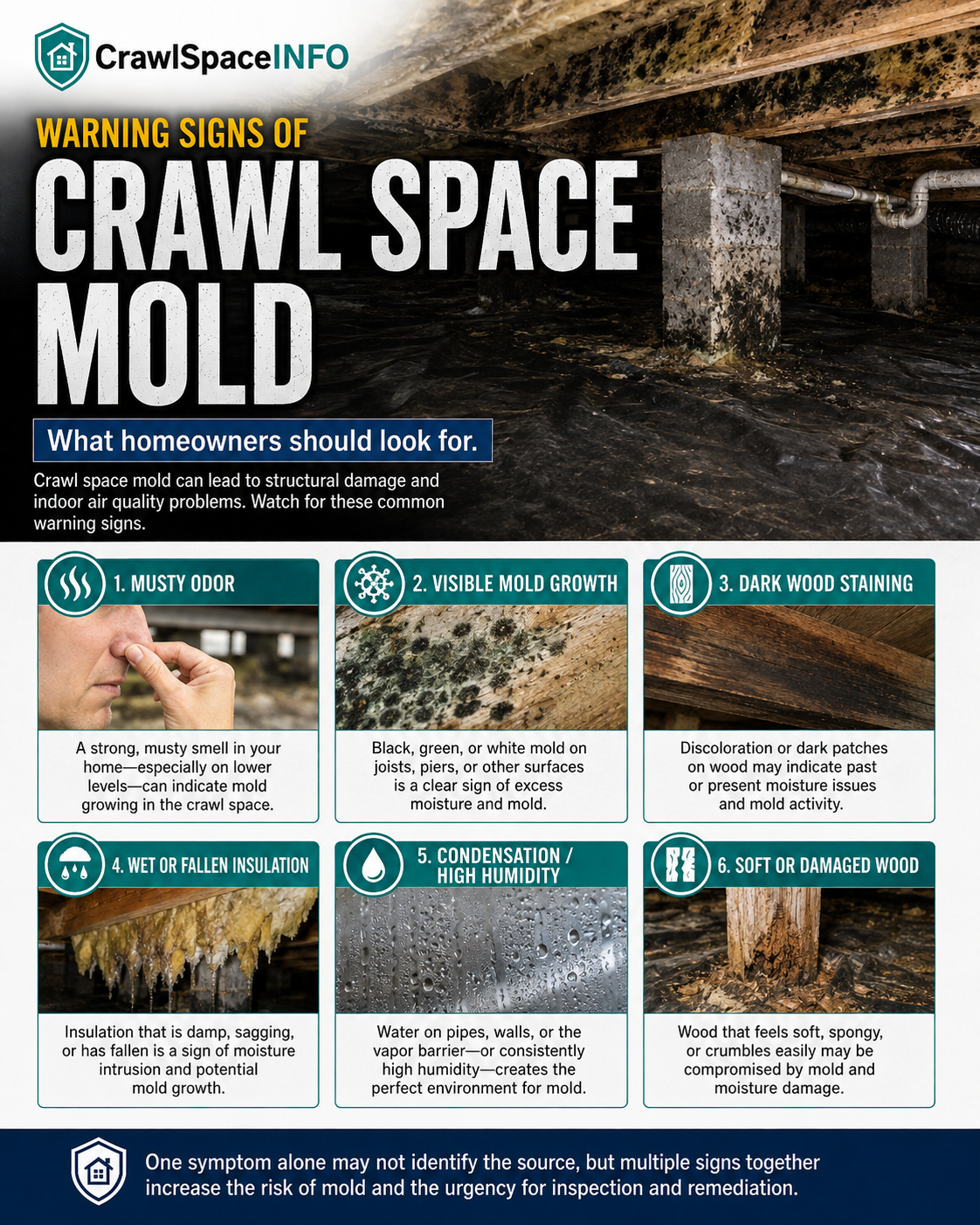
A smell alone cannot prove that mold is present, but a persistent earthy or musty odor is useful evidence. Hidden mold may be behind insulation, on the upper side of subflooring, around plumbing penetrations, or in other areas that are difficult to see from the crawl-space entrance.
What Does Crawl Space Mold Look Like?
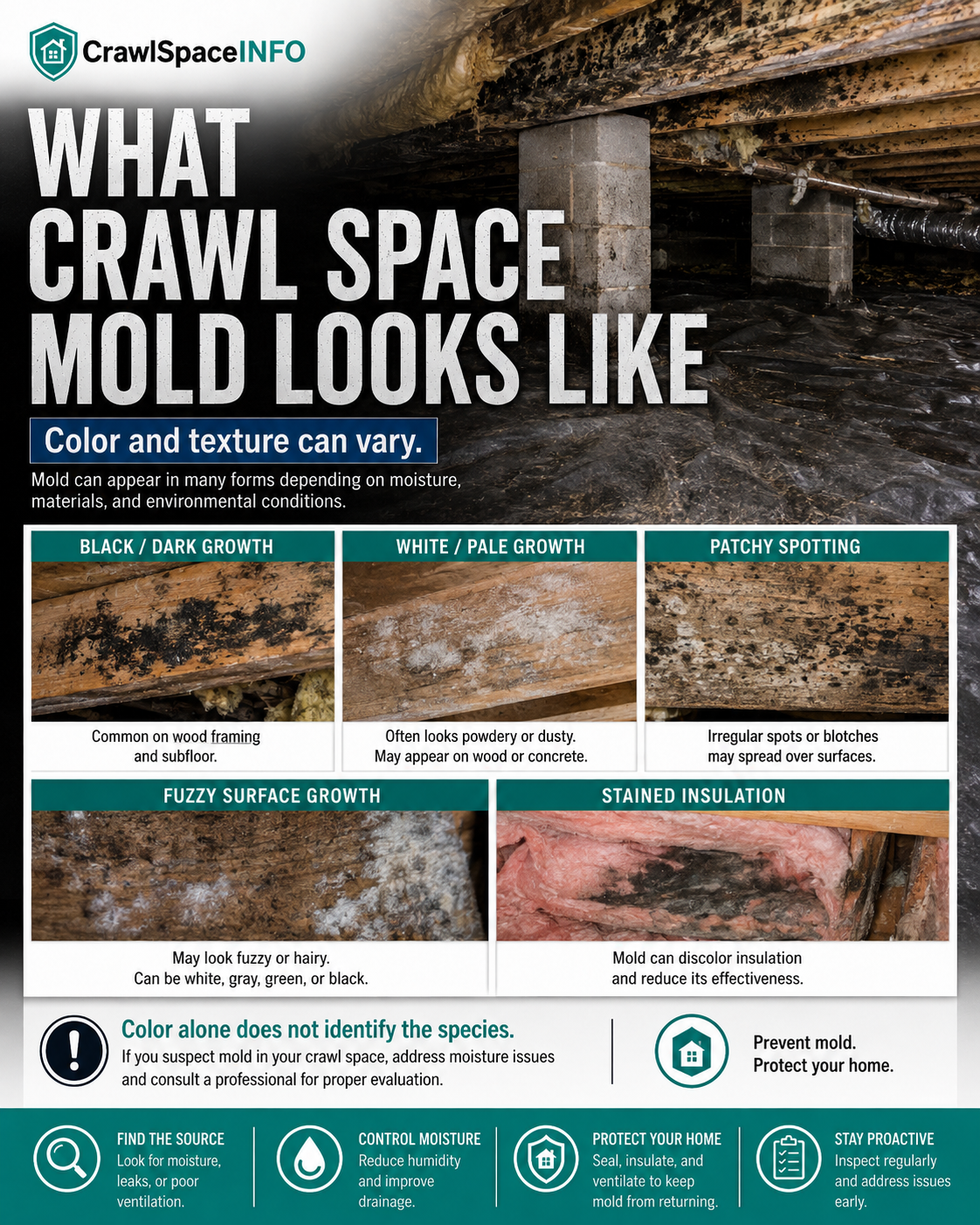
Mold can appear as black, white, green, gray, brown, yellow, or other colored spotting or growth. Color alone does not identify a species and does not tell you how hazardous a growth is. The CDC notes that common indoor molds include Cladosporium, Penicillium, and Aspergillus, but homeowners generally do not need to identify the species before correcting a visible mold problem.
Black Mold in a Crawl Space
“Black mold” is a visual description, not a diagnosis. Many molds can look dark. Stachybotrys chartarum is one mold commonly discussed in connection with dark growth, but a black patch cannot be identified as Stachybotrys by color alone.
White Mold in a Crawl Space
White or pale growth may be mold, another fungus, mineral deposits on masonry, or residue. On wood, the pattern, texture, moisture conditions, and material condition matter more than color alone.
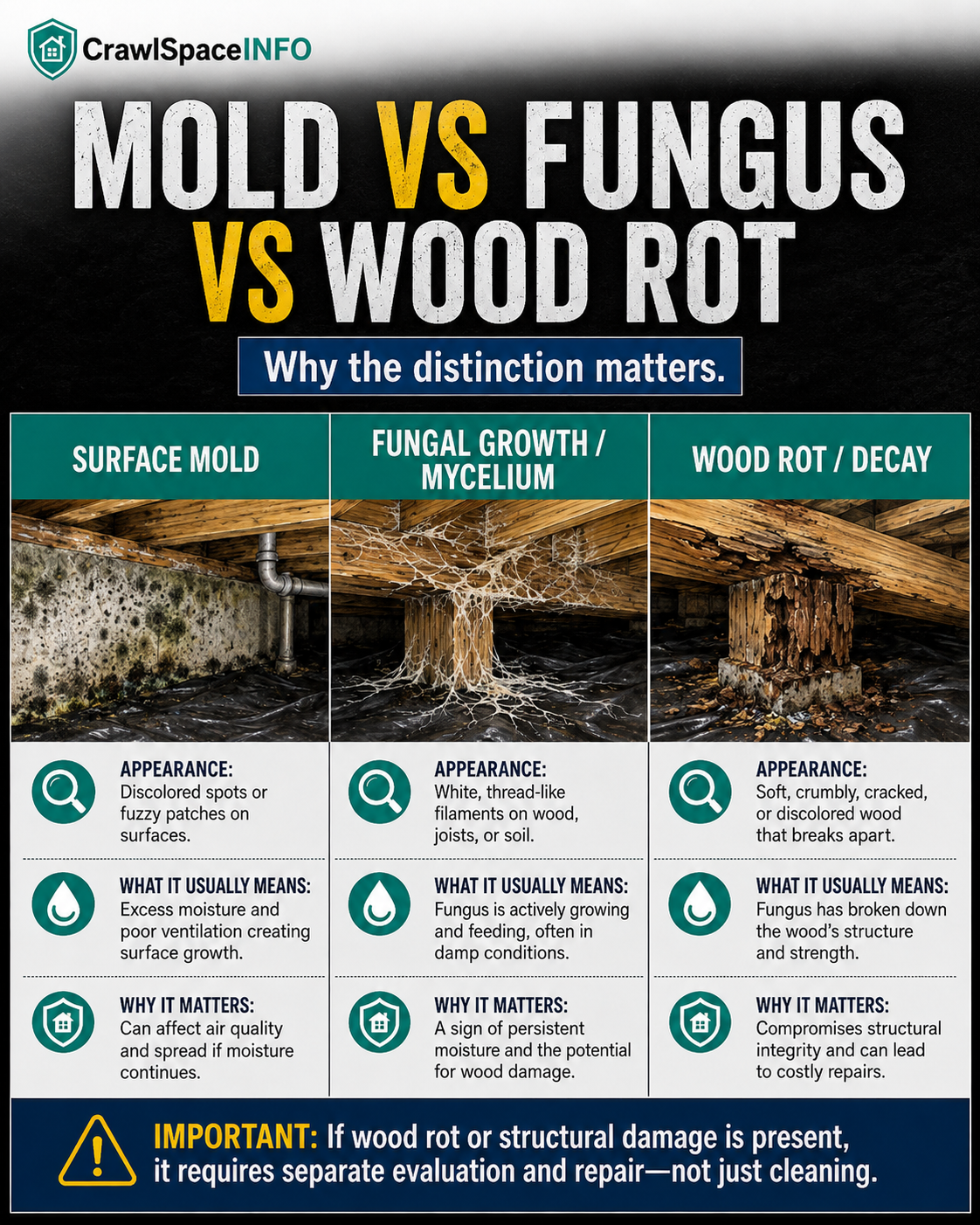
Fungus, Mold, and Wood-Decaying Fungi
Mold is fungal growth, but not every fungus affecting wood behaves the same way. Wood-decay fungi can damage structural material by breaking down components of the wood itself. Brown rot, white rot, soft rot, dry-rot terminology, fungal hyphae, mycelium, and fruiting bodies belong to a broader fungal-decay discussion and should not be treated as interchangeable with superficial mold staining.
Is Mold in a Crawl Space Dangerous?
People respond differently to damp and moldy environments. The CDC reports that some people may experience nasal or throat irritation, coughing or wheezing, burning eyes, or skin irritation, while people with asthma, mold allergies, immune compromise, or chronic lung disease can face greater concerns.
A crawl-space article should not diagnose a person’s symptoms or claim that a particular color of mold is “toxic.” If someone has health concerns related to mold exposure, the appropriate next step is medical advice from a qualified health professional.
Can Crawl Space Mold Affect the House Above?
The crawl space is part of the building enclosure. Air leakage, pressure differences, penetrations, ductwork, and openings between the crawl space and living areas can allow odors, moisture, and particles to move. A wet, moldy crawl space therefore should not be considered isolated simply because it is below the floor.
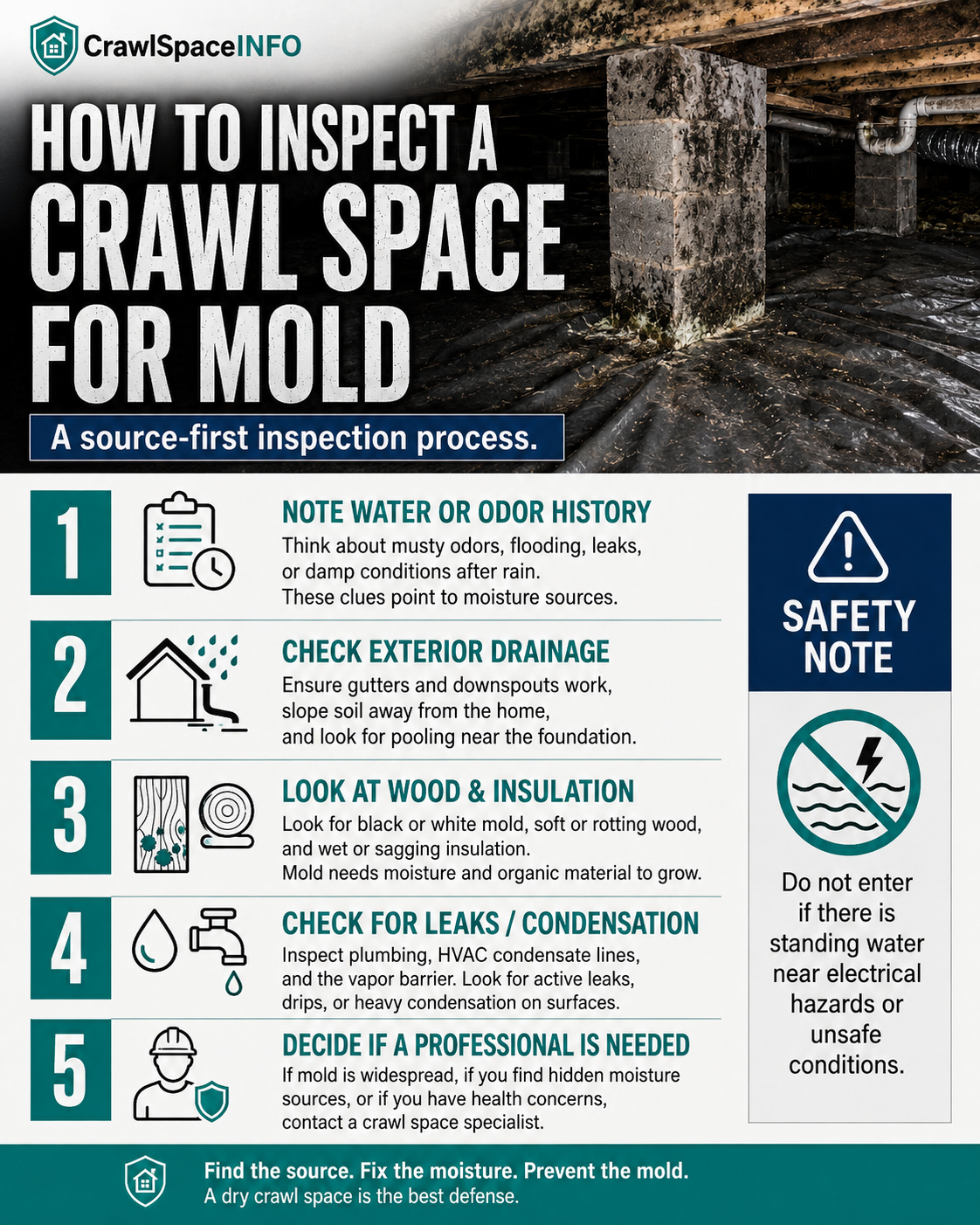
How to Inspect a Crawl Space for Mold
Begin with moisture conditions rather than immediately disturbing suspect growth. Note recent weather, leaks, humidity readings, standing water, condensation, wet insulation, and areas of wood staining. Photograph conditions from consistent locations so you can compare them after drying or repairs.
Do You Need Mold Testing?
In most cases, visible mold does not require sampling before cleanup. EPA guidance says sampling is generally unnecessary when visible mold growth is present, and CDC does not recommend routine home mold testing because there are no federal standards defining an acceptable concentration of different molds in a home.
Sampling may have a role in unusual investigations or professional verification, but it should be designed and interpreted by someone with appropriate experience rather than used as a substitute for fixing obvious moisture.
Can You Remove Crawl Space Mold Yourself?
Sometimes—but the decision depends on more than square footage. EPA guidance says that a moldy area smaller than about 10 square feet can, in most cases, be handled by a homeowner following appropriate cleanup guidance. That is a practical reference point, not a guarantee that every small crawl-space job is safe.
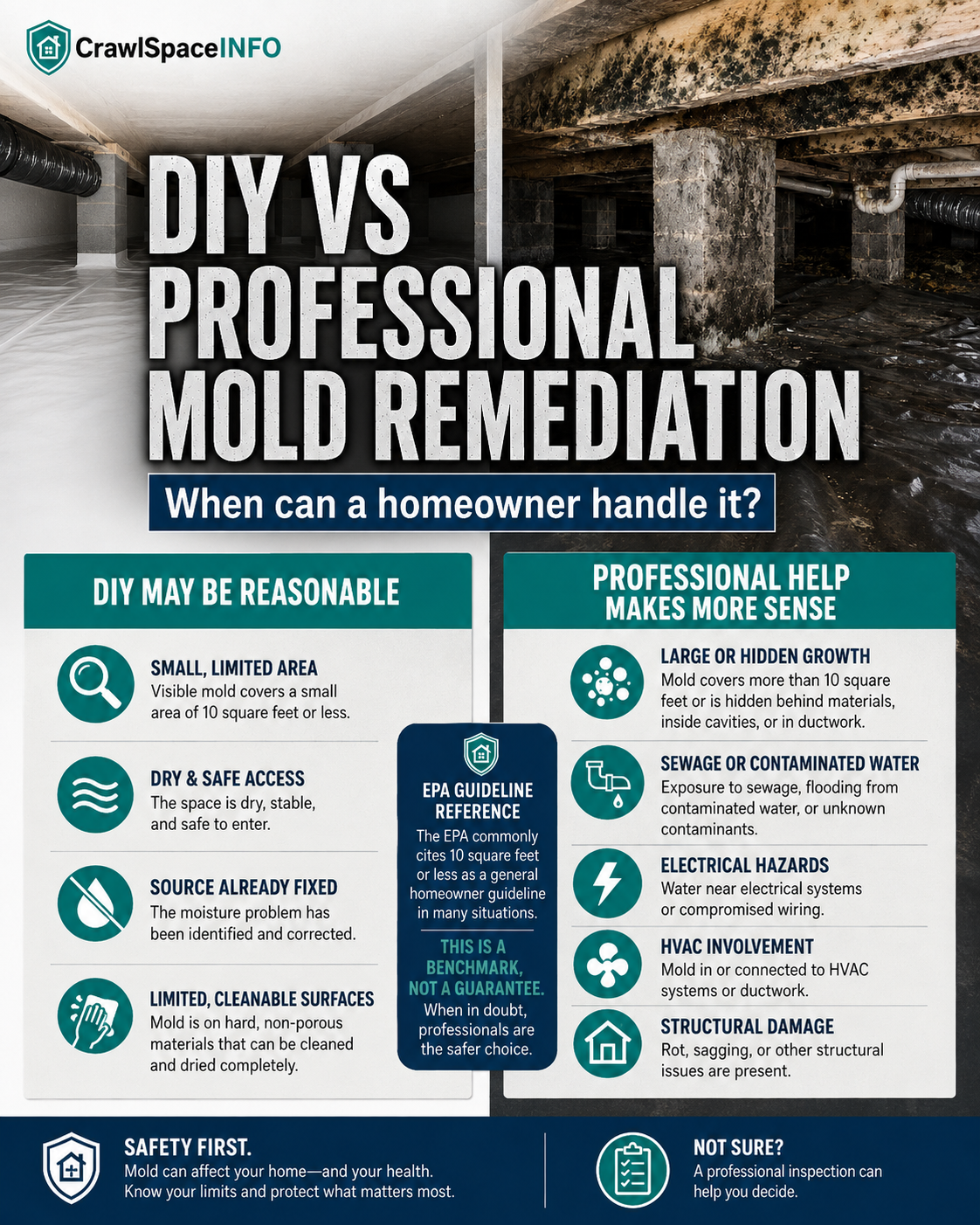
| Condition | DIY May Be Reasonable | Professional Help Makes More Sense |
|---|---|---|
| Extent | Small, clearly limited area | Large, widespread, recurring, or hidden growth |
| Water source | Minor clean-water source already fixed | Flooding, groundwater, sewage, or uncertain source |
| Access | Dry, stable, safely accessible area | Very low clearance, unsafe wiring, unstable framing |
| Materials | Limited cleanable surfaces | Extensive porous materials or structural wood damage |
| HVAC | No suspected contamination | Mold near intake/duct system or suspected HVAC contamination |
For small cleanup, appropriate protective equipment matters. EPA homeowner guidance discusses gloves, goggles, and an N-95 respirator as exposure-reduction measures. Crawl spaces add confinement, awkward access, nails, wiring, pests, and other hazards that may justify professional help even when the visible mold area is limited.
How Crawl Space Mold Removal and Remediation Work
“Mold removal,” “mold cleanup,” “mold treatment,” “mold mitigation,” and “mold remediation” are often used loosely. A good remediation process is broader than applying a spray. It controls the source, limits cross-contamination where needed, removes unsalvageable material, physically cleans remaining surfaces, uses HEPA filtration or HEPA vacuuming when appropriate, dries the area, and verifies that moisture conditions have been corrected.
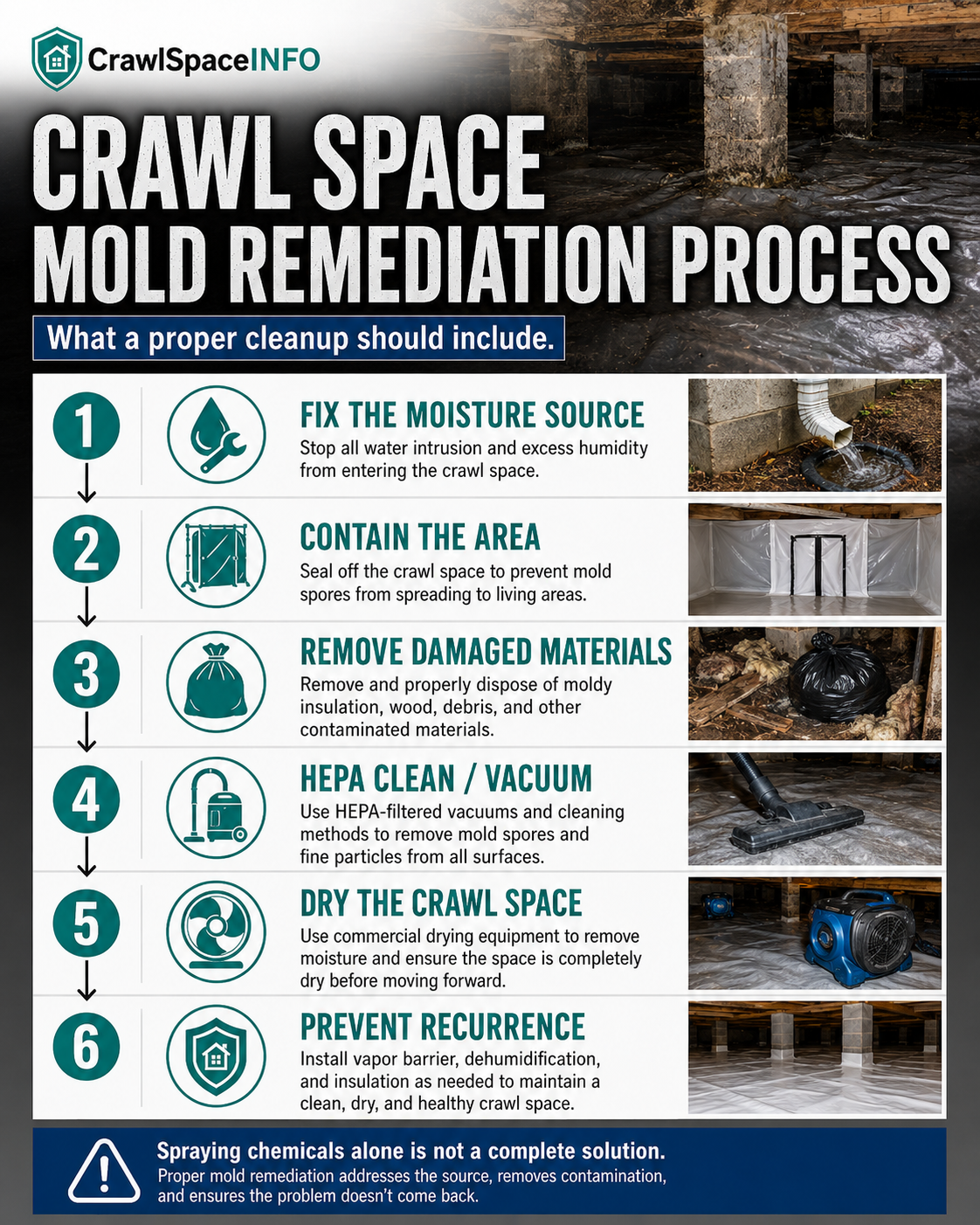
1. Correct the Moisture Source
Repair plumbing leaks, improve drainage, remove standing water, correct condensate problems, and address the humidity source before calling the cleanup complete.
2. Decide What Can Be Cleaned
Hard surfaces can often be physically cleaned. Porous materials that are deeply contaminated or cannot be dried may need removal. Wet insulation is a common crawl-space example.
3. Control Cross-Contamination
Larger remediation projects may use containment barriers, negative pressure, HEPA air scrubbers, controlled work zones, and decontamination procedures to reduce the spread of dust and spores.
4. Clean, Remove, and Dry
The objective is source removal, not simply discoloring or killing growth. EPA notes that dead mold can still trigger allergic reactions in some people, so killing mold without removing it is not considered a complete solution.
5. Verify the Cause Is Fixed
Cleanup is not complete if the crawl space is still getting wet. Recheck humidity, wood moisture, drainage behavior, leaks, and visible conditions after the repair.
What Should You Spray on Mold in a Crawl Space?
This is one of the most common homeowner searches, but “what to spray” is not the first question to answer. Chemicals cannot compensate for an active moisture source, damaged porous material, or structural decay.
Will Bleach Kill Crawl Space Mold?
EPA does not recommend biocides such as chlorine bleach as a routine practice for mold cleanup. There may be circumstances where professional judgment supports their use, but routine remediation is based on moisture correction and physical removal/cleaning rather than sterilizing the crawl space.
If bleach or another disinfectant is used, follow the product label and never mix chlorine bleach with ammonia or other incompatible cleaners because dangerous fumes can result.
Will Vinegar Kill Crawl Space Mold?
Vinegar is frequently discussed in DIY advice, but the important issue is not whether a household liquid can damage a mold colony. The affected surface still has to be cleaned appropriately, contaminated porous material may still require removal, and the moisture source still has to be corrected.
Mold Removers, Antimicrobials, Fungicides, and Coatings
Commercial products may be labeled as antimicrobial treatments, fungicides, disinfectants, sanitizers, mold inhibitors, encapsulants, or mold-resistant coatings. Product choice should match the material, label instructions, and remediation plan. A coating should not be used to hide active mold or wet material.
Crawl Space Mold Removal Cost
Crawl-space mold remediation cost varies widely with the affected area, clearance, containment requirements, damaged insulation, structural repairs, moisture correction, and local labor. Current consumer cost guides differ substantially, which is why a single national “average” should not be treated as a quote.
| Planning Item | Broad 2026 Planning Range | What Changes It |
|---|---|---|
| Crawl-space mold remediation | About $500–$4,000+ | Extent, access, containment, cleaning method |
| Mold inspection/testing when used | Often a few hundred dollars | Sampling scope, region, number of samples |
| Wet insulation removal/replacement | Separate project cost | Area, material, disposal, access |
| Moisture correction | Separate project cost | Leak repair, drainage, sump, vapor barrier, dehumidification |
| Structural wood repair | Can exceed remediation cost | Joists, beams, sill/rim, subfloor damage |
Planning figures only. Published 2026 consumer guides currently show crawl-space mold remediation ranges roughly from $500–$2,000 on Angi and $500–$4,000 on Forbes Home. Actual proposals should be compared by scope, not price alone.
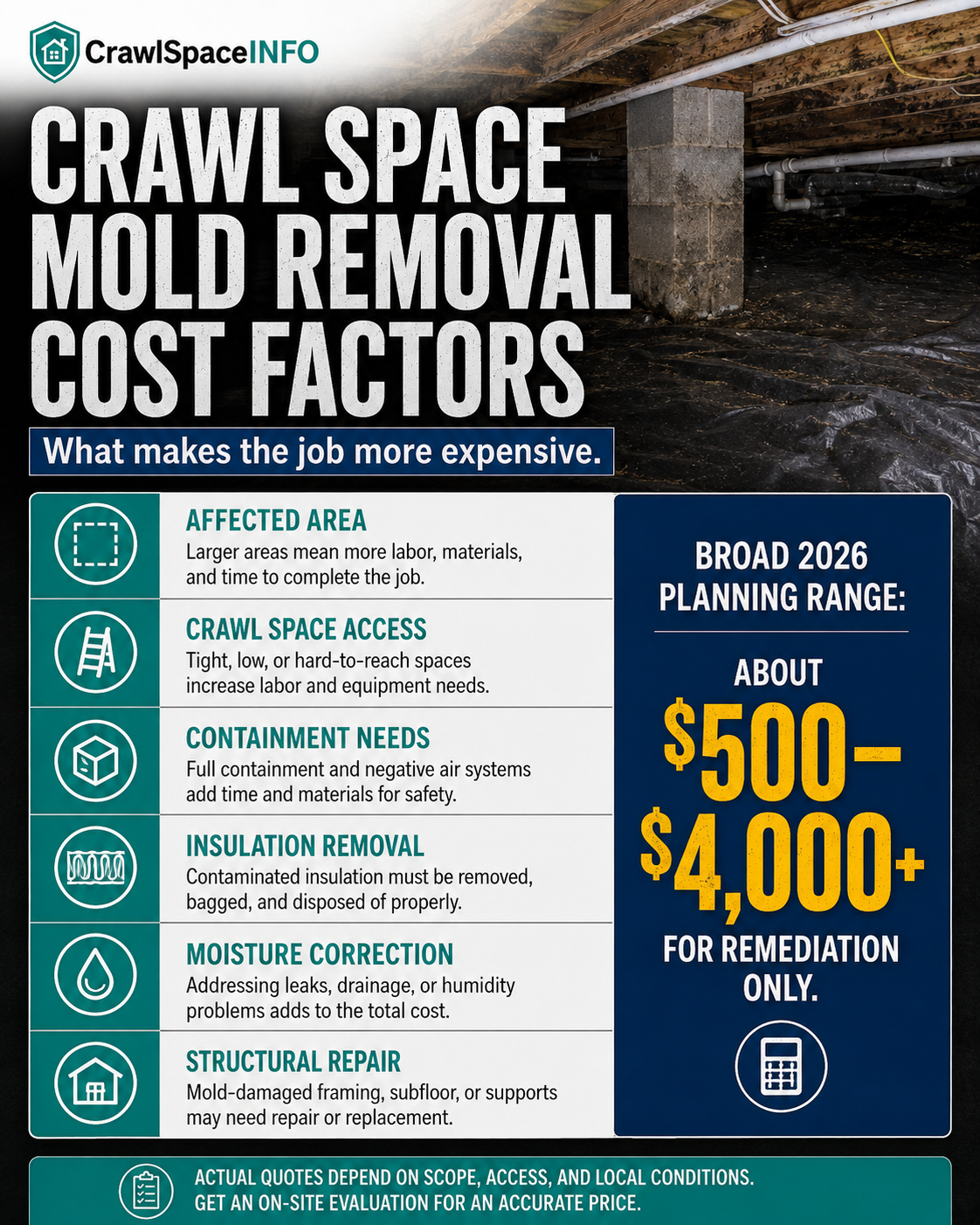
When comparing estimates, ask what the contractor believes caused the mold, which materials will be removed versus cleaned, how dust and spores will be controlled, whether insulation is included, how the moisture source will be corrected, and what conditions define successful completion.
Mold on Floor Joists, Subfloor, and Crawl Space Wood
Mold can grow on the surface of floor joists, beams, subflooring, sill plates, and rim areas. Surface growth does not automatically mean the wood has lost structural capacity. The more important structural questions are whether the wood has decay, softness, section loss, splitting, excessive moisture, or deformation.
Wood-decay fungi can be more serious than superficial mold because they degrade the material itself. Soft wood, crumbling fibers, sagging floors, damaged beam ends, or widespread fungal decay should be evaluated separately from mold cleaning.
What About Moldy Crawl Space Insulation?
Insulation that is wet, fallen, heavily contaminated, or trapping moisture against framing may need removal. Replacement should wait until leaks and humidity conditions are corrected so new insulation is not installed into the same wet environment.
Mold, Moisture, and Crawl Space Humidity
Relative humidity is one of the most useful conditions to monitor, but there is no single magic number at which every species suddenly begins growing. Temperature, surface moisture, material, time, and air movement all matter.
For general indoor moisture control, EPA advises keeping relative humidity below 60%, ideally 30%–50%, while CDC recommends keeping home humidity no higher than 50% when possible. In a crawl space, sustained elevated humidity should trigger investigation of exposed soil, air leakage, groundwater, drainage, and condensation rather than reliance on a dehumidifier alone.
Does Crawl Space Encapsulation Get Rid of Mold?
Encapsulation can be an important long-term moisture-control strategy, but it is not a substitute for remediation. Existing visible mold and damaged materials should be addressed, bulk water should be controlled, and the moisture source should be understood before a liner and air-sealing system are treated as the solution.
Will a Dehumidifier Kill Mold?
A dehumidifier does not remove existing mold colonies. Its role is to lower airborne moisture so surfaces can remain drier after water intrusion and vapor sources have been controlled. Dehumidification is therefore a prevention and moisture-management tool, not a replacement for source removal.
For many homes the durable sequence is: drainage or leak repair → cleanup/remediation → vapor control or encapsulation where appropriate → humidity control and monitoring.
How to Prevent Crawl Space Mold From Returning
Prevention is a system rather than a single product. Keep roof drainage working, route downspouts away from the foundation, maintain positive grading, repair plumbing and condensate leaks quickly, remove standing water, and prevent wet insulation or debris from remaining in contact with framing.
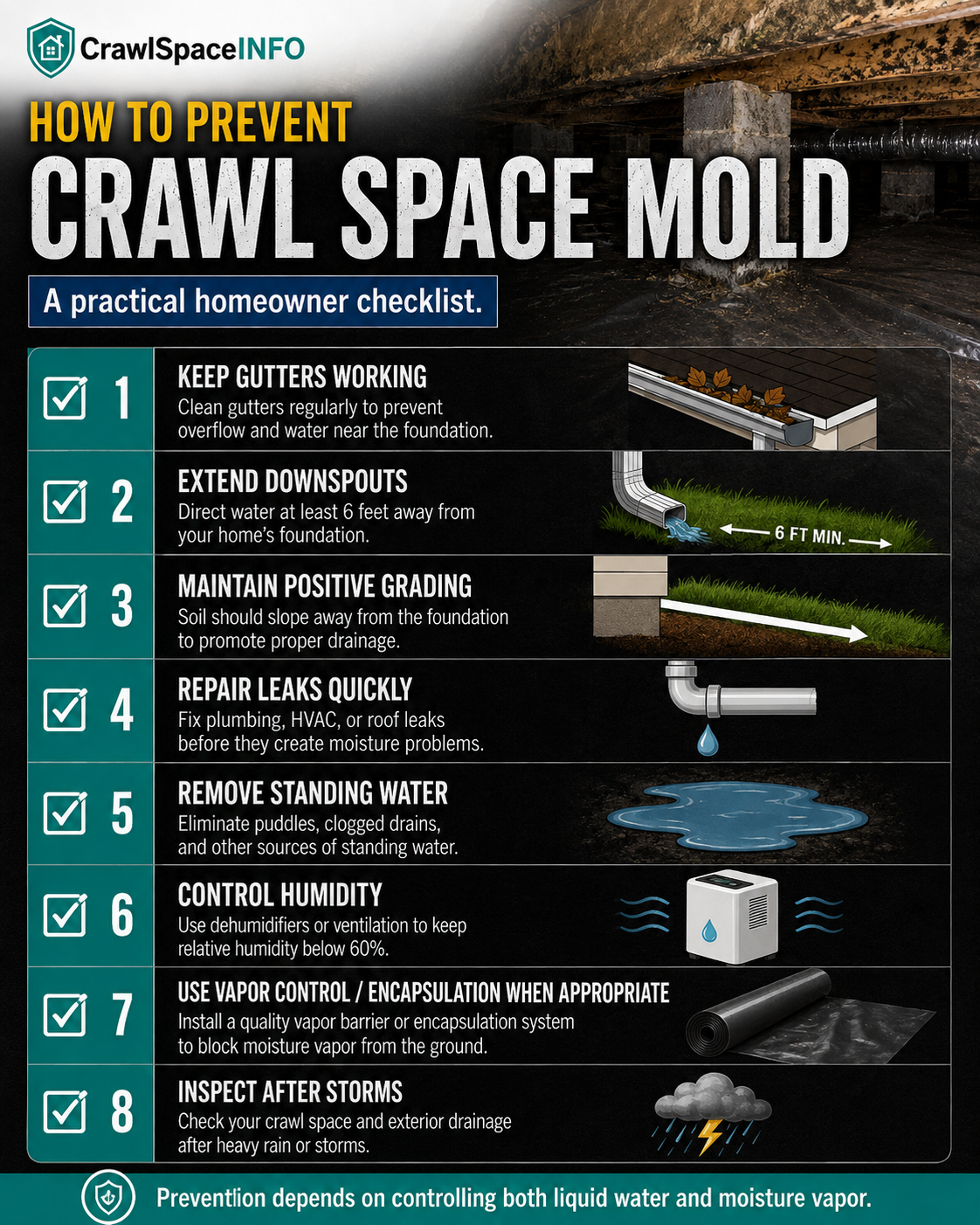
Where exposed soil is a major vapor source, a properly installed ground vapor barrier or encapsulation system may be appropriate. Where groundwater recurs, drainage and a sump system may be necessary. Where humidity remains high after bulk water is controlled, a crawl-space dehumidifier can help maintain a drier environment.
Continue monitoring after the repair. A hygrometer, periodic crawl-space inspection, sump-pump testing, and checks after major storms can catch a moisture problem before widespread fungal growth returns.
Frequently Asked Questions
Is mold in a crawl space normal?
Mold spores are common, but active indoor mold growth is a moisture-control problem that should be corrected rather than accepted as normal.
How do I get rid of mold in a crawl space?
Identify and correct the moisture source, decide which materials can be cleaned and which must be removed, physically clean affected surfaces with appropriate precautions, dry the area, and then control humidity so the growth does not return.
Can I remove crawl space mold myself?
EPA says areas smaller than about 10 square feet can, in most cases, be handled by a homeowner following cleanup guidance. Crawl-space hazards, contaminated water, HVAC involvement, extensive hidden growth, or structural damage can justify professional help even when the visible area is small.
Does bleach kill mold in a crawl space?
Bleach is a biocide, but EPA does not recommend routine biocide use as the standard approach to mold cleanup. Moisture correction and physical removal/cleaning are essential, and dead mold can still cause allergic reactions.
Will vinegar kill mold in a crawl space?
Vinegar is often promoted for DIY cleaning, but the important issues are whether the material can be cleaned, whether contaminated porous material should be removed, and whether the moisture source has been corrected.
What humidity causes mold in a crawl space?
There is no universal single threshold for every mold and material. As general indoor guidance, EPA recommends below 60% RH and ideally 30%–50%, while CDC recommends no higher than 50% when possible. Sustained high crawl-space humidity deserves investigation.
Does encapsulation kill mold?
No. Encapsulation is a moisture-control system. Existing mold and water problems should be addressed before or as part of the encapsulation project.
Will a dehumidifier remove mold?
No. A dehumidifier reduces moisture in the air. It can help prevent recurrence after the water source and existing growth have been addressed.
Do I need mold testing?
Usually not when visible growth is already present. EPA says sampling is generally unnecessary in that situation, and CDC does not recommend routine home mold testing.
How much does crawl space mold removal cost?
Published 2026 consumer guides show broad crawl-space remediation ranges from roughly $500 to $4,000, but actual cost depends on the affected area, access, containment, damaged materials, and the moisture or structural repairs that must accompany remediation.
Final Takeaway
If you find mold in a crawl space, do not begin with the color of the growth or the strongest chemical you can buy. Begin with moisture. Find out why the wood, insulation, or other material stayed damp; correct that source; clean or remove affected material appropriately; dry the crawl space; and then put the right long-term moisture controls in place.
That sequence avoids a common failure: paying to “treat” mold while leaving the leak, groundwater, exposed soil, condensation, or humidity condition that allowed it to grow in the first place.
Not Sure What’s Causing the Mold?
Use the CrawlSpaceInfo Free Crawl Space Assessment Tool to organize the moisture symptoms, odors, visible growth, water history, and structural warning signs you are seeing.
Authoritative Sources
Technical guidance used for this homeowner guide includes U.S. EPA mold-cleanup and moisture-control guidance and CDC mold-health and prevention guidance. Cost figures are planning ranges synthesized from current 2026 consumer cost guides and should not be treated as contractor quotes.
- U.S. EPA — Mold Cleanup in Your Home
- U.S. EPA — A Brief Guide to Mold, Moisture and Your Home
- CDC — Mold: About, Prevention, Cleaning and Testing