

A practical, moisture-aware guide to crawl space insulation: where it belongs, which materials make sense, how vented and unvented crawl spaces differ, what R-value means, when wet insulation should be replaced, and how insulation fits with vapor barriers and encapsulation.
Quick Answer
Crawl space insulation should be installed at the home’s intended thermal boundary—not simply wherever there is open framing. In a traditional vented crawl space, insulation is commonly installed in the floor assembly above the crawl space. In a qualifying unvented or encapsulated crawl space, the thermal boundary often moves to the crawl-space foundation walls. Before adding insulation, correct standing water, leaks, ground moisture and persistent humidity. Wet, compressed, poorly supported or contaminated insulation may need repair or replacement.
Not Sure Whether the Problem Is Insulation or Moisture?
Use the CrawlSpaceInfo Free Crawl Space Assessment to organize cold-floor, condensation, humidity, water, mold, insulation and structural symptoms before choosing a repair.
What Is Crawl Space Insulation?
Crawl space insulation is the thermal layer that reduces unwanted heat flow between the home, the crawl space and the outdoors. Depending on the crawl-space design, that thermal layer may be located in the floor framing above the crawl space or along the crawl-space foundation walls.
Insulation is often discussed as if it were only an energy-saving product. In a crawl space, however, its performance is closely tied to air leakage, moisture, drainage, vapor control, ductwork, plumbing, climate and whether the space is designed to be vented or unvented.
A successful project starts by answering two questions: Where is the thermal boundary? and Is the crawl space dry enough for the insulation assembly to perform?
Where Should Crawl Space Insulation Go?
The correct location depends primarily on whether the crawl space is outside or inside the home’s thermal envelope.
Floor Insulation
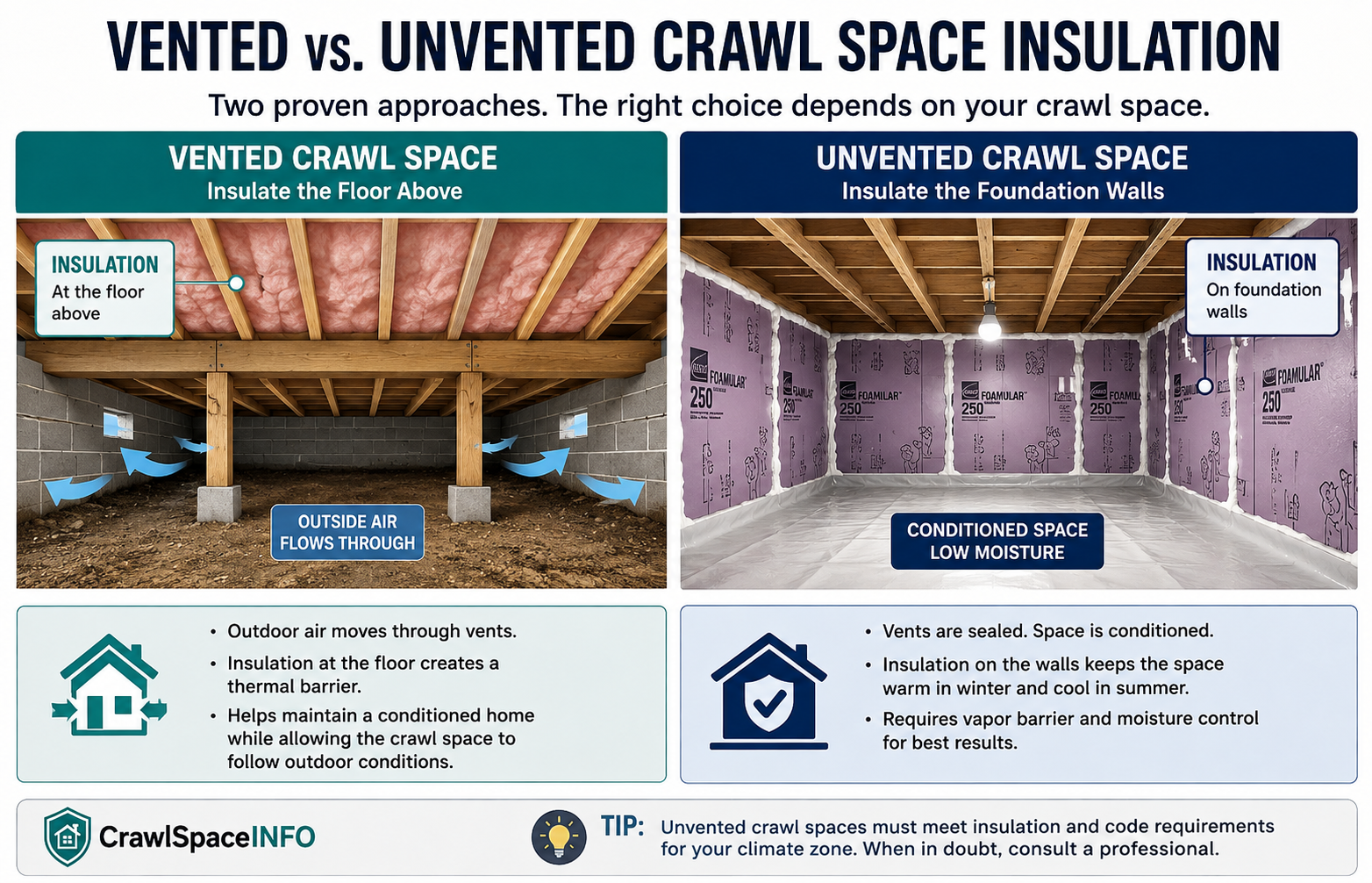
When a crawl space is vented to the outdoors and treated as unconditioned space, the floor above commonly forms the thermal boundary. Insulation is installed between or below the floor joists, and air-permeable insulation needs proper support and enclosure for the intended assembly.
Crawl Space Wall Insulation
When a crawl space is intentionally unvented, air sealed and managed as part of the conditioned or semi-conditioned enclosure, insulation is commonly installed along the crawl-space walls rather than between the floor joists. This can keep ducts, pipes and mechanical components inside a more temperate environment.
Vented vs. Unvented Crawl Space Insulation
| Feature | Vented Crawl Space | Unvented / Encapsulated Crawl Space |
|---|---|---|
| Typical thermal boundary | Floor above crawl space | Foundation walls / perimeter |
| Exterior vents | Used as part of the vented design | Closed and air sealed as part of a qualifying unvented design |
| Ground vapor control | Still important | Critical to the system |
| Ducts and pipes | Remain in a more outdoor-like environment | Can be brought inside a more controlled environment |
| Common insulation location | Floor joists | Foundation walls and rim/band area |
Climate and local code matter. Termite inspection, flood, fire-protection and vapor-retarder requirements can change the details.
Fix Crawl Space Moisture Problems Before Insulating
Insulation should not be used to cover a water problem. Wet fiberglass can sag or fall. Damp materials can support mold growth. Foam products can conceal leaks or make inspection more difficult if applied before the source is addressed.
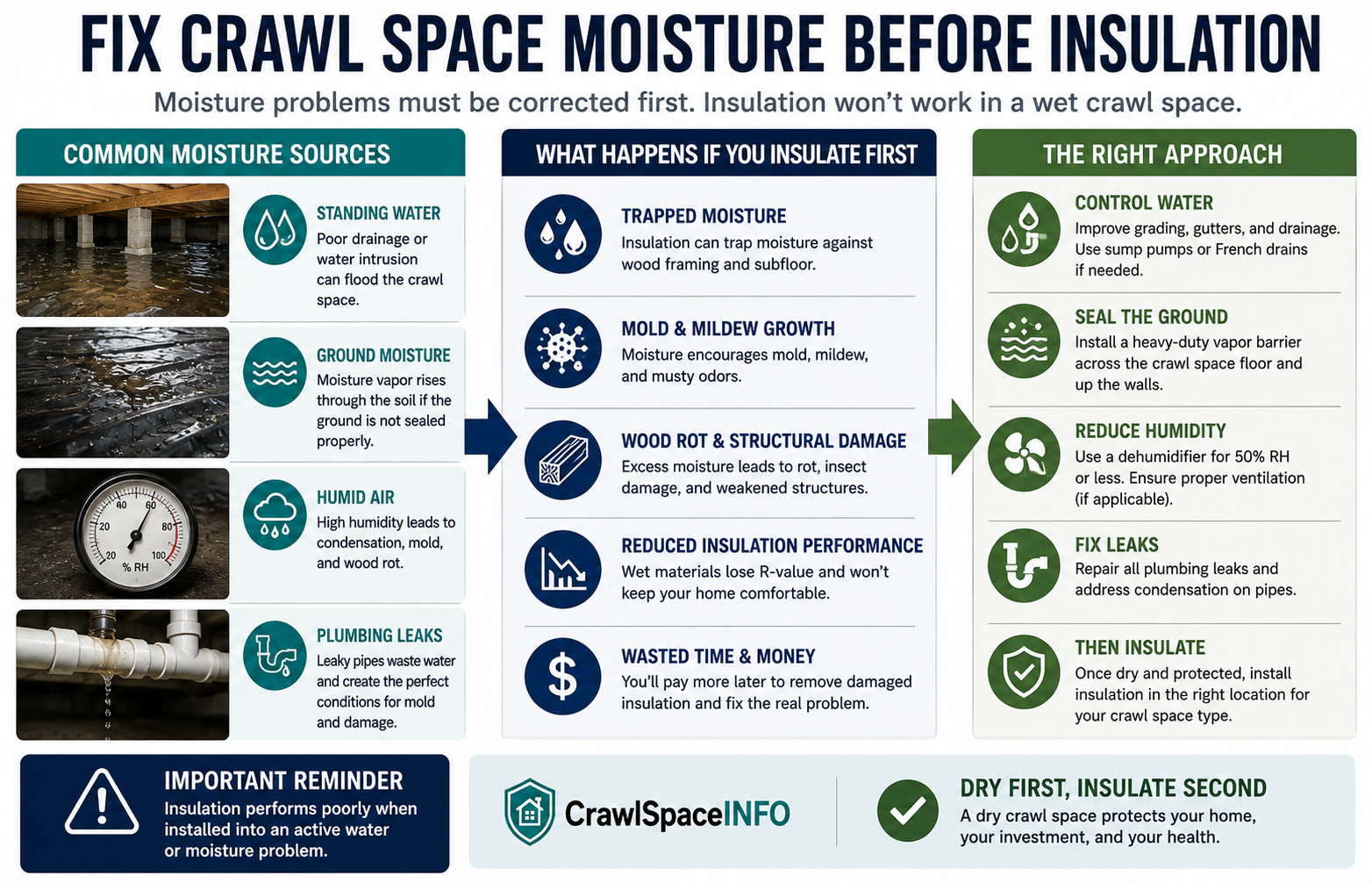
Before replacing or adding insulation, inspect for standing water, plumbing or condensate leaks, roof runoff, poor grading, groundwater, a missing vapor barrier, persistent humidity, condensation, mold, wood decay and pest damage.
If water is entering the crawl space, start with the Water in Crawl Space guide or Crawl Space Waterproofing guide. If ground vapor is the main concern, see the Vapor Barrier guide.
Best Crawl Space Insulation Materials
There is no single best insulation for every crawl space. Material choice should follow the assembly: where it will be installed, how much moisture exposure is possible, whether air sealing is required, what fire or ignition-barrier requirements apply, how pests will be inspected for, and what R-value the local code requires.
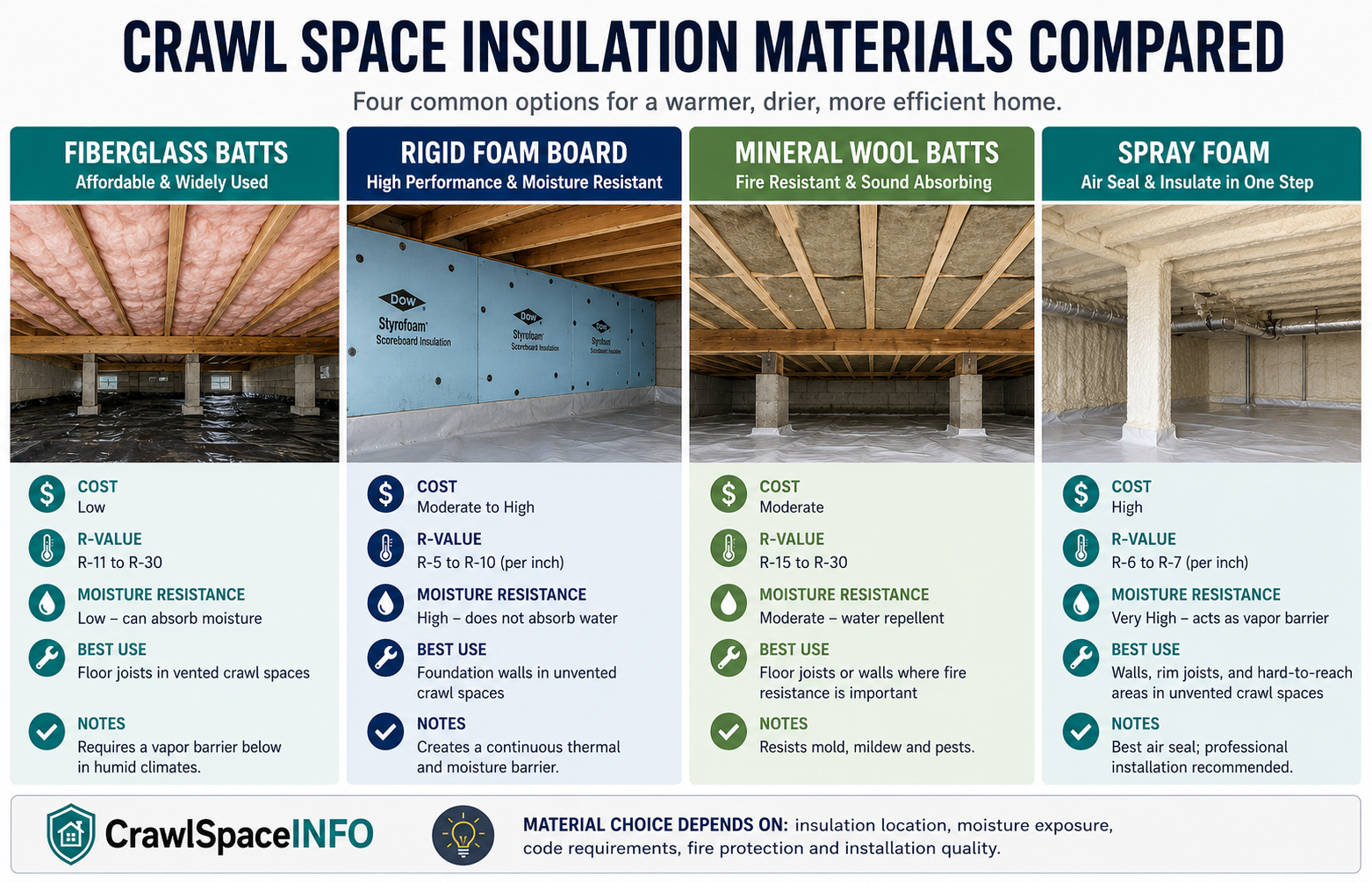
| Material | Common Use | Advantages | Limitations |
|---|---|---|---|
| Fiberglass batts | Floor cavities in some vented crawl spaces | Widely available and relatively inexpensive | Gaps, compression, air movement and moisture can reduce performance |
| Rigid foam board | Foundation walls and rim areas in unvented assemblies | Continuous insulation and moisture resistance | Foam-plastic fire and termite-inspection details may apply |
| Spray polyurethane foam | Rim joists, walls or selected floor assemblies | Can insulate and air seal irregular areas | Requires correct product, application and code/fire detailing |
| Mineral wool | Selected floor or wall assemblies | Noncombustible fiber and good dimensional stability | Still needs correct air/moisture strategy and secure installation |
Fiberglass Crawl Space Insulation
Fiberglass batts are common in older vented crawl spaces, especially between floor joists. They can perform when installed fully in contact with the intended air barrier, cut around obstructions without large gaps, and supported so they do not sag away from the subfloor.
Fiberglass hanging in strips beneath a house is usually a sign the assembly is no longer performing as intended. Gravity, moisture, pests, poor support, air movement and maintenance work can all contribute.
Wet or contaminated fiberglass should be evaluated before it is simply pushed back into place. Correct the reason it became wet first.
Rigid Foam Board for Crawl Space Walls
Rigid foam is commonly used as continuous insulation on foundation walls in unvented crawl spaces. It can help create an insulated, air-sealed crawl-space enclosure and can keep ducts and plumbing inside a more temperate environment.
Common foam types include expanded polystyrene, extruded polystyrene and polyisocyanurate. Their R-values, water absorption, vapor permeance, temperature performance and fire requirements differ, so product-specific data matters.
Spray Foam Insulation in a Crawl Space
Spray foam can be useful because it combines insulation with air sealing, especially around irregular rim-joist and framing areas. It is also a real search-demand topic in the CrawlSpaceInfo keyword set.
Open-cell and closed-cell foams behave differently. The assembly must account for moisture drying potential, wood inspection, termite access, combustion and fire-protection rules, wiring and plumbing access, and future repair needs.
Mineral Wool in Crawl Spaces
Mineral wool can be used in some crawl-space floor or wall assemblies and offers good fire resistance and dimensional stability. The material itself is water resistant, but the assembly still needs bulk-water control, air sealing and an appropriate vapor strategy.
What R-Value Does Crawl Space Insulation Need?
There is no single R-value that applies to every crawl space in the United States. Required levels depend on climate zone, whether the thermal boundary is the floor or crawl-space walls, the compliance path, local amendments and the code edition adopted by the jurisdiction.
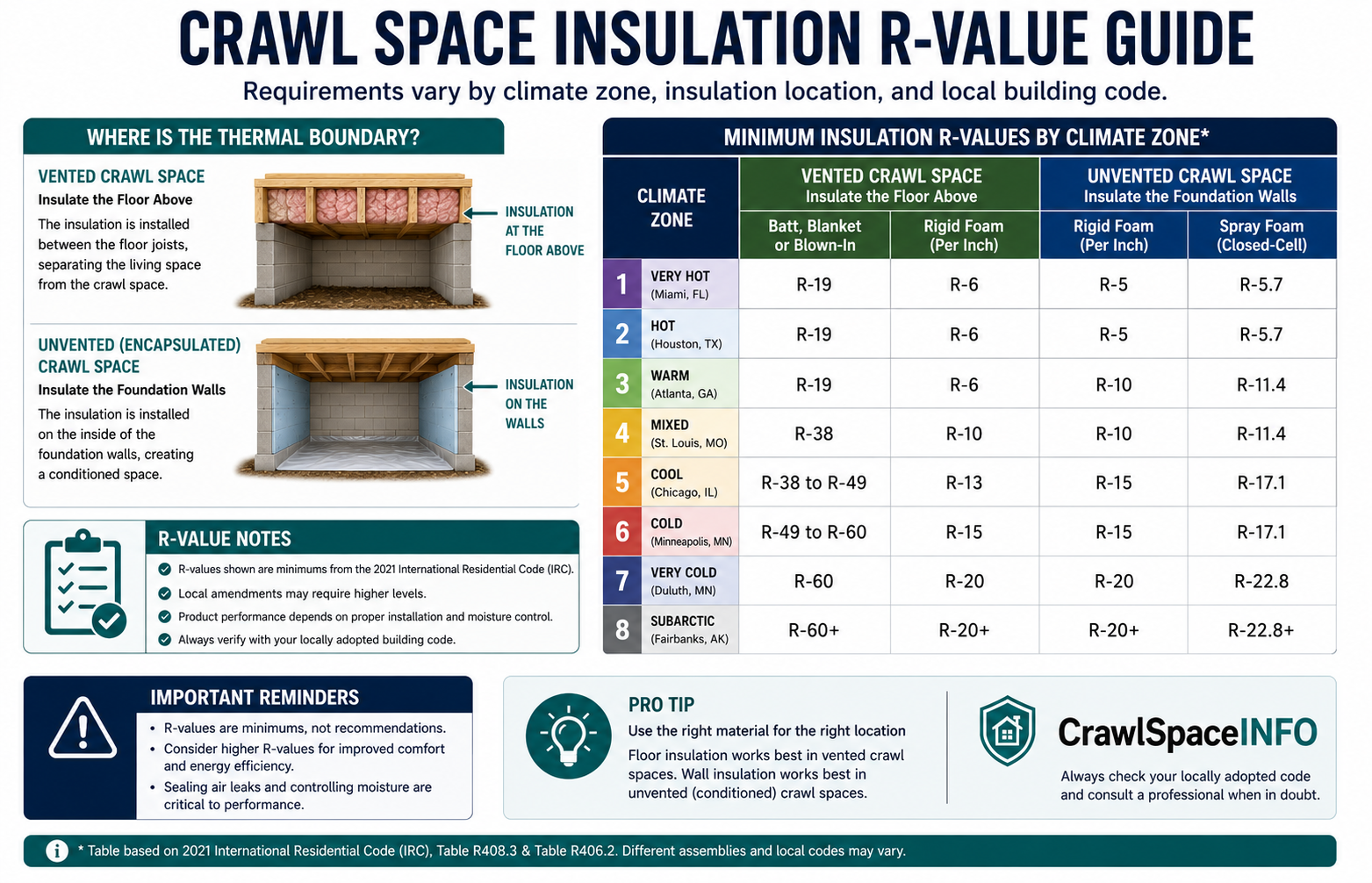
The 2024 IRC energy-efficiency provisions illustrate why one-size-fits-all advice is misleading: prescriptive floor and crawl-space-wall insulation levels change by climate zone, and qualifying unvented crawl spaces can use crawl-space-wall insulation instead of the insulated floor-above strategy.
Crawl Space Insulation and Encapsulation
Encapsulation can change where a crawl space should be insulated. When a vented crawl space is converted to a properly designed unvented enclosure, the thermal boundary can move from the floor above to the foundation perimeter.
This can bring ducts and plumbing into a more controlled environment. But encapsulation also requires ground vapor control, air sealing and an approved strategy for managing the under-floor environment.
Do not remove floor insulation solely because a liner was installed. See the Crawl Space Encapsulation guide for the complete enclosure strategy.
Signs Crawl Space Insulation Needs Repair or Replacement
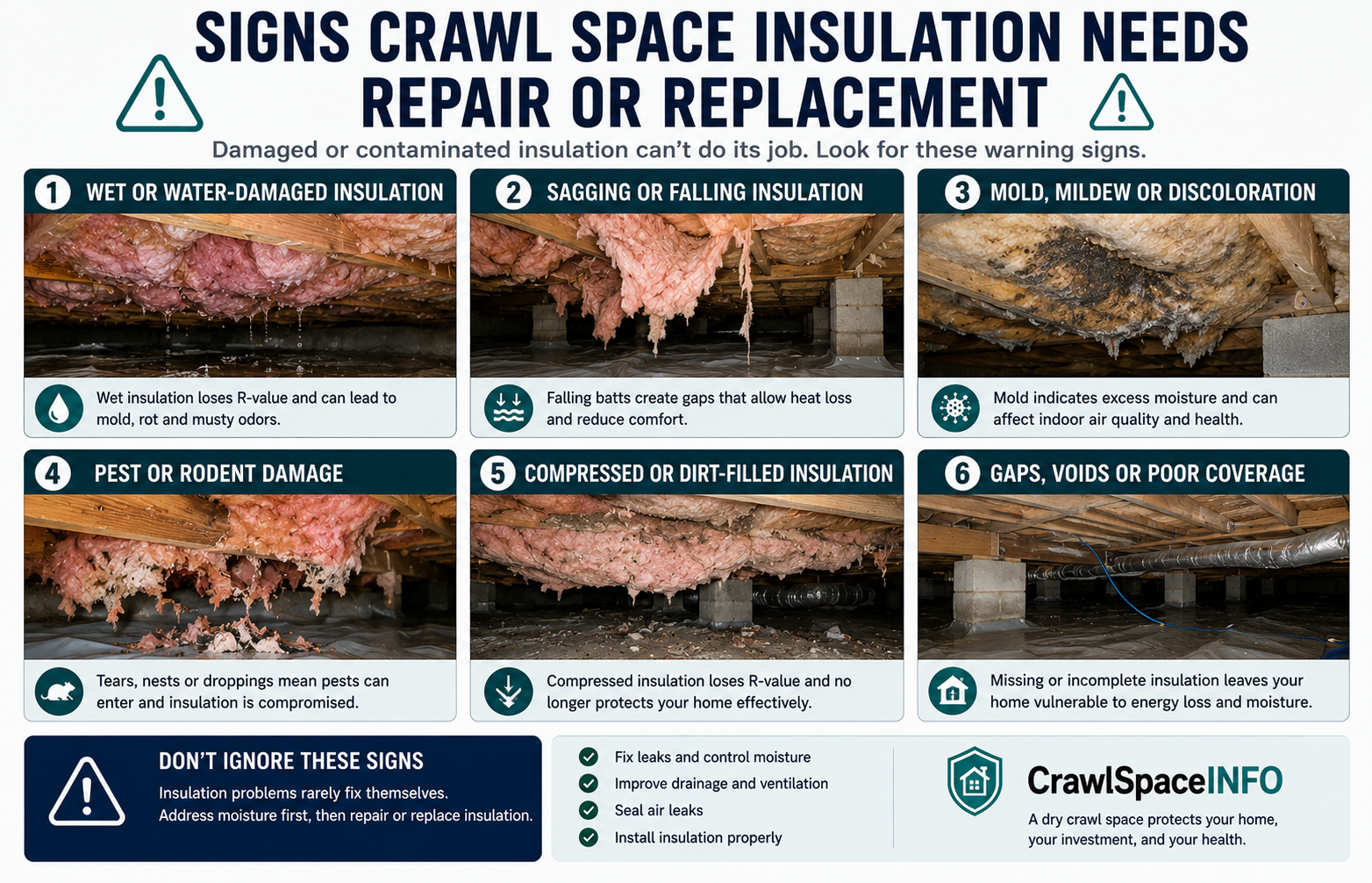
- Fiberglass batts hanging or falling
- Wet insulation after a leak or flood
- Visible staining, mold or odor
- Pest nesting or damaged insulation
- Large gaps around wiring, plumbing or framing
- Compressed batts
- Cold or uneven floors
- Condensation near insulation or HVAC components
- Insulation left in the wrong location after an encapsulation retrofit
How Much Does Crawl Space Insulation Cost?
Cost varies widely because a simple fiberglass repair is very different from removing contaminated insulation, air sealing, installing rigid foam on foundation walls and converting the crawl space to an unvented enclosure.
Major cost factors include square footage, height and access, removal and disposal, moisture or pest remediation, floor vs. wall strategy, material type, required R-value, air sealing, rim-joist work, vapor barrier or encapsulation work, foam fire-protection details and local labor.
DIY Crawl Space Insulation vs. Professional Installation
DIY May Be Reasonable When
- The crawl space is dry and safely accessible
- The existing assembly is straightforward
- You are replacing limited damaged insulation
- There is no extensive mold, pest or structural damage
- You understand the support, air-sealing and code details
Professional Evaluation Is More Appropriate When
- Insulation repeatedly becomes wet or falls
- The crawl space has standing water or chronic humidity
- You are converting from vented to unvented
- Spray foam or extensive rigid foam is planned
- Electrical, combustion or HVAC equipment creates constraints
- Wood decay, termite damage or structural problems are visible
Common Crawl Space Insulation Mistakes
Insulating Before Fixing Water
Wet crawl spaces should be dried and the source corrected before insulation is replaced.
Closing Vents Without Creating a Complete Unvented System
Blocking vents alone is not equivalent to a properly designed unvented crawl space.
Leaving Gaps and Compression
Insulation that is compressed, folded or installed with gaps does not deliver its labeled performance across the full assembly.
Ignoring Air Sealing
Air can move around many insulation materials. Insulation and air sealing solve different parts of the building-envelope problem.
Using Spray Foam to Hide Damage
Foam should not conceal wet, rotten, pest-damaged or structurally questionable framing.
Crawl Space Insulation Maintenance Checklist
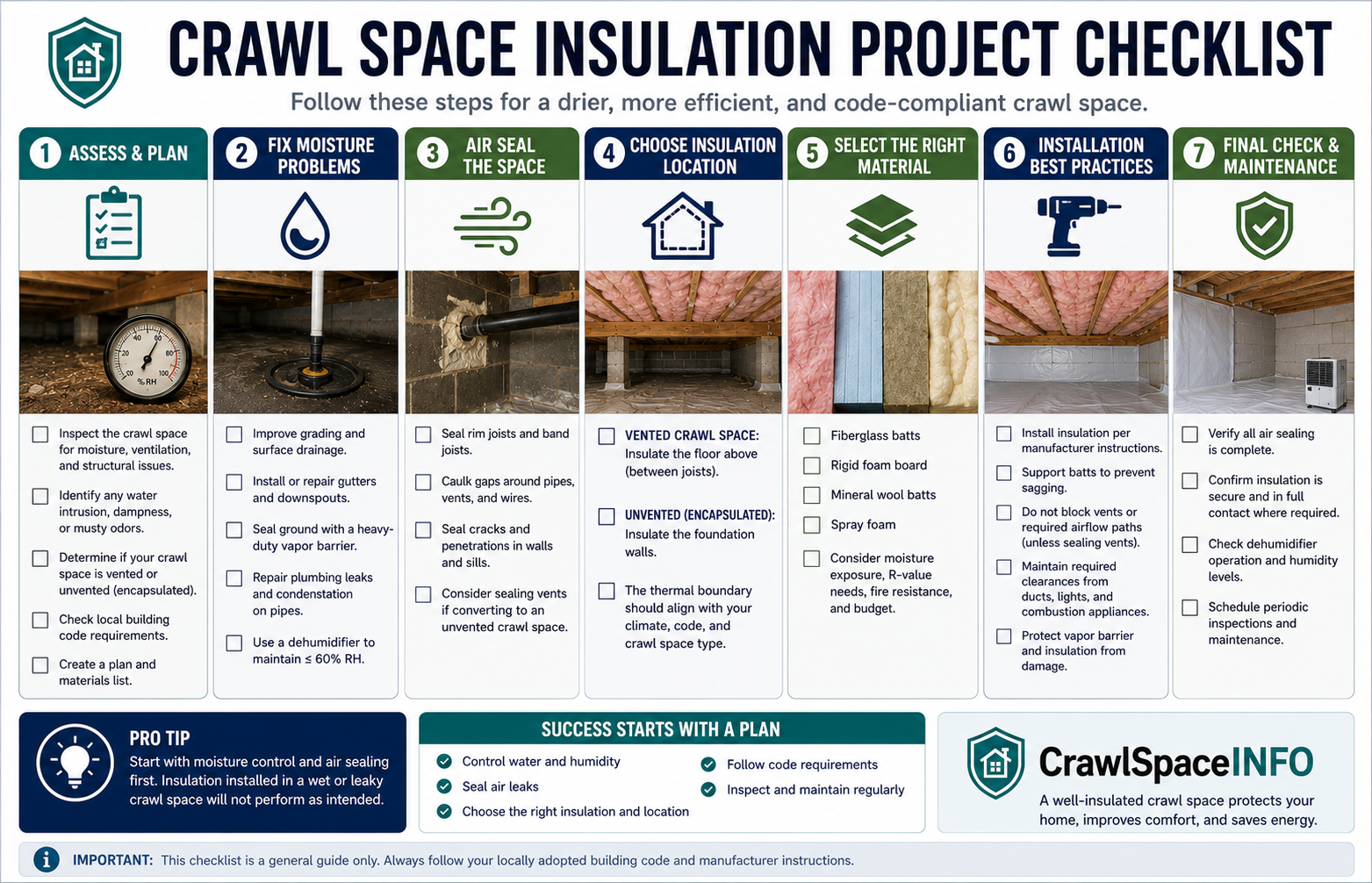
Inspect periodically and after major storms, leaks or pest activity. Look for wet or sagging insulation, new gaps, condensation, plumbing leaks, pest damage, mold, vapor-barrier damage and air leaks around access doors, penetrations and rim areas.
Crawl Space Insulation FAQs
Should I insulate the crawl space floor or walls?
Vented crawl spaces commonly place insulation in the floor assembly above. Properly designed unvented or encapsulated crawl spaces commonly move the insulation to the foundation perimeter. Verify the complete assembly and local code before changing locations.
What is the best insulation for a crawl space?
There is no universal best material. Fiberglass, rigid foam, mineral wool and spray foam can each be appropriate in particular assemblies.
Is spray foam good for a crawl space?
It can be useful for air sealing and insulating selected assemblies, but moisture, foam type, fire protection, termite inspection and the ability to inspect framing all need consideration.
Should wet crawl space insulation be replaced?
First correct the water source. Whether insulation can be dried or should be replaced depends on material, duration of wetting, contamination and physical damage.
Why is my crawl space insulation falling down?
Common causes include poor support, moisture, gravity, pests, air movement and maintenance work. Reattaching it without correcting the cause may only be temporary.
Does encapsulation replace crawl space insulation?
No. Encapsulation is primarily an air- and moisture-control strategy. It can change where the thermal boundary belongs, but the house still needs an appropriate insulation strategy.
Can I insulate over mold?
No. Do not intentionally conceal mold growth or wet, damaged materials behind new insulation. Correct the moisture source and address affected materials first.
What R-value do I need?
It varies by climate zone, insulation location, code edition and local amendments. Check the locally adopted energy code rather than relying on one universal number.
Before You Replace the Insulation, Find Out Why It Failed
Use the Free Crawl Space Assessment to organize moisture, water, mold, insulation, odor and floor symptoms so you can choose the right next step.
Sources & Technical References
- 2024 International Residential Code — Chapter 11 Energy Efficiency: floor and crawl-space-wall insulation requirements vary by climate zone and assembly.
- 2024 International Residential Code — R408.3: requirements for qualifying unvented crawl spaces, including ground vapor control.
- U.S. Department of Energy / Building America Solution Center — Unvented, Insulated Crawlspaces.
- U.S. Department of Energy / Building America Solution Center — Vented to Unvented Crawl Space retrofit guidance.