

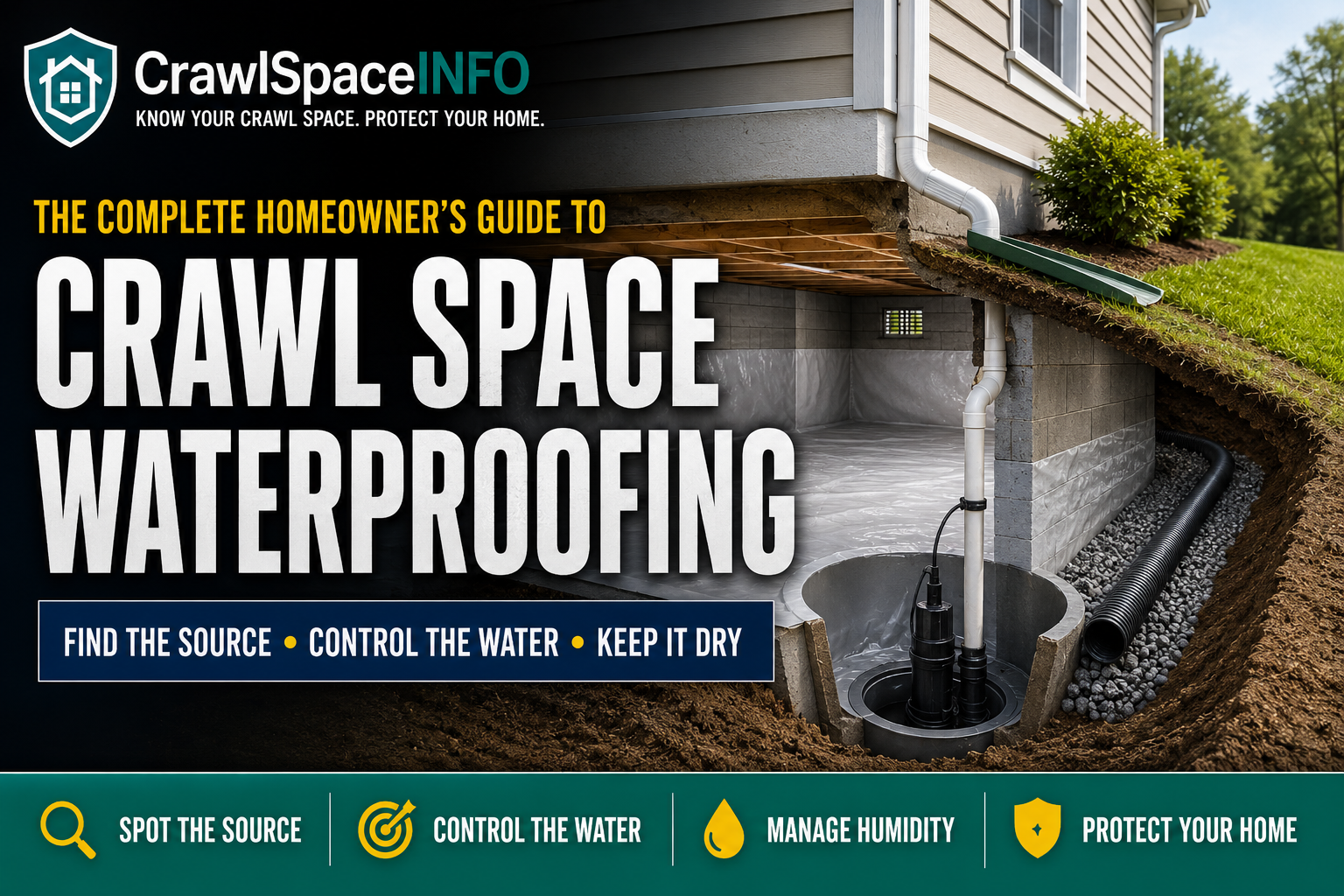
A source-first homeowner guide to crawl space waterproofing: where water comes from, which repairs solve which problems, how drainage and sump systems work, what waterproofing can cost, and when vapor barriers, encapsulation or dehumidification should be added.
Quick Answer: What Is Crawl Space Waterproofing?
Crawl space waterproofing is not one product. It is a water-management strategy that identifies how water reaches the crawl space, reduces avoidable water around the exterior, collects or drains water that still reaches the foundation, safely discharges that water, and then controls remaining ground vapor and humidity. Depending on the house, the system may include grading, gutters and downspouts, exterior waterproofing, perimeter drainage, a sump pump, foundation repairs, a vapor barrier, encapsulation and dehumidification.
Not Sure Where the Water Is Coming From?
Use the free CrawlSpaceInfo assessment to organize when the water appears, where it collects and which moisture or structural symptoms you are seeing.
What Does Crawl Space Waterproofing Actually Mean?
Homeowners often use crawl space waterproofing to describe almost anything intended to make the area beneath a house drier. In practice, a durable system usually combines several layers of water and moisture control rather than relying on one coating, liner, drain or pump.
The first distinction to make is between bulk liquid water and water vapor or humidity. Puddles, seepage and flooding are liquid-water problems. Damp soil, high relative humidity and condensation are moisture problems. They may occur together, but they are not controlled in exactly the same way.
The important question is not simply, “Do I need waterproofing?” It is: What water pathway needs to be controlled? A sump pump cannot correct an overflowing gutter. A vapor barrier cannot repair a plumbing leak. A dehumidifier cannot stop groundwater from entering beneath the home.
Where Does Water in a Crawl Space Come From?
Water can reach a crawl space from above, beside, below or inside the home. Identifying the active pathway is one of the most important steps in choosing the right repair.
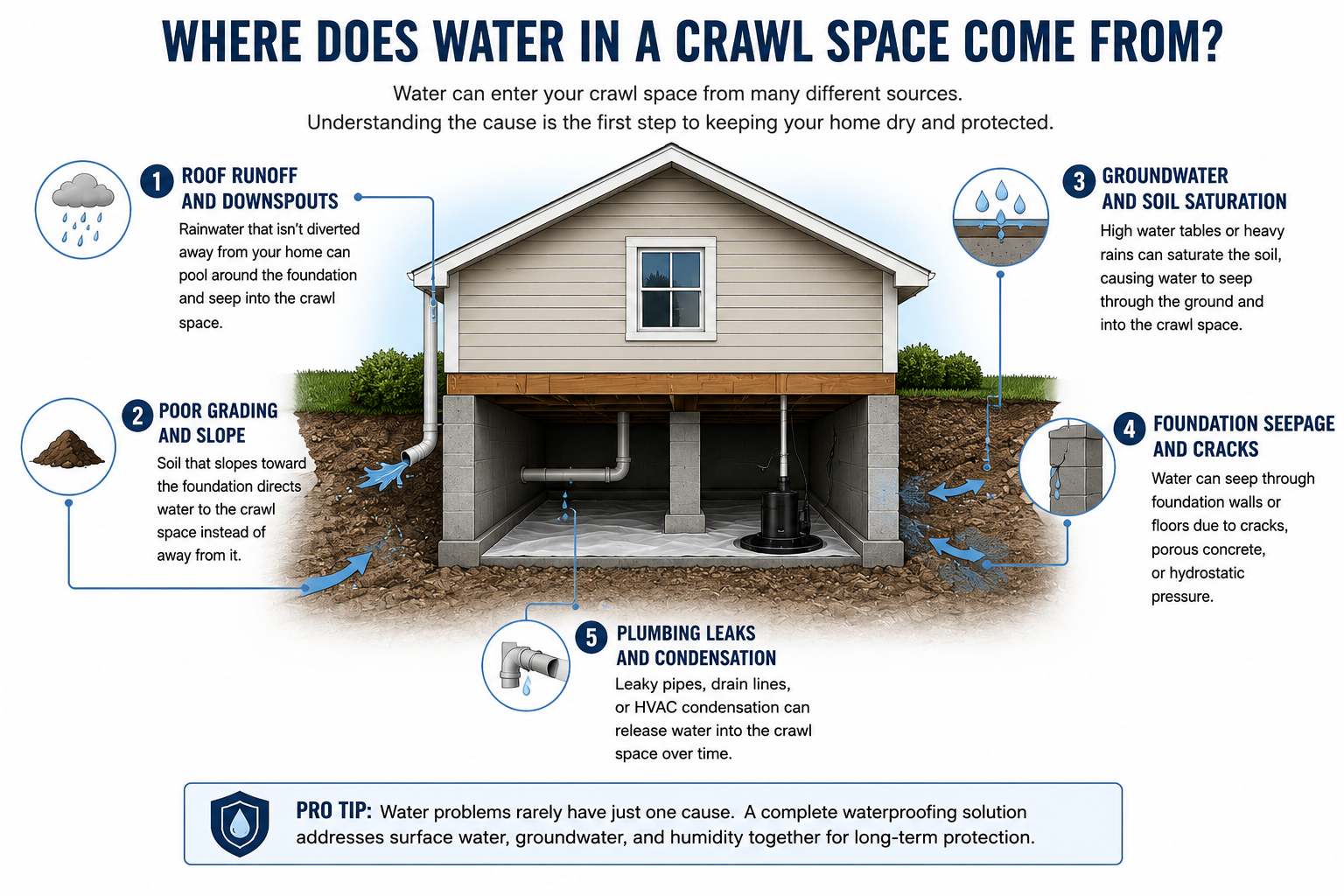
Roof Runoff and Downspouts
Clogged gutters, overflowing gutters, short downspouts or roof drainage that releases water beside the foundation can saturate the surrounding soil. Extending roof-water discharge away from the foundation is often one of the first conditions to inspect.
Poor Grading and Surface Drainage
Soil, patios, walkways or driveways that slope toward the house can direct stormwater toward foundation walls. Low areas beside the home can also hold water and keep foundation soils saturated.
Groundwater and a High Water Table
Groundwater can rise beneath a crawl space or build pressure around below-grade foundation components. Recurring water that appears even when roof drainage and surface grading are functioning correctly may require subsurface drainage and possibly a sump system.
Foundation Seepage and Openings
Cracks, masonry joints, utility penetrations, porous foundation materials and low access openings can provide pathways for water. Sealing an obvious opening may be part of the repair, but the water pressure or drainage condition feeding that opening should also be investigated.
Plumbing and Mechanical Leaks
Supply piping, drain lines and HVAC condensate systems can create water beneath a house that resembles groundwater intrusion. Repairing the leak is more appropriate than installing a waterproofing system around an active plumbing problem.
Ground Vapor, Humidity and Condensation
Even without visible puddles, moisture can evaporate from exposed soil. Humid air can also condense on cooler ducts, pipes, framing and other surfaces. These conditions generally require vapor control, air control and sometimes dehumidification after active liquid-water problems have been addressed.
Signs You May Have a Crawl Space Water Problem
- Standing water or recurring puddles after rain
- Mud or persistently wet soil
- Water stains on foundation walls or piers
- White mineral deposits on masonry
- Erosion channels or washed-out soil
- Rust on metal supports or fasteners
- Wet, sagging or fallen insulation
- Persistent musty odors
- Visible mold or fungal growth associated with chronic moisture
- Soft, stained or deteriorating wood
- Condensation on ducts or pipes
- A sump pump that runs frequently or cannot keep up
- Water repeatedly appearing from the same wall, corner or low spot
How Does a Crawl Space Waterproofing System Work?
A complete water-management strategy generally follows a logical sequence: reduce water reaching the foundation, provide a controlled path for water that still arrives, collect it where necessary, discharge it safely, then control remaining vapor and humidity.
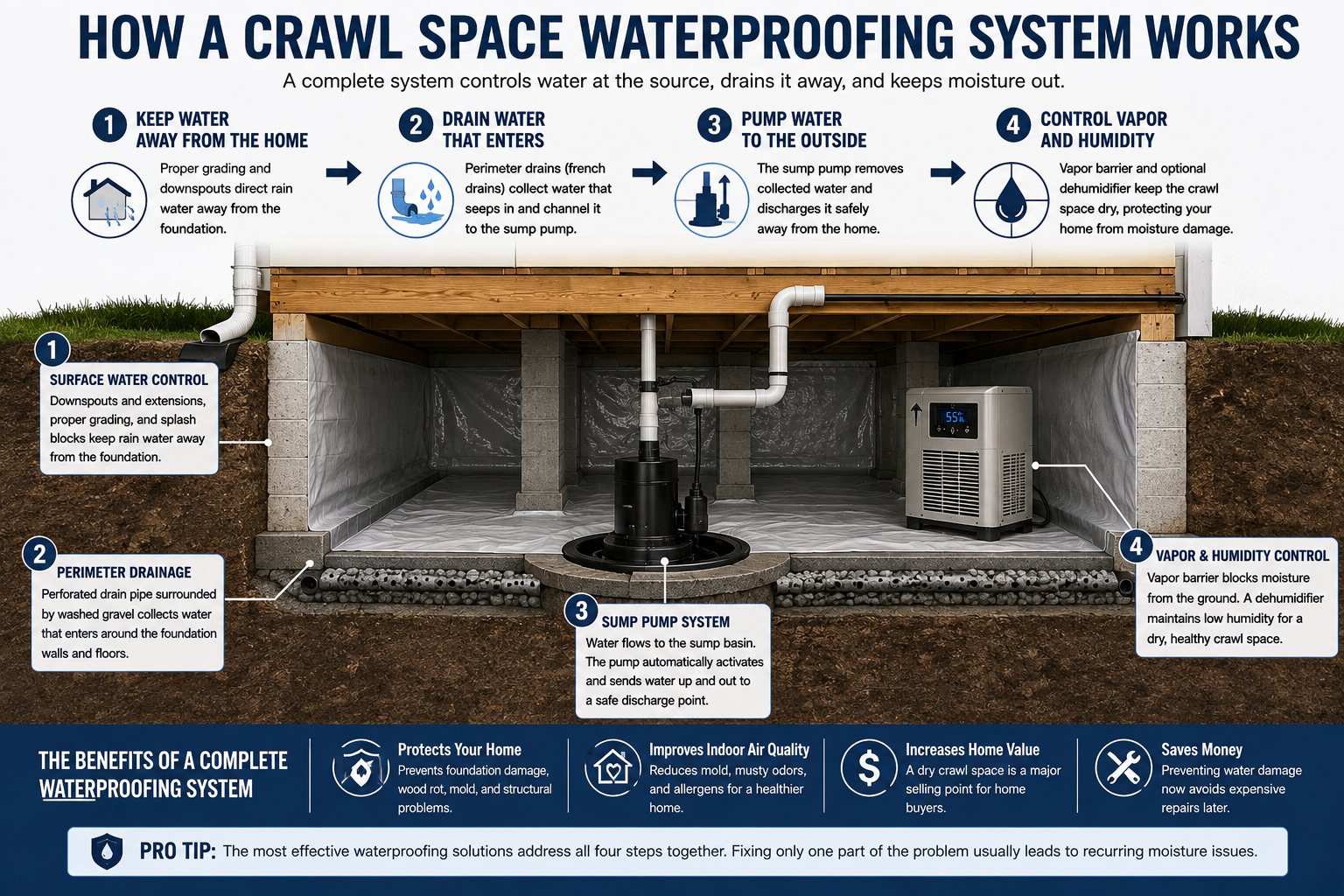
1. Keep Surface Water Away
Gutters, downspouts, grading, swales and appropriate surface drainage reduce the amount of stormwater that reaches the foundation.
2. Protect Below-Grade Foundation Surfaces
Where soil contacts below-grade foundation walls, appropriate dampproofing or waterproofing systems may help reduce moisture transmission and water entry.
3. Provide Drainage
Exterior or interior perimeter drainage can collect water and direct it toward a safe gravity outlet or sump basin rather than allowing it to spread beneath the home.
4. Pump Water When Gravity Drainage Is Not Practical
A sump basin and pump can mechanically remove collected water when site elevation does not provide a dependable gravity-drainage route.
5. Control Ground Vapor
A ground vapor barrier reduces moisture moving from exposed soil into crawl-space air.
6. Control Remaining Humidity
If humidity remains high after liquid-water problems are corrected, air sealing, encapsulation, insulation changes or dehumidification may be appropriate depending on the crawl-space design and climate.
| Component | What It Controls | What It Does Not Fix by Itself |
|---|---|---|
| Gutters & downspout extensions | Roof runoff near the foundation | Groundwater, plumbing leaks or ground vapor |
| Corrected grading | Surface water moving toward the house | High water table or interior leaks |
| Exterior footing/perimeter drain | Water accumulating around the foundation | Humidity or exposed-soil vapor |
| Interior perimeter drain | Water entering at the crawl-space perimeter | The exterior source of roof runoff or plumbing leaks |
| Sump basin & pump | Collected water that cannot drain by gravity | The reason water reached the foundation |
| Vapor barrier | Moisture vapor from exposed soil | Standing water, flooding or active leaks |
| Encapsulation | Ground vapor and uncontrolled air exchange as part of a broader system | Unresolved bulk-water intrusion |
| Dehumidifier | Excess moisture in crawl-space air | Puddles, groundwater or plumbing leaks |
Exterior vs. Interior Crawl Space Waterproofing
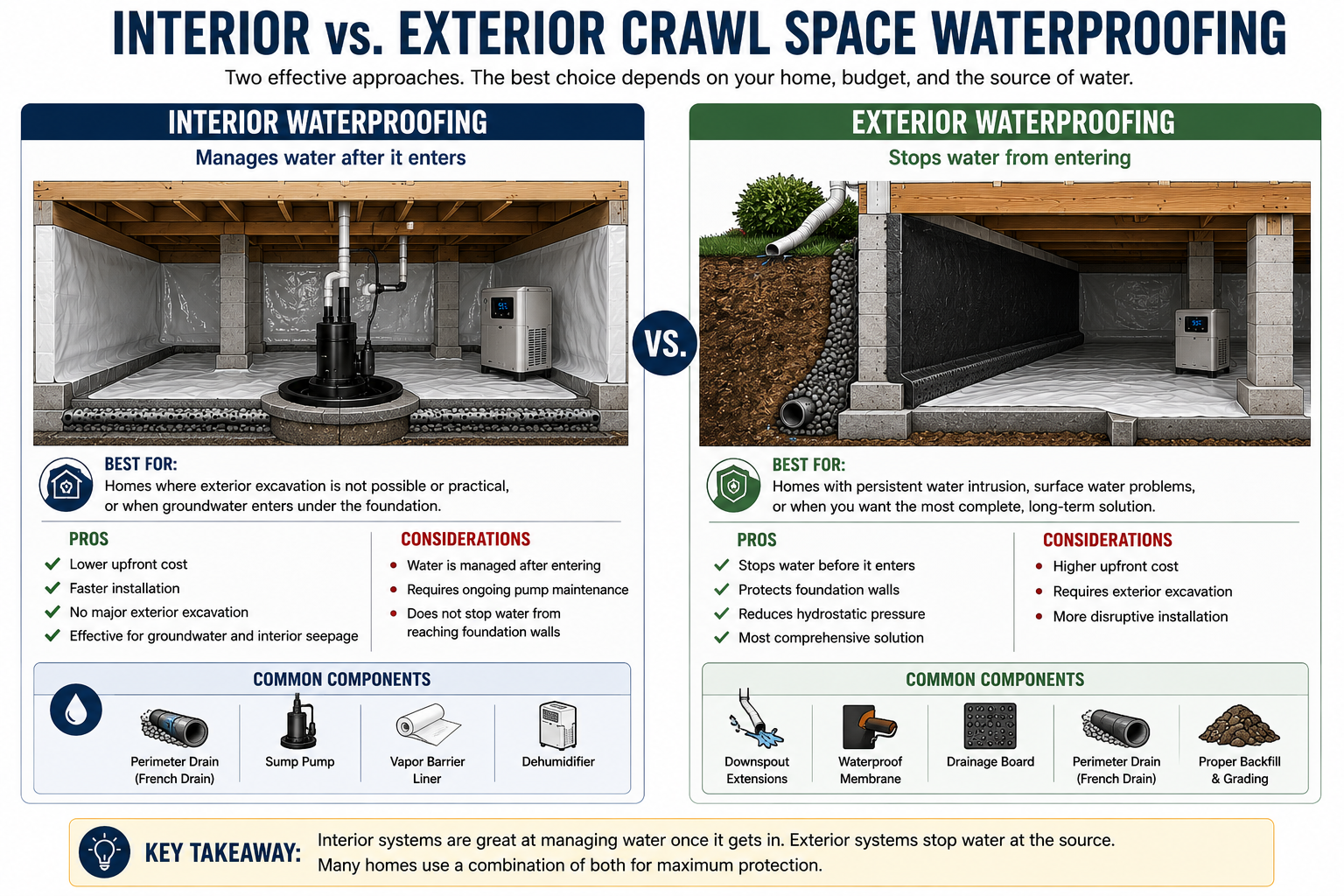
Neither approach is automatically better. The right method depends on where the water originates, site drainage, soil conditions, foundation construction, access, elevation, discharge options and the severity of the problem.
| Approach | What It Does | Best Fit | Main Limitation |
|---|---|---|---|
| Exterior water management | Reduces water reaching the foundation through grading, runoff control, drainage and appropriate wall treatment. | Surface-water problems, foundation-wall exposure and conditions that can reasonably be corrected outside. | Excavation and access can make major exterior work disruptive. |
| Interior perimeter drainage | Collects water after it reaches the foundation area and routes it toward a sump or approved outlet. | Recurring seepage or groundwater where exterior excavation is impractical. | It manages incoming water rather than preventing all water from reaching the exterior foundation. |
| Combined system | Reduces exterior water load while providing an interior collection path. | Difficult or recurring problems involving multiple water pathways. | Greater project scope and complexity. |
Crawl Space Drainage and French Drains
A drainage system gives water a controlled route instead of allowing it to spread across crawl-space soil or remain against the foundation.
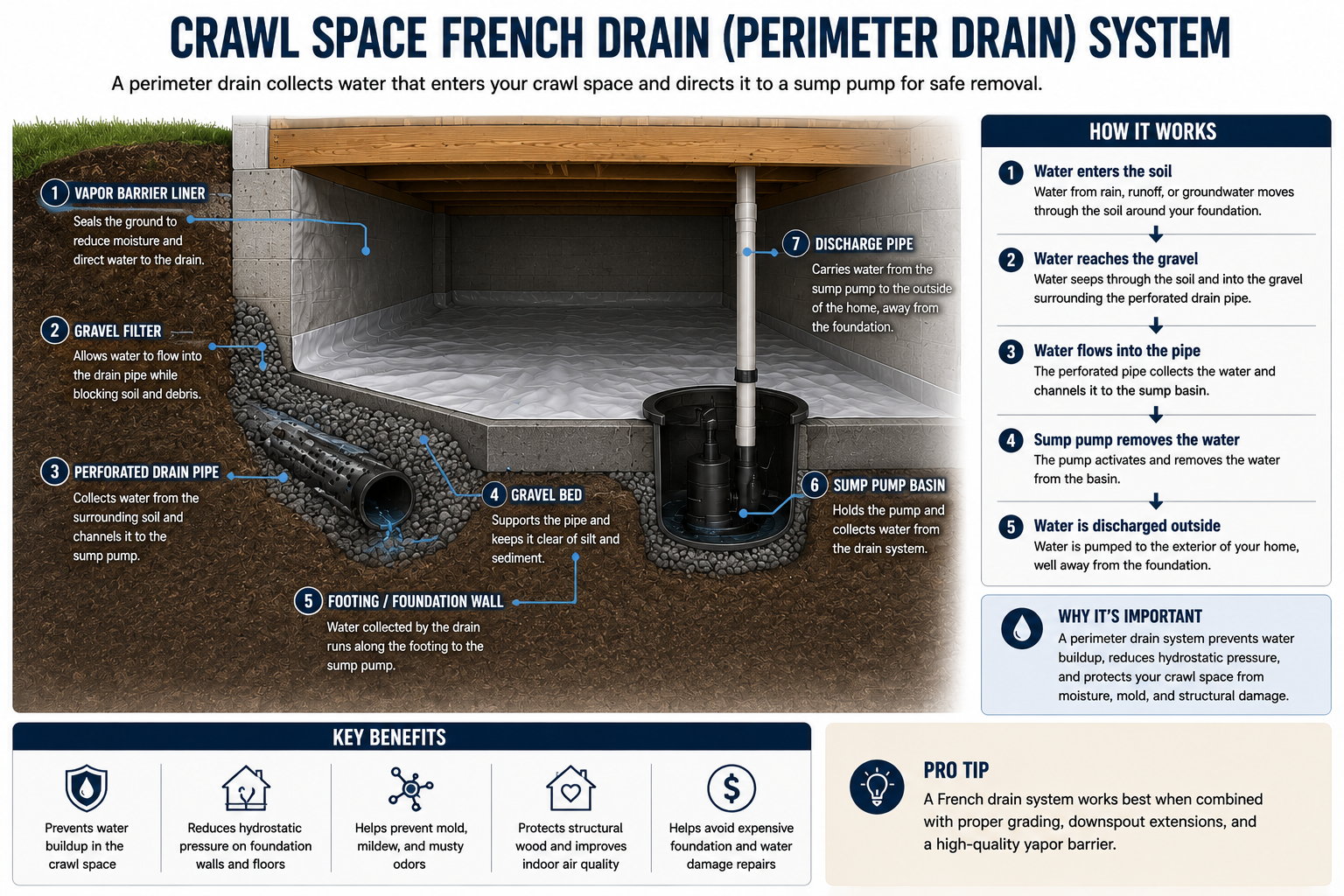
Depending on the project, a perimeter drainage system may use perforated pipe, washed aggregate, filter fabric, drainage mat or another appropriate drainage assembly. The water must ultimately have somewhere safe to go.
Interior French Drain
In crawl-space work, “French drain” commonly refers to a perforated drainage line installed around the interior perimeter. Water entering near the foundation is collected and directed toward a sump basin or other discharge point.
Exterior Foundation Drain
Exterior foundation drainage is intended to reduce water accumulation beside below-grade walls and footings. Depending on the construction, it may be combined with free-draining backfill and appropriate foundation-wall dampproofing or waterproofing.
When Does a Crawl Space Need a Sump Pump?
A sump pump is used when collected water must be mechanically lifted and discharged away from the crawl space. It is commonly paired with perimeter drainage where groundwater, recurring stormwater entry or low areas beneath the home repeatedly collect water.
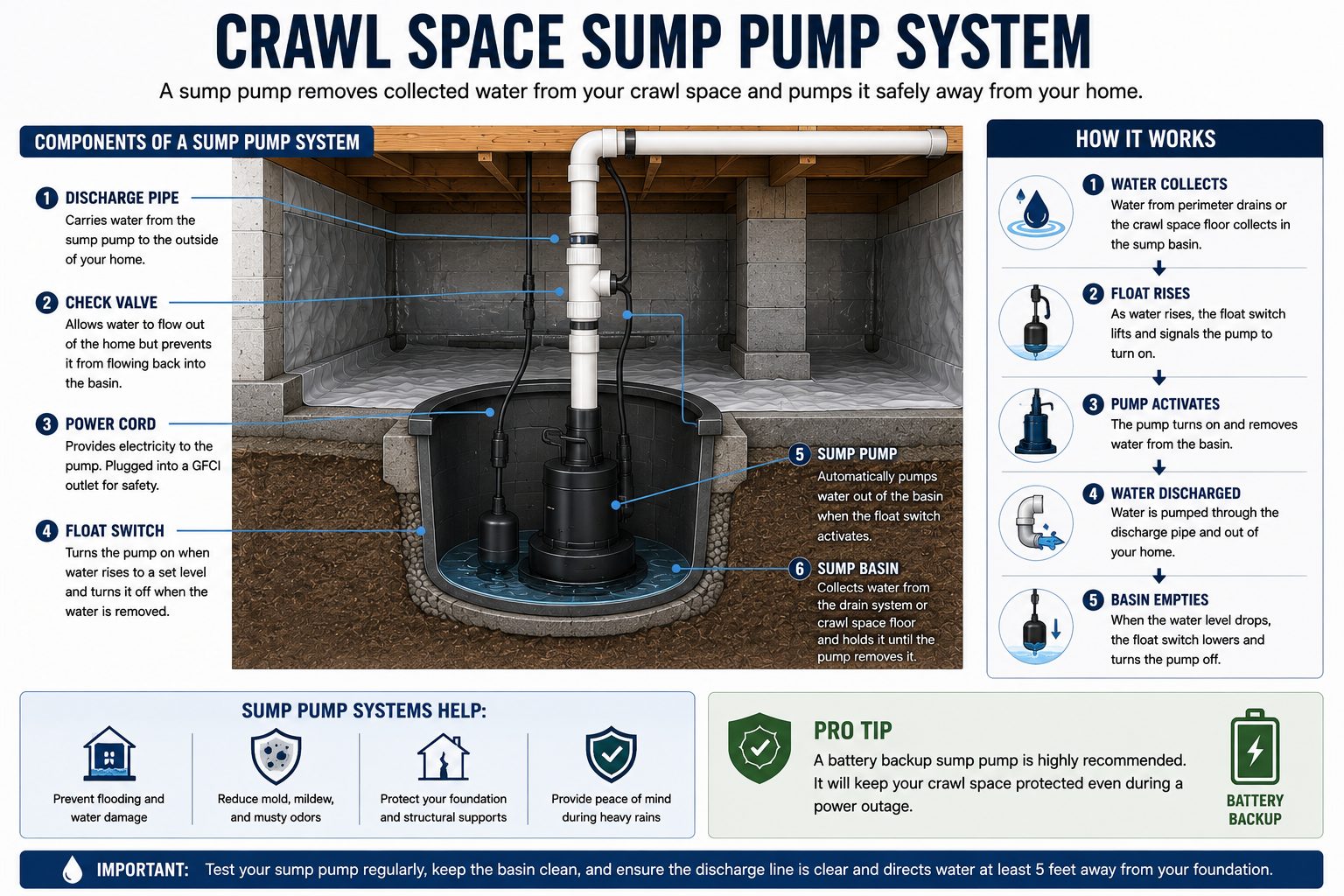
A complete sump system should consider pump capacity, basin location, discharge routing, electrical safety, accessibility for service and backup protection where pump failure could create significant damage.
The discharge point matters. Water should not simply be pumped a short distance outside and released where it can soak back into the soil beside the same foundation.
Does Crawl Space Waterproofing Include a Vapor Barrier?
Often, yes—but drainage and vapor control perform different jobs.
Waterproofing and drainage manage bulk liquid water. A ground vapor barrier primarily reduces water vapor coming from the soil.
A crawl space can have effective drainage and still remain humid if large areas of damp soil remain exposed. Conversely, installing a liner over a crawl space with unresolved standing water does not eliminate the drainage problem beneath it.
See our Crawl Space Vapor Barrier: Complete Homeowner Guide.
Crawl Space Waterproofing vs. Vapor Barrier vs. Encapsulation
Waterproofing, vapor barriers, and encapsulation overlap, but they solve different moisture problems.
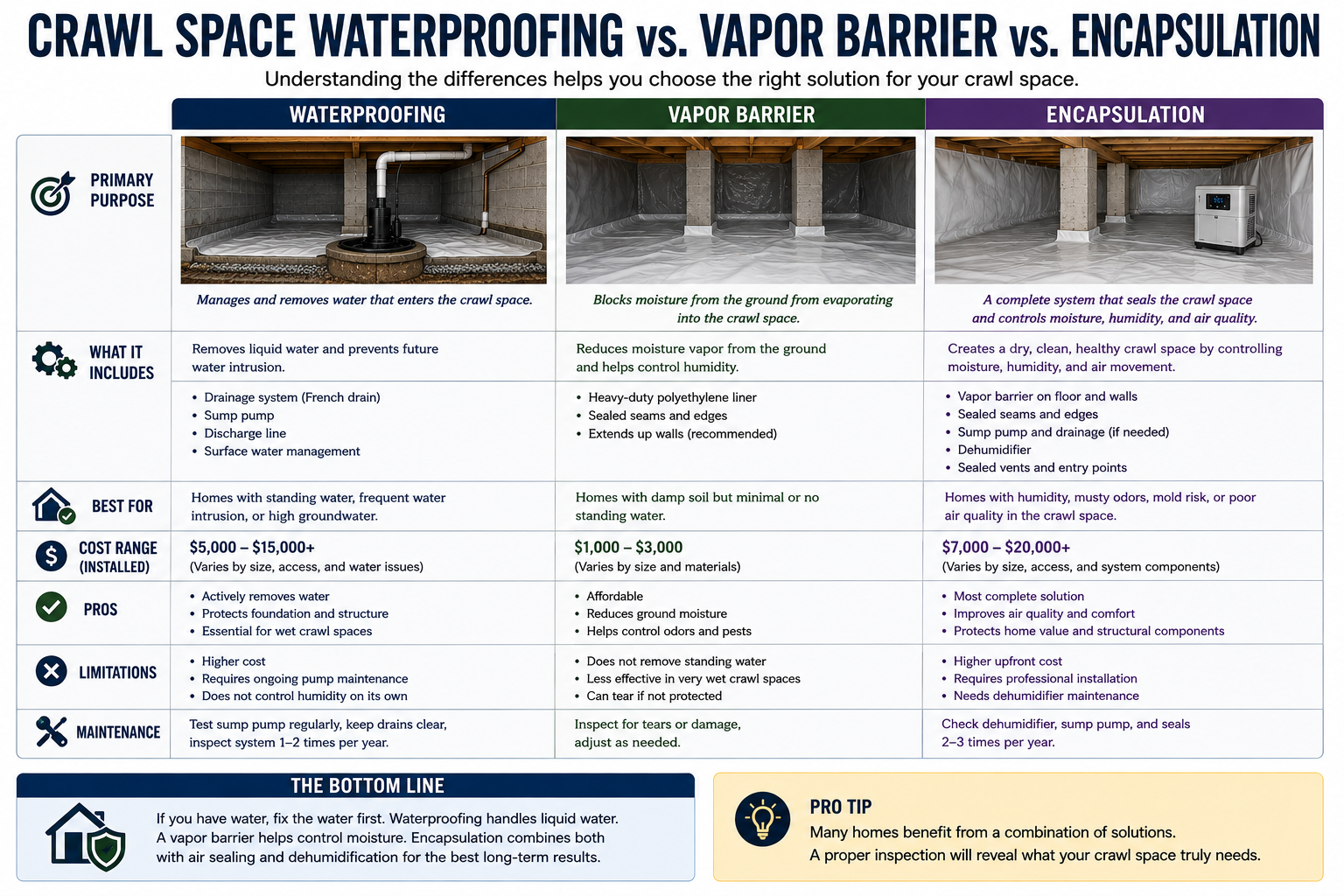
| System | Primary Job | Typical Components |
|---|---|---|
| Waterproofing | Control liquid-water intrusion and accumulation. | Grading, downspouts, membranes, drains, sump pumps and discharge piping. |
| Vapor barrier | Reduce moisture vapor from soil. | Ground liner with appropriate seams and detailing. |
| Encapsulation | Create a more controlled crawl-space environment. | Sealed liner, wall and pier detailing, air sealing, vent treatment and a humidity-control strategy. |
| Dehumidification | Remove excess moisture from crawl-space air. | Dedicated dehumidifier, drainage, electrical supply and humidity control. |
A wet crawl space may require drainage or waterproofing before encapsulation. For example, recurring groundwater might require perimeter drainage and a sump pump before a sealed liner is installed.
Once liquid water is controlled, encapsulation can help separate the crawl space from exposed soil and uncontrolled exterior air.
See our Crawl Space Encapsulation: Complete Homeowner Guide.
Do You Need a Dehumidifier After Waterproofing?
Possibly. If active water sources have been corrected but crawl-space humidity remains persistently high, a dehumidifier can help control moisture in the air.
Dehumidifiers are commonly used as part of sealed or encapsulated crawl-space systems in humid conditions. Equipment should be appropriately sized for the space and moisture load and provided with reliable condensate drainage.
A dehumidifier should not be used as a substitute for a sump pump, foundation drain, plumbing repair, gutter correction or other repair needed to stop active liquid water.
What Should You Fix First?
When several crawl-space moisture problems exist at once, repair sequence matters.
- Stop active plumbing or HVAC condensate leaks. Direct leaks should be repaired at their source rather than treated as drainage problems.
- Inspect gutters and downspouts. Make sure roof runoff is being carried away instead of released beside the foundation.
- Inspect grading and exterior ponding. Look for soil or hard surfaces that direct water toward the house.
- Determine whether the recurring problem is surface water or groundwater. When the water appears can provide useful clues.
- Provide a collection and discharge path where necessary. That may involve exterior drainage, interior perimeter drainage, gravity discharge or a sump system.
- Control ground vapor. Cover exposed soil with an appropriate vapor-control layer after bulk-water conditions are addressed.
- Control humidity if it remains high. Air sealing, encapsulation or dehumidification may be appropriate depending on the crawl-space design and climate.
- Repair moisture-damaged materials after controlling the source. Wet insulation, mold contamination or deteriorated structural materials may require separate corrective work.
How Much Does Crawl Space Waterproofing Cost?
There is no useful single national price for “crawl space waterproofing” because the phrase can describe anything from correcting a downspout or grading problem to installing drainage, sump pumps, foundation waterproofing, vapor control and encapsulation.
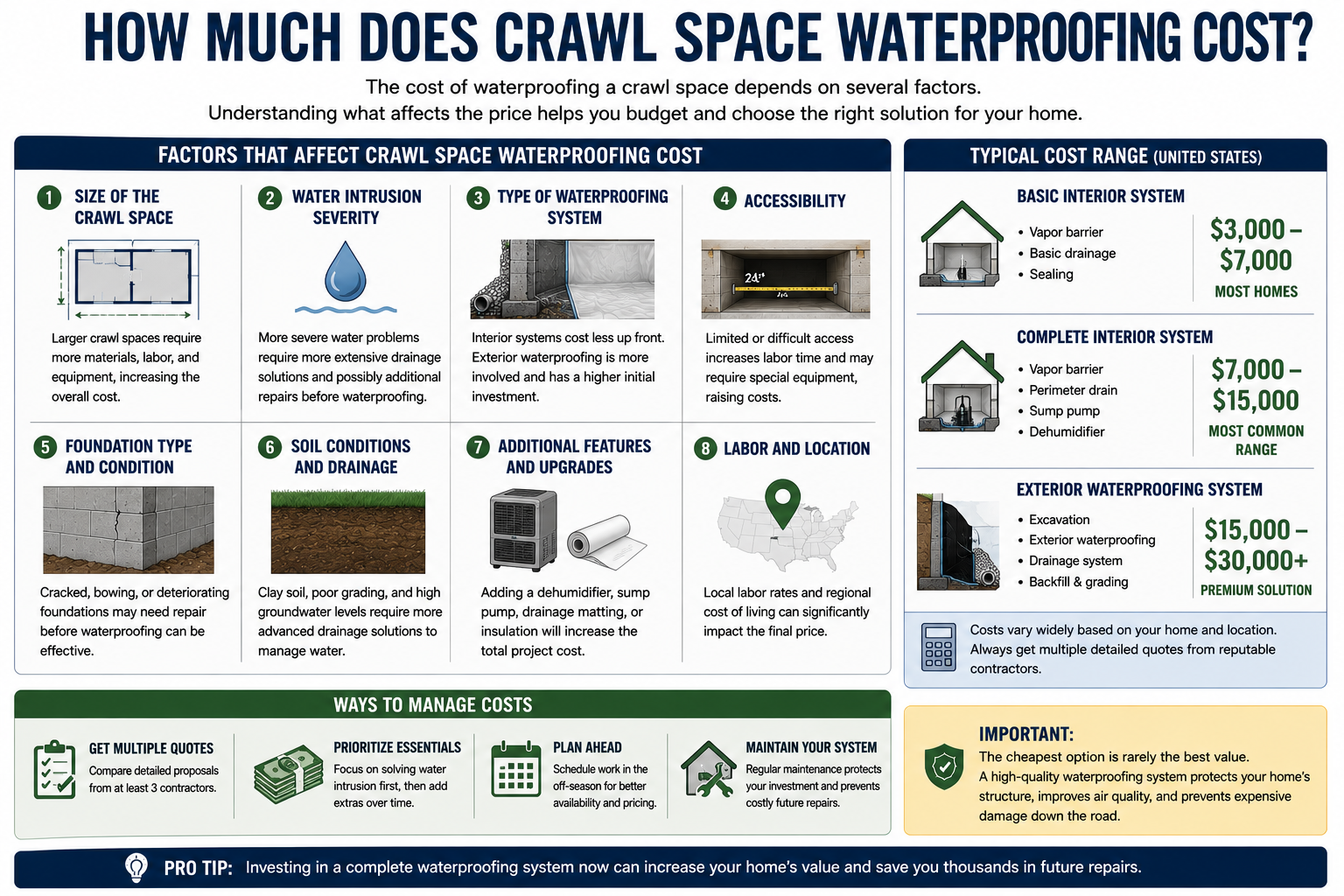
| Scope | Why Cost Varies |
|---|---|
| Gutters / downspouts / grading | May involve a small exterior correction or substantial landscape and drainage work. |
| Interior perimeter drainage | Depends on perimeter length, excavation difficulty, aggregate, discharge routing and crawl-space access. |
| Sump system | Pump capacity, basin, electrical work, discharge distance, alarms and backup equipment affect scope. |
| Exterior waterproofing | Excavation depth, access, wall length, membrane system, drainage and site restoration can substantially change the project. |
| Vapor barrier / encapsulation | Material grade, walls, piers, penetrations, sealing, insulation and humidity-control equipment vary widely. |
| Repairs / remediation | Mold, damaged wood, insulation, pests, plumbing and structural repairs are typically separate scopes. |
DIY Crawl Space Waterproofing vs. Professional Work
Some inspection and basic water-management tasks are realistic for homeowners. Other work can involve excavation, pumps, electrical systems, structural conditions, contaminated materials or difficult diagnosis.
DIY May Be Reasonable For
- Cleaning gutters
- Extending downspouts
- Monitoring where water appears during rain
- Monitoring crawl-space humidity
- Correcting straightforward minor surface drainage where safe and appropriate
- Addressing an obvious minor maintenance issue within your skill level
Professional Evaluation Is More Appropriate For
- Recurring standing water or flooding
- Groundwater problems
- Foundation-wall seepage
- Major interior or exterior perimeter drainage
- Sump systems involving electrical work
- Extensive excavation
- Structural movement or deteriorated framing
- Large or changing foundation cracks
- Extensive mold contamination
- Sewage or contaminated floodwater
- Flood-zone or code-sensitive work
Common Crawl Space Waterproofing Mistakes
Choosing a Product Before Finding the Source
Buying a dehumidifier, sump pump, liner or encapsulation system before diagnosing the water pathway can lead to spending money without correcting the underlying problem.
Ignoring Roof Water
An expensive interior drainage system may be compensating for gutters or downspouts that release large amounts of roof runoff beside the foundation.
Encapsulating Over an Active Water Problem
A sealed liner can hide water temporarily while groundwater or drainage problems continue beneath it.
Discharging a Sump Too Close to the House
Water pumped outside and released immediately beside the foundation can soak back into the same soil and return to the crawl space.
Assuming Every Foundation Crack Is a Waterproofing Problem
Some cracks are associated primarily with shrinkage, some may provide a water pathway, and others may indicate movement. Large, changing or otherwise concerning cracks should be evaluated for their underlying cause.
Forgetting Maintenance
Drains can clog, pumps can fail, discharge lines can become blocked or freeze, gutters fill with debris and soil grading can settle over time.
How to Choose a Crawl Space Waterproofing Contractor
A good contractor should be able to explain where the water is coming from and why the proposed system matches that source.
Questions worth asking include:
- Where is the water entering?
- What evidence supports that diagnosis?
- What exterior corrections should be made first?
- Is the proposed system preventing water, collecting it, or both?
- Where will collected water discharge?
- What happens during a power outage?
- Is backup pumping or an alarm appropriate?
- Is a vapor barrier included?
- Is encapsulation included or separate?
- Does the scope require electrical work?
- What regular maintenance is required?
- What is covered by the workmanship or equipment warranty?
- Are permits or inspections required locally?
Crawl Space Waterproofing Maintenance
Inspect the crawl space periodically and after unusually heavy storms. Even a system that performed well for years can develop problems as pumps age, drainage outlets become obstructed or exterior drainage conditions change.
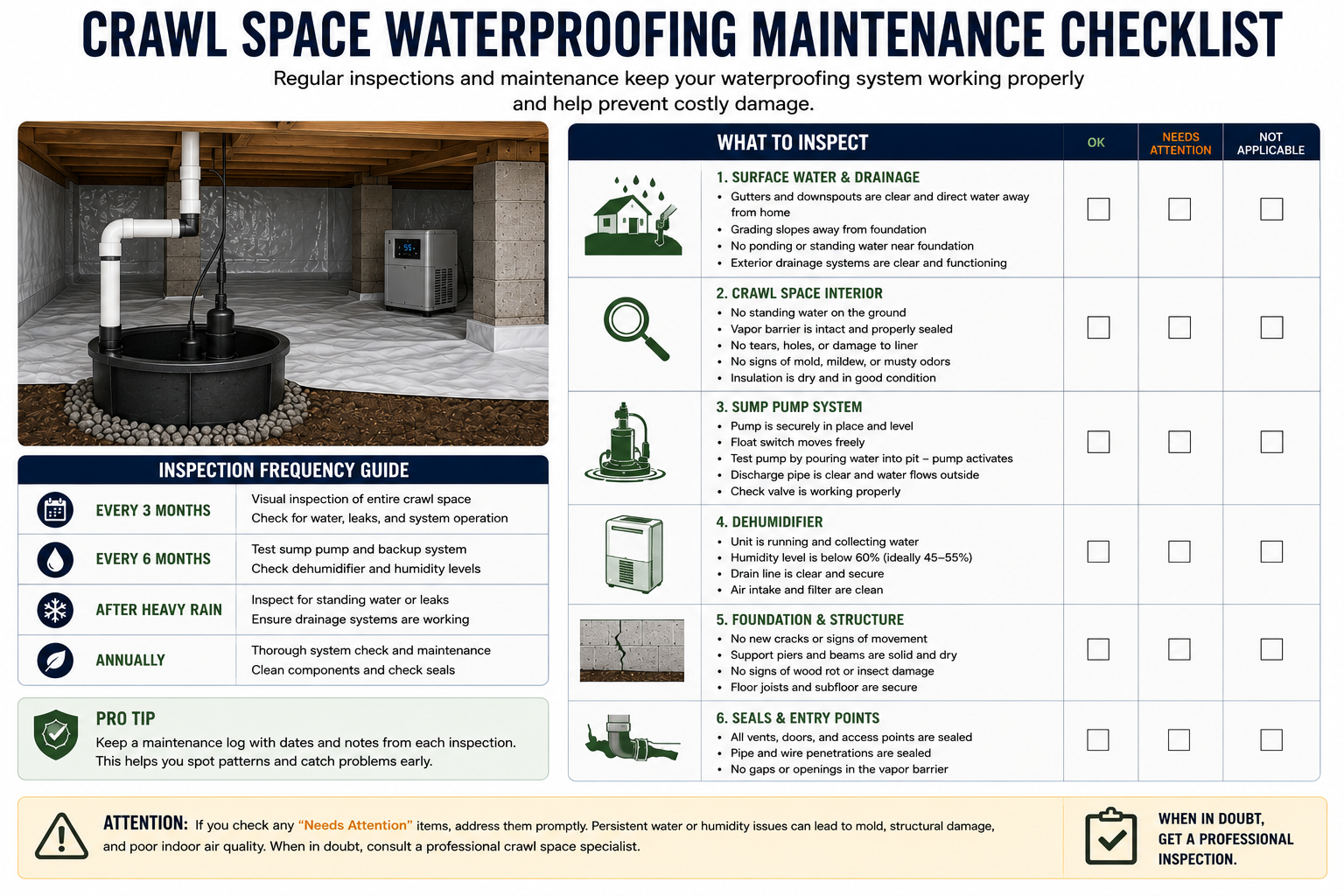
Check for:
- New water entry
- Sump pump operation
- Backup pump or battery condition
- Discharge piping and outlet condition
- Visible drainage blockages
- Vapor-barrier tears or loose seams
- Plumbing leaks
- Unexpected humidity changes
- Musty odors or visible mold
- Gutter and downspout performance
- Settled soil beside the foundation
Crawl Space Waterproofing FAQs
What is the best way to waterproof a crawl space?
The best solution depends on the actual water source. Roof runoff may require gutters, downspouts and grading; groundwater may require drainage and a sump; foundation seepage may require drainage or wall treatment; exposed-soil moisture requires vapor control.
Can you completely waterproof a crawl space?
No system can guarantee that a crawl space will never encounter water under every possible condition. A better goal is a layered water-management system that reduces water at the source, provides safe drainage for unavoidable water and controls remaining vapor and humidity.
Can you waterproof a crawl space from the inside?
Yes. Interior drainage systems can collect water that reaches the crawl-space perimeter and direct it toward a sump or other appropriate outlet. Interior systems manage water after it reaches the foundation area rather than preventing all exterior water exposure.
Do I need a French drain in my crawl space?
Not every crawl space needs one. Perimeter drainage is most useful where recurring seepage or groundwater needs a dependable collection path.
Does a vapor barrier waterproof a crawl space?
A vapor barrier primarily reduces moisture vapor coming from soil. It should not be relied upon as the drainage system for recurring standing water, groundwater, flooding or active plumbing leaks.
Do I need a sump pump in my crawl space?
A sump pump is useful when collected water must be mechanically discharged because gravity drainage is not practical. A home with only a roof-drainage or plumbing problem may not need one.
Is encapsulation the same as waterproofing?
No. Waterproofing focuses primarily on liquid-water control. Encapsulation creates a more controlled crawl-space environment and primarily addresses ground vapor and uncontrolled air exchange. Wet crawl spaces may need drainage before encapsulation.
Should I encapsulate before waterproofing?
Recurring bulk-water problems should generally be identified and controlled rather than simply concealed beneath a sealed liner. Drainage and encapsulation can be designed together as parts of one larger moisture-management system.
Will a dehumidifier fix a wet crawl space?
A dehumidifier controls moisture in the air. It cannot stop active groundwater, flooding, stormwater entry or plumbing leaks. Liquid-water sources should be corrected first.
Why does my crawl space get wet only after heavy rain?
That timing may point toward roof runoff, poor grading, surface drainage, foundation entry or storm-related groundwater. Observing where exterior water accumulates during rain can help narrow the cause.
Can crawl space water cause mold?
Persistent moisture can create conditions favorable to mold growth. Moisture control is therefore an important part of addressing recurring mold conditions.
How long should crawl space waterproofing last?
There is no universal lifespan because a waterproofing system may include drains, pumps, membranes, liners, sealants and exterior drainage improvements with different maintenance needs and service lives.
Final Takeaway
The most effective crawl space waterproofing plan starts with a simple question: Where is the water coming from? Roof runoff, poor grading, groundwater, foundation openings, plumbing leaks and ground vapor require different controls.
Keep avoidable water away from the foundation, provide a dependable collection and discharge path for water that still reaches the crawl space, then address vapor and humidity. That sequence is more reliable than choosing a liner, pump or dehumidifier before diagnosing the source.
Build Your Crawl Space Action Plan
Use the free CrawlSpaceInfo assessment to organize your symptoms before comparing drainage, sump-pump, vapor-barrier, encapsulation or dehumidifier options.
Sources & Technical References
- U.S. Department of Energy Building America Solution Center — Water Management of Existing Crawlspace Floor
- U.S. Department of Energy Building America Solution Center — Drain or Sump Pump Installed in Basements or Crawlspaces
- U.S. Department of Energy Building America Solution Center — Pre-Retrofit Assessment of Crawlspaces and Basements
- U.S. Environmental Protection Agency — A Brief Guide to Mold, Moisture and Your Home
- U.S. Environmental Protection Agency — Moisture Control Guidance for Building Design, Construction and Maintenance
- FEMA — Crawlspace Construction for Buildings Located in Special Flood Hazard Areas
- Applicable locally adopted building, electrical, plumbing and stormwater requirements should be verified for the specific property and jurisdiction.