

A practical guide to crawl space drainage and sump pumps: how water is collected, when a perimeter drain is appropriate, how a sump system removes water, what backup protection matters, and how drainage fits with vapor barriers, waterproofing and encapsulation.
Quick Answer
A crawl space drainage system gives unwanted water a controlled path to an approved outlet or sump basin. When gravity cannot remove the collected water, a sump pump lifts it and discharges it away from the foundation. The best system starts by identifying the water source, reducing exterior runoff where possible, and then designing collection, pumping and discharge around the actual site conditions. A sump pump removes collected water; it does not by itself fix poor grading, leaking plumbing, uncontrolled roof runoff or high crawl-space humidity.
Water Collecting Under Your Home?
Use the CrawlSpaceInfo Free Crawl Space Assessment to organize where the water appears, when it happens and which moisture or structural symptoms you are seeing.
What Is Crawl Space Drainage?
Crawl space drainage is the planned collection and removal of liquid water beneath or around a home. Instead of allowing seepage or groundwater to spread across soil, pool in low areas or remain against foundation components, a drainage system creates a predictable route to a safe discharge point.
Depending on the house and the water source, that route may begin outside with grading and downspouts, at the footing with foundation drainage, or inside the crawl space with a perimeter or channel drain. If gravity drainage is not practical, collected water is commonly directed into a sump basin and removed by a pump.
Signs Your Crawl Space May Need Better Drainage
- Standing water after rain
- Recurring puddles in the same low areas
- Muddy or persistently saturated soil
- Water entering along foundation walls or wall-floor transitions
- Visible flow paths or sediment left after storms
- Efflorescence or water staining on masonry
- A sump basin that fills rapidly during wet weather
- A pump that runs frequently or cannot keep up
- Wet insulation, rusting metal or deteriorating wood associated with recurring moisture
- Water beneath a ground liner or encapsulation system
These symptoms do not automatically mean that a sump pump is the correct first repair. Roof runoff, downspout discharge, grading, plumbing leaks and exterior drainage should also be investigated.
How a Crawl Space Drainage and Sump Pump System Works
A well-planned system follows a simple sequence: reduce unnecessary water at the exterior, intercept or collect water that reaches the foundation, move that water toward a low collection point, and discharge it far enough away that it does not immediately return.
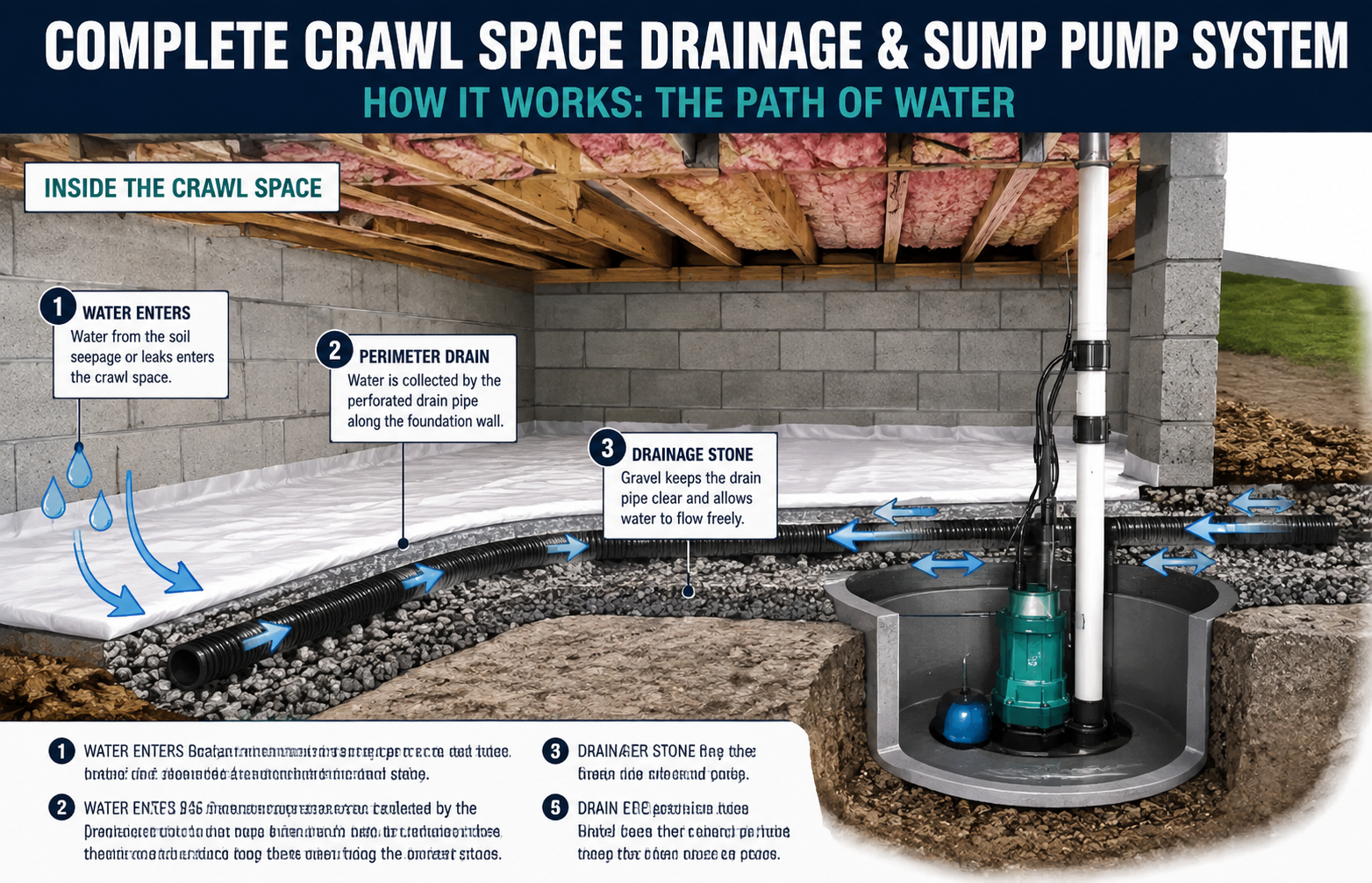
1. Reduce Surface Water
Clean gutters, functional downspouts and positive grading can reduce the amount of stormwater that reaches foundation soils.
2. Collect Water
Foundation drains, interior perimeter drains or other approved drainage systems intercept water before it can spread throughout the crawl space.
3. Move Water to the Basin
The drainage path must maintain a usable route to the collection point. Poor pitch, sediment, crushed pipe or blocked outlets can reduce performance.
4. Pump When Gravity Is Not Enough
A sump pump activates as water rises in the basin and lifts the water into a discharge line.
5. Discharge Safely
The outlet must send water to an approved location without creating erosion, a nuisance, a freezing hazard or a short loop back toward the foundation.
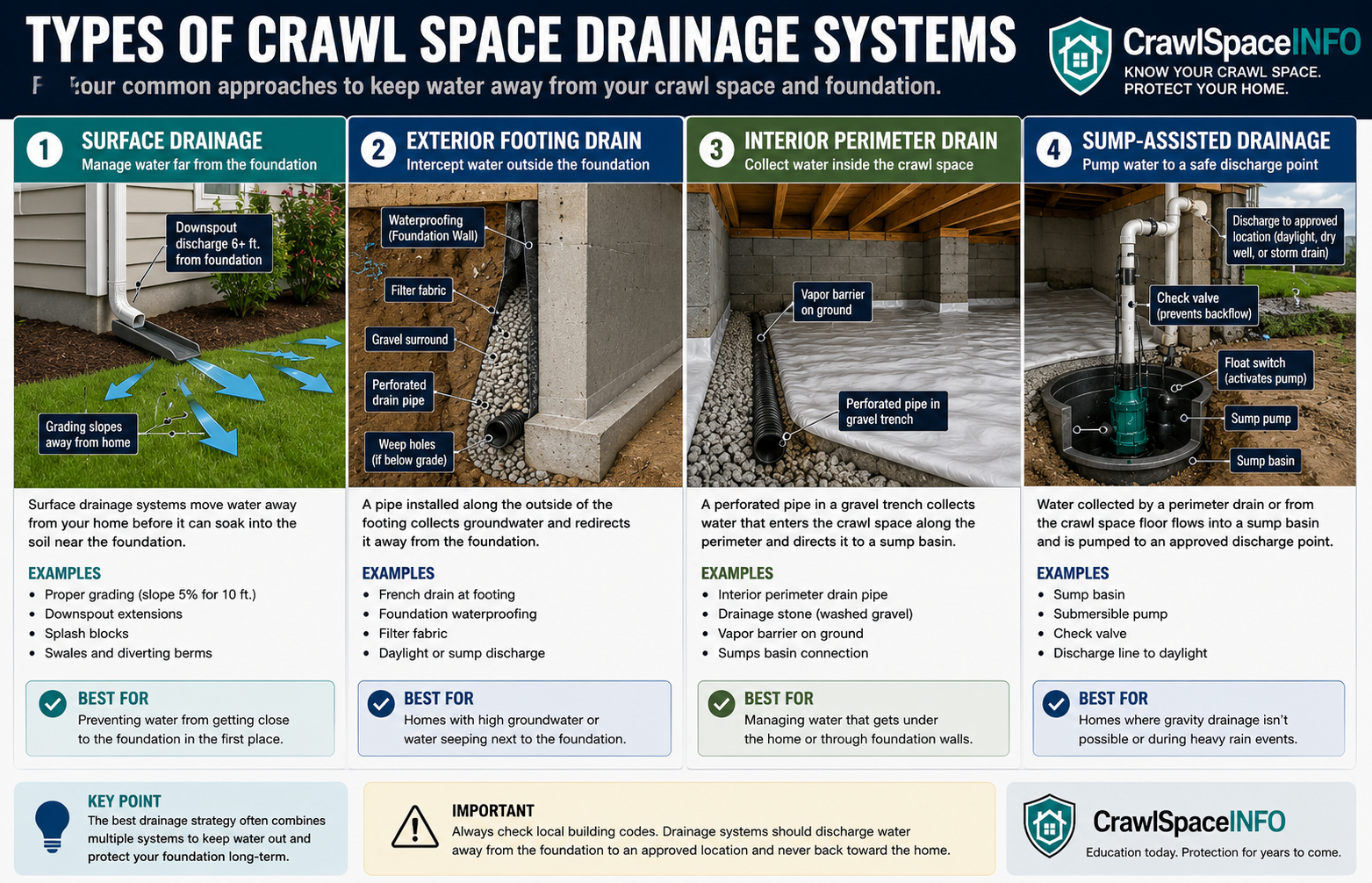
Types of Crawl Space Drainage Systems
| Approach | Primary Job | Common Use | Limitation |
|---|---|---|---|
| Surface drainage | Moves rainwater away from the home. | Roof runoff, poor grading, low areas beside foundation. | Does not necessarily solve groundwater. |
| Exterior foundation drain | Relieves water around below-grade foundation components. | New construction or accessible exterior excavation. | Retrofit excavation can be disruptive. |
| Interior perimeter drain | Collects seepage or groundwater at the interior perimeter. | Recurring crawl-space water where exterior work is impractical. | Manages water that has already reached the foundation area. |
| Gravity drain | Uses elevation to move collected water to an approved outlet. | Sites with a suitable lower discharge point. | Not possible on every property. |
| Sump system | Mechanically lifts collected water. | Low crawl spaces or sites without workable gravity drainage. | Depends on pump, power and discharge reliability. |
What Is a Crawl Space French Drain?
In crawl-space contracting, “French drain” often refers to an interior perimeter drainage trench containing a drainage medium and perforated pipe or a proprietary drainage channel. The system collects water near the foundation perimeter and routes it toward a sump basin or other approved outlet.
The term is used broadly, so homeowners should ask exactly what is being installed: pipe size and type, drainage medium, filtration strategy, location relative to the footing, flow path, cleanout access, basin connection and final discharge.
For applicable below-grade concrete or masonry foundations, the 2024 IRC requires foundation drainage in Section R405, with an exception for certain well-drained soils. It permits drainage by gravity or mechanical means into an approved drainage system. Local adoption and amendments vary, so the locally enforced code controls.
For a broader discussion, see our Crawl Space Waterproofing: Complete Homeowner Guide.
How Does a Crawl Space Sump Pump Work?
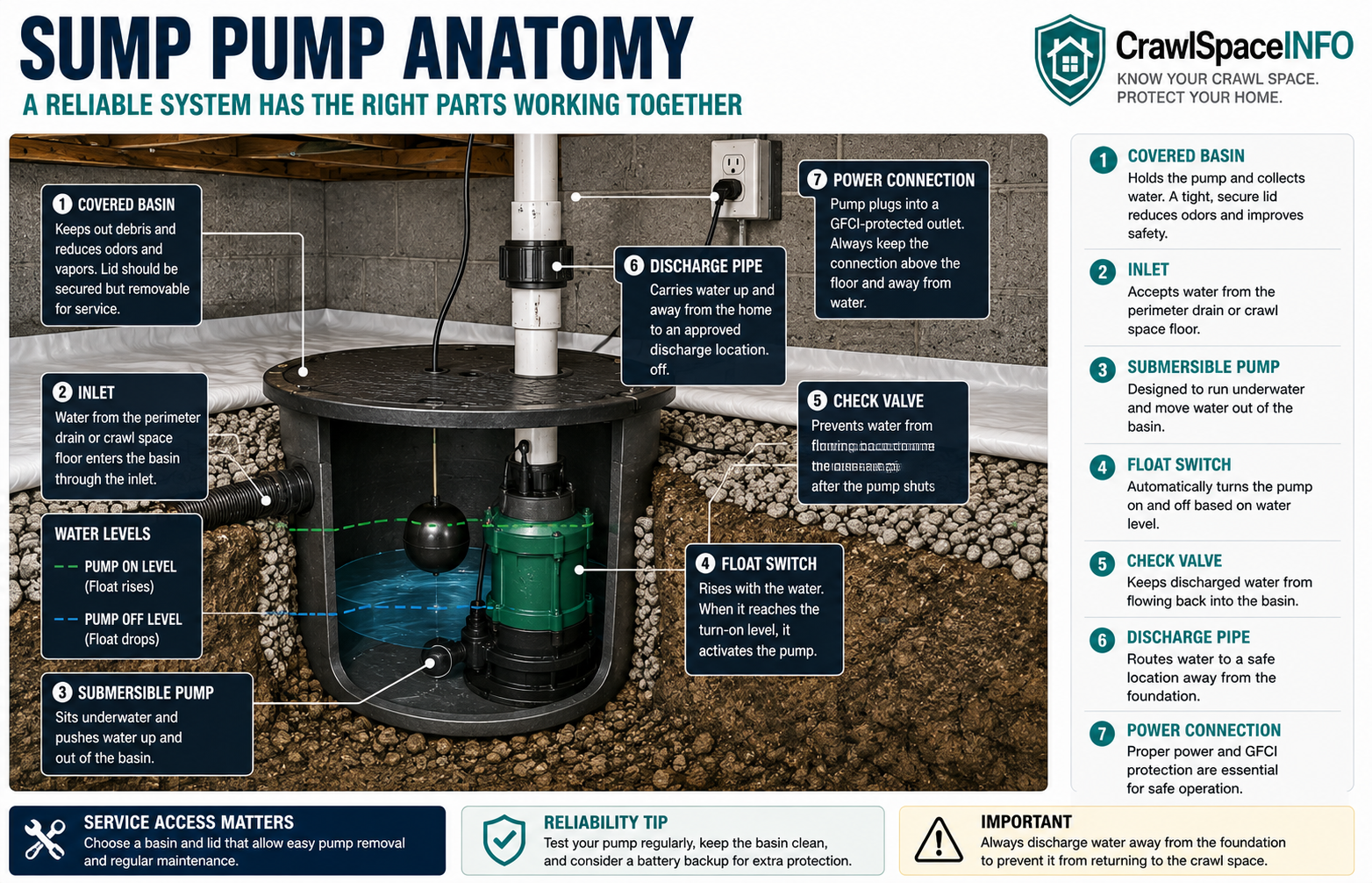
A sump pump sits in or above a basin installed at a low collection point. Water from perimeter drainage or surrounding soil enters the basin. As the water level rises, a float or electronic control activates the pump. The pump pushes water through discharge piping and away from the structure.
Sump Basin
The basin provides a collection point and allows the pump control to operate through its intended range. It should remain accessible for inspection and service.
Pump
The pump must be capable of handling expected flow and the vertical and horizontal demands of the discharge system. A larger horsepower rating alone does not guarantee a better installation.
Float or Water-Level Control
The control turns the pump on and off. It needs enough room to operate without snagging on the basin, piping or wiring.
Check Valve
The 2024 IRC storm-drainage provisions require an accessible full-flow check valve in sump discharge piping governed by those provisions. Always verify the locally adopted code and manufacturer instructions.
Discharge Pipe
The discharge line carries pumped water away from the house. Routing, elevation, freeze exposure and outlet location matter as much as the pump itself.
Submersible vs. Pedestal Sump Pumps
| Type | Configuration | Potential Advantages | Considerations |
|---|---|---|---|
| Submersible | Pump operates inside the sump basin. | Compact installation; commonly used with covered basins. | Requires basin space and service access. |
| Pedestal | Motor remains above the basin with pumping components below. | Motor is easier to access and stays out of the water. | Requires vertical clearance and may be less convenient in a low crawl space. |
The correct choice depends on basin dimensions, crawl-space height, expected water volume, required pumping head, solids-handling needs, noise considerations, serviceability and manufacturer specifications.
Does a Crawl Space Sump Pump Need Backup Protection?
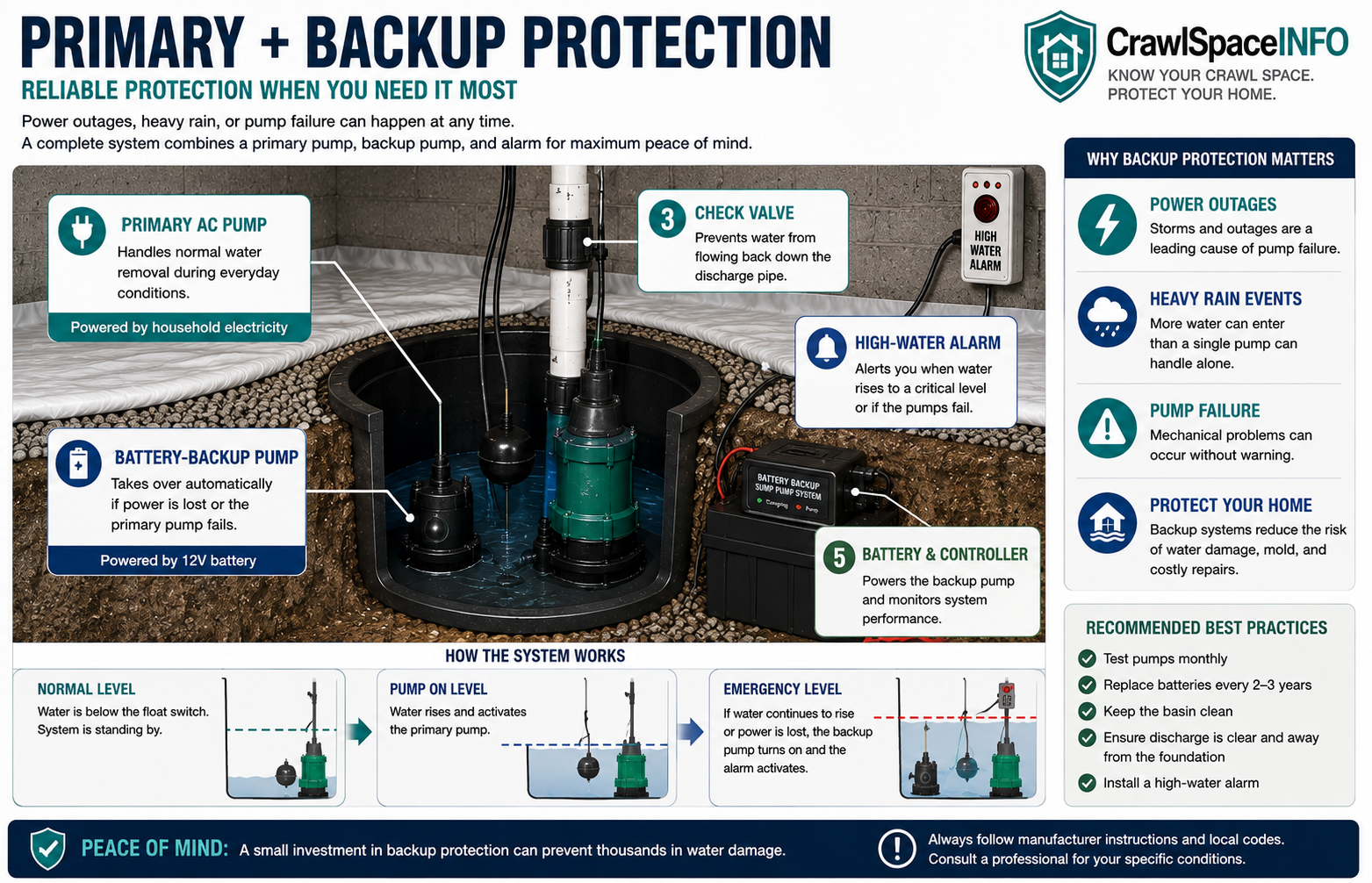
Backup protection deserves serious consideration when pump failure could allow rapid flooding. The primary pump can become unavailable because of a power outage, failed switch, blocked discharge, mechanical failure or water inflow that exceeds its capacity.
Battery Backup Pump
A separate battery-powered pump can provide temporary pumping during a power outage or primary-pump failure. Runtime and pumping capacity depend on the equipment, battery condition and water inflow.
Secondary Pump
Some high-risk installations use a second pump positioned to activate if the primary system cannot keep the water level under control.
High-Water Alarm
An alarm does not remove water, but it can warn that the basin has reached an abnormal level. Remote notification can be useful when the property is unoccupied.
Where Should a Sump Pump Discharge?
The discharge location is a critical part of the drainage design. Pumping water out of the crawl space only to release it beside the same foundation can create a cycle in which the water returns to the sump.
The appropriate outlet depends on site grading, property boundaries, soil, climate and locally approved stormwater or drainage locations. Building America guidance specifically warns against depositing sump outflow next to the foundation because that can recycle water back through the drainage system.
- Route water away from the foundation.
- Avoid creating erosion or standing water on neighboring property.
- Protect exposed piping from damage.
- Consider freezing conditions where applicable.
- Keep the outlet observable and maintainable when practical.
- Verify local rules before connecting to any sewer or storm system.
Do You Still Need a Vapor Barrier With Crawl Space Drainage?
Often, yes. Drainage and a sump pump control liquid water. Exposed soil can continue releasing moisture vapor even when no standing water is visible.
A ground vapor barrier reduces moisture migration from soil into the crawl-space air. In many crawl spaces, drainage addresses the bulk-water layer while the vapor barrier addresses the ground-vapor layer.
See our Crawl Space Vapor Barrier: Complete Homeowner Guide.
Drainage, Sump Pumps and Crawl Space Encapsulation
Encapsulation should not be treated as a substitute for correcting active bulk-water problems. If a crawl space experiences recurring groundwater or stormwater entry, drainage and pumping may need to be addressed before or as part of the encapsulation project.
Once bulk water is controlled, a sealed liner, air sealing and an appropriate humidity-control strategy can create a more stable crawl-space environment.
See our Crawl Space Encapsulation: Complete Homeowner Guide and Crawl Space Dehumidifiers: Complete Buyer’s Guide.
How Much Do Crawl Space Drainage and Sump Pumps Cost?
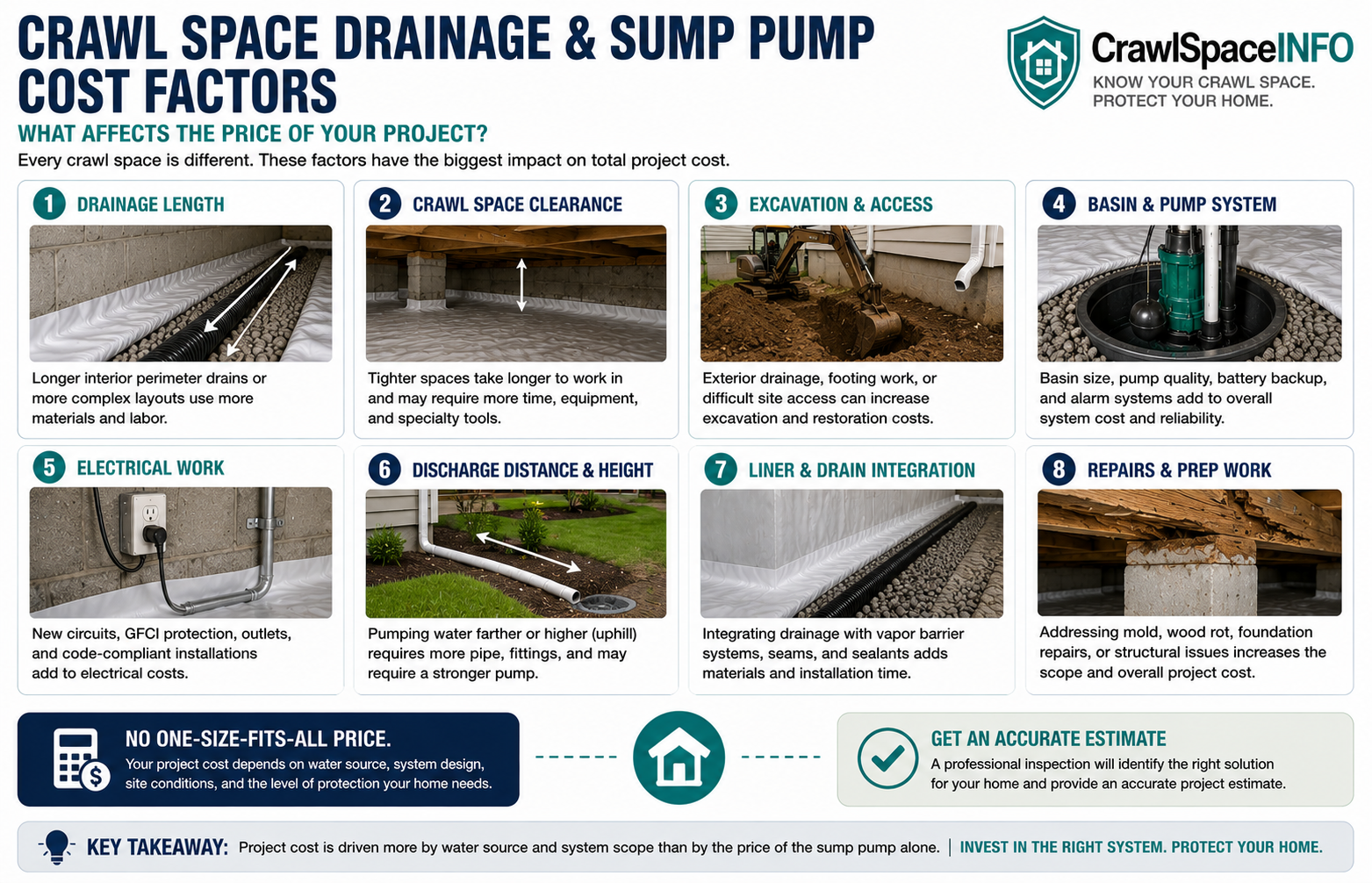
There is no reliable single price because “crawl space drainage” can mean a small exterior correction, a sump replacement, a full interior perimeter drain, or a combined waterproofing and encapsulation project.
| Cost Driver | Why It Matters |
|---|---|
| Drainage length | Longer perimeter systems require more excavation, pipe/channel and aggregate. |
| Crawl-space access | Low clearance and difficult entry increase labor. |
| Soil and excavation | Hard soil, rock, mud and obstructions can slow installation. |
| Sump configuration | Basin, primary pump, secondary pump, battery backup and alarm change scope. |
| Electrical work | A safe, code-compliant power supply may require an electrician. |
| Discharge route | Long runs, elevation, trenching, freeze protection and outlet work add complexity. |
| Waterproofing / liner work | Drainage may be one part of a larger moisture-control project. |
| Repairs and cleanup | Damaged insulation, mold, wood deterioration or contaminated water are separate scopes. |
DIY Crawl Space Drainage vs. Professional Installation
Homeowner Tasks That May Be Reasonable
- Cleaning gutters
- Extending downspouts where appropriate
- Observing where water appears during rain
- Checking an accessible discharge outlet
- Testing an existing pump according to manufacturer instructions
- Using a humidity monitor to track conditions
Professional Help Is Usually Better For
- Recurring standing water or groundwater
- Interior perimeter drain installation
- Excavation around footings or foundations
- Sump basin installation
- New electrical circuits or unsafe wiring
- Complex discharge routing
- Structural cracking or movement
- Sewage or contaminated floodwater
- Water problems beneath an existing encapsulation system
Excavating beside or below foundation components without understanding the structure can create serious problems. Drainage design should not undermine footings or destabilize soil supporting the home.
Common Crawl Space Drainage and Sump Pump Mistakes
Installing a Pump Without Fixing the Water Path
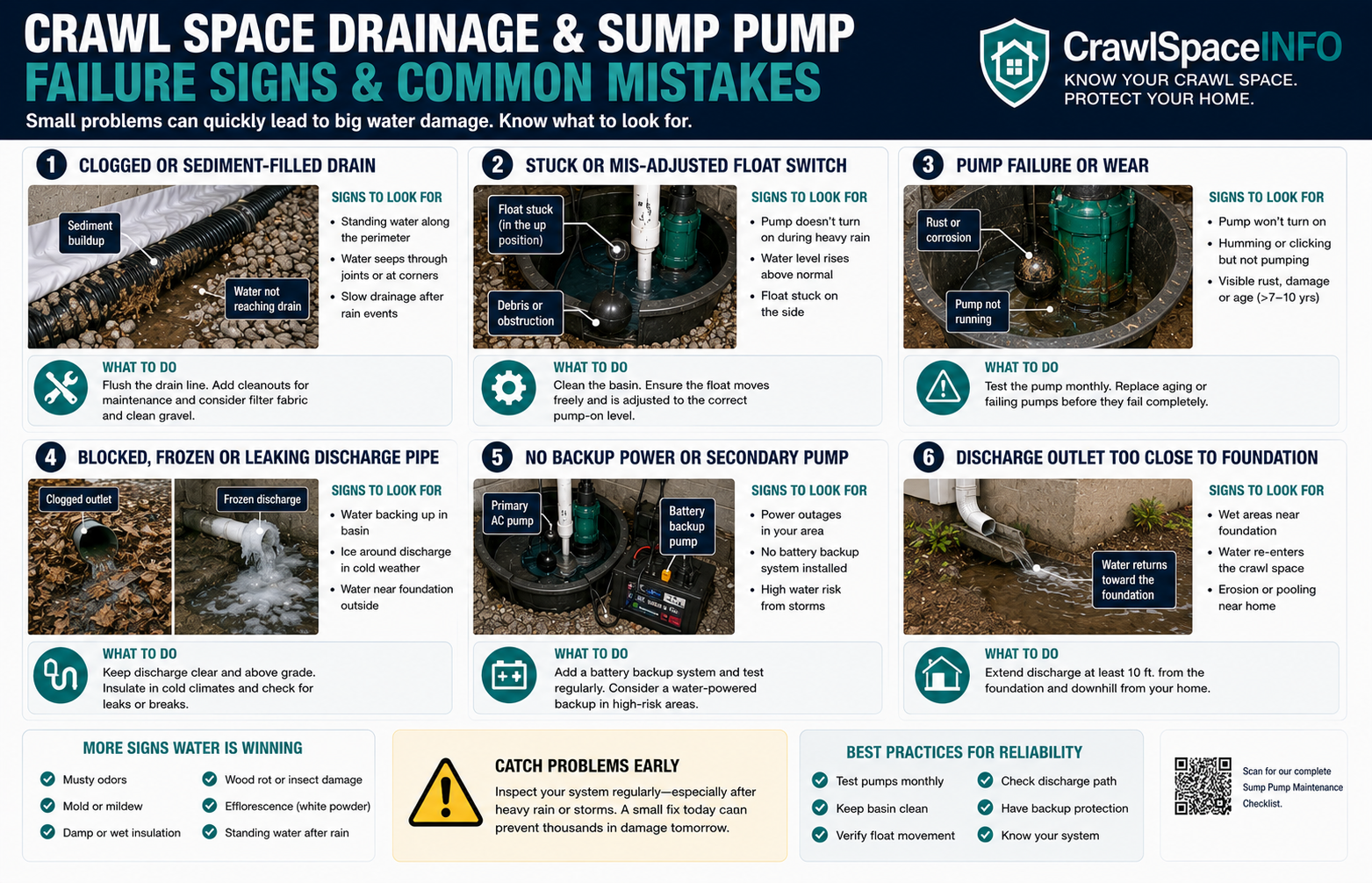
A pump can remove water from its basin only after the water reaches it. Puddles elsewhere may remain if the crawl space has no effective collection path.
Ignoring Gutters and Grading
Interior drainage should not be an excuse to direct avoidable roof and surface water toward the foundation.
Using the Wrong Pump for the System
Pump selection should consider expected flow, vertical lift, discharge friction and the manufacturer’s performance curve—not horsepower alone.
Allowing the Float to Obstruct
A float that catches on piping, wiring or the basin wall may prevent the pump from starting or stopping correctly.
Poor Discharge Location
Water released too close to the home may infiltrate the same foundation soils and return.
No Plan for Power Failure
If the worst water events occur during storms, the same event may also interrupt electrical service.
Covering Problems With a Liner
A vapor barrier or encapsulation liner can hide drainage problems if bulk water is not addressed first.
Crawl Space Drainage and Sump Pump Maintenance
A drainage system should be inspected periodically and after unusually heavy storms. Manufacturer instructions should govern pump-specific service.
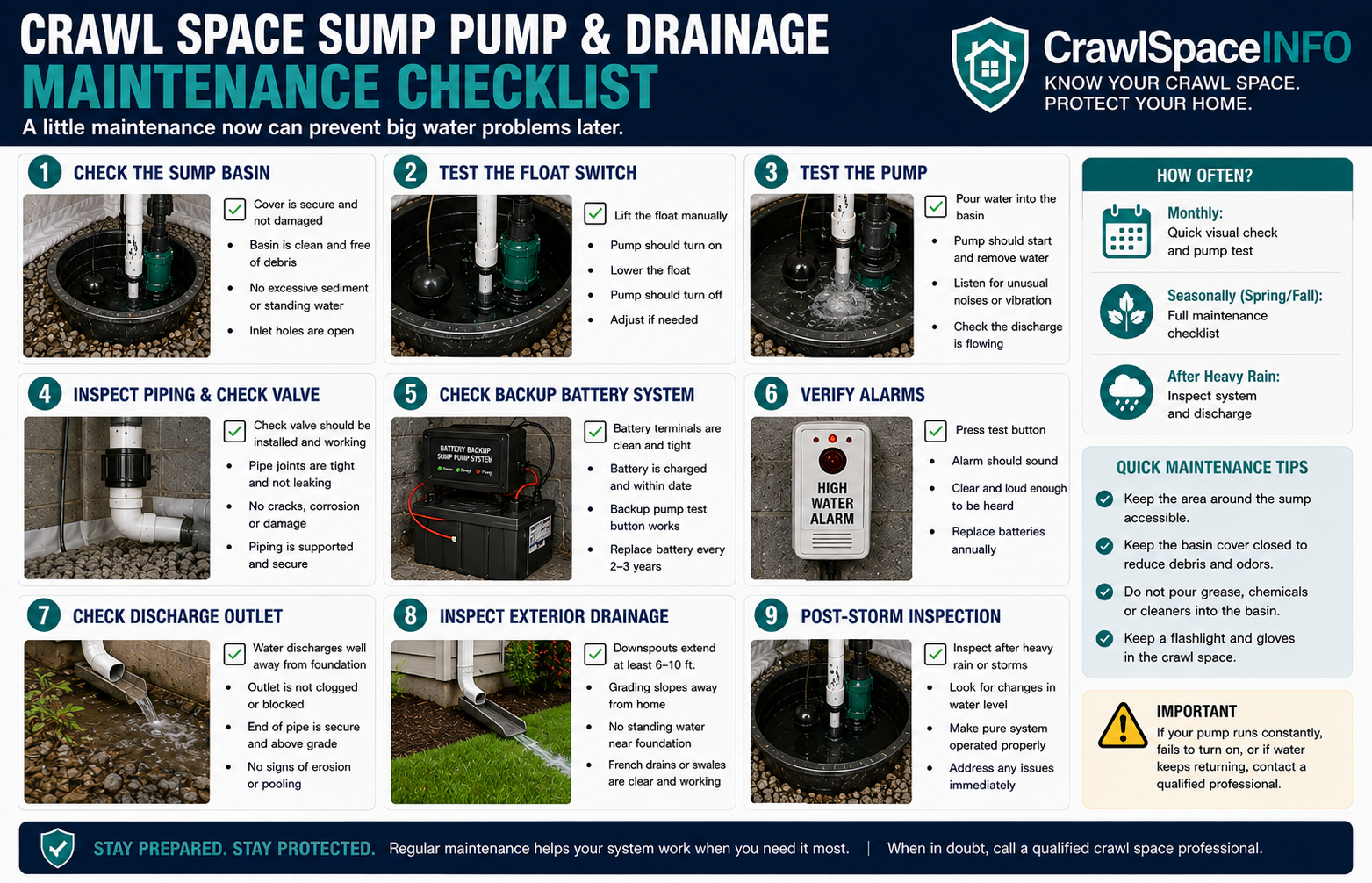
- Check the basin for unusual sediment or debris.
- Confirm the float or level control moves freely.
- Test pump operation according to manufacturer guidance.
- Listen for unusual cycling, vibration or noise.
- Inspect visible discharge piping for leaks or damage.
- Confirm the exterior outlet is open and not directing water back toward the home.
- Test high-water alarms.
- Check backup batteries and secondary pumps according to their instructions.
- Inspect the crawl space for new puddles, staining or erosion.
- Check gutters, downspouts and grading after major storms or landscaping changes.
Crawl Space Drainage & Sump Pump FAQs
Does every crawl space need a sump pump?
No. Some crawl spaces have no recurring bulk-water problem, and some drainage systems can discharge by gravity. A sump pump is useful when collected water must be mechanically lifted to an appropriate discharge point.
Will a sump pump keep my crawl space dry?
It can remove water that reaches the sump basin, but it does not automatically correct roof runoff, grading, plumbing leaks, foundation seepage away from the collection system, soil vapor or high airborne humidity.
What is the difference between a French drain and a sump pump?
A perimeter or French drain collects and routes water. A sump pump mechanically removes water from a collection basin. They are often used together.
Can a sump pump drain outside?
Yes, where the discharge location and routing comply with local requirements. The outlet should not simply return water to the foundation or create a hazard or nuisance.
Should a sump pump have a battery backup?
Backup protection is especially worth considering when a power outage or primary-pump failure could cause significant flooding. The appropriate backup depends on expected inflow and risk.
Why is my sump pump running constantly?
Possible causes include heavy groundwater inflow, a stuck or poorly positioned switch, an undersized system, discharge water returning toward the foundation, a failed check valve, or another drainage problem. Continuous operation should be investigated rather than assumed normal.
Why is there still water in my crawl space when the sump pump works?
The water may not have an effective path to the basin, the crawl-space floor may contain low areas, the drain may be blocked, inflow may exceed capacity, or the water may come from a separate leak or source.
Do I need a vapor barrier if I have a sump pump?
Often yes. A sump pump controls collected liquid water, while a ground vapor barrier reduces moisture vapor released from exposed soil.
Should drainage be installed before encapsulation?
Recurring bulk-water problems should generally be diagnosed and controlled before they are hidden beneath a sealed liner. In wet crawl spaces, drainage may be integrated into the encapsulation project.
Final Takeaway
A crawl space sump pump is only one component of water management. Reliable drainage begins with identifying where the water comes from, reducing avoidable exterior water, creating a dependable collection path, selecting a pump that matches the system, and sending the discharge to an appropriate location. After bulk water is controlled, vapor barriers, encapsulation and dehumidification can address the remaining moisture layers.
Not Sure Which Water-Control Step Comes First?
Use the free CrawlSpaceInfo assessment to organize your symptoms before comparing drainage, sump pump, vapor-barrier or encapsulation options.
Related Crawl Space Guides
Sources & Technical References
- International Code Council — 2024 International Residential Code, Chapter 4, including R401.3 and R405, plus applicable local amendments.
- International Code Council — 2024 IRC storm-drainage provisions for sumps and pumping systems, where applicable.
- U.S. Department of Energy Building America Solution Center — Drain or Sump Pump Installed in Basements or Crawlspaces; Footing Drain Pipe; crawl-space retrofit assessment guidance.
- U.S. Environmental Protection Agency — moisture and mold guidance for crawl spaces.
- Equipment-specific installation, maintenance and performance requirements should be verified against the sump-pump manufacturer’s current instructions and locally adopted electrical/plumbing requirements.