

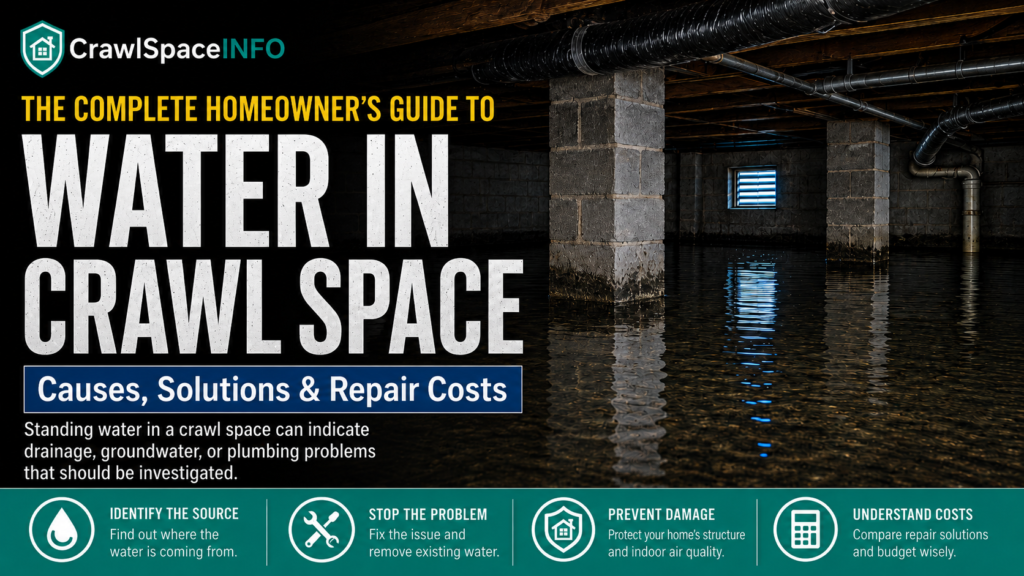
Found water under your house? Use this guide to narrow down where it may be coming from, how serious it may be, what to do next, and which repairs actually match the cause.
Quick Answer
Water in a crawl space is a symptom, not a diagnosis. If it appears mainly after rain, start with gutters, downspouts, grading, and exterior drainage. If it stays wet during dry weather, consider plumbing or mechanical leaks. If water appears seasonally from the soil, groundwater may be involved. Remove standing water safely, but do not choose encapsulation, a dehumidifier, or another system until the bulk-water source is understood. If water is near electrical equipment, sewage is involved, or structural damage is visible, stay out of the crawl space and call a qualified professional.
Found Water but Don’t Know the Cause?
Answer a few questions about when the water appears, how much you see, and what other symptoms are present. The free assessment helps you organize severity, likely next steps, and cost considerations before you choose a repair.
Start Here: What Are You Seeing?
The pattern often gives the first clue. Choose the situation that looks most like yours, or use the assessment if you are not sure.
Important: If standing water may be in contact with electrical equipment, sewage is present, or the structure appears unsafe, do not enter the crawl space.
Check My Crawl SpaceWhat Does Water in a Crawl Space Mean?
Water in a crawl space can range from damp soil and isolated puddles to several inches of standing water. The amount matters, but the pattern matters even more. Water that appears only after storms points toward roof runoff, grading, or drainage. Water that persists during dry weather raises different possibilities, including a plumbing leak or groundwater.
A crawl space is part of the building enclosure, not an area that can simply be ignored because it is out of sight. Persistent moisture can affect wood framing, insulation, fasteners, ducts, equipment, pests, odors, and humidity conditions. The goal is therefore not merely to pump out visible water. It is to identify how the water entered, correct that pathway, dry affected materials, and then control ongoing moisture.
Is Water in a Crawl Space Normal?
A crawl space does not need to be perfectly dry every minute of the year, but recurring standing water is not a condition to accept as normal. A small damp area immediately after an extreme storm may disappear without damage, yet repeated puddling, saturated soil, water marks, or consistently elevated humidity indicate that the moisture load is exceeding the crawl space’s ability to dry.
Why Water in a Crawl Space Can Become a Serious Problem
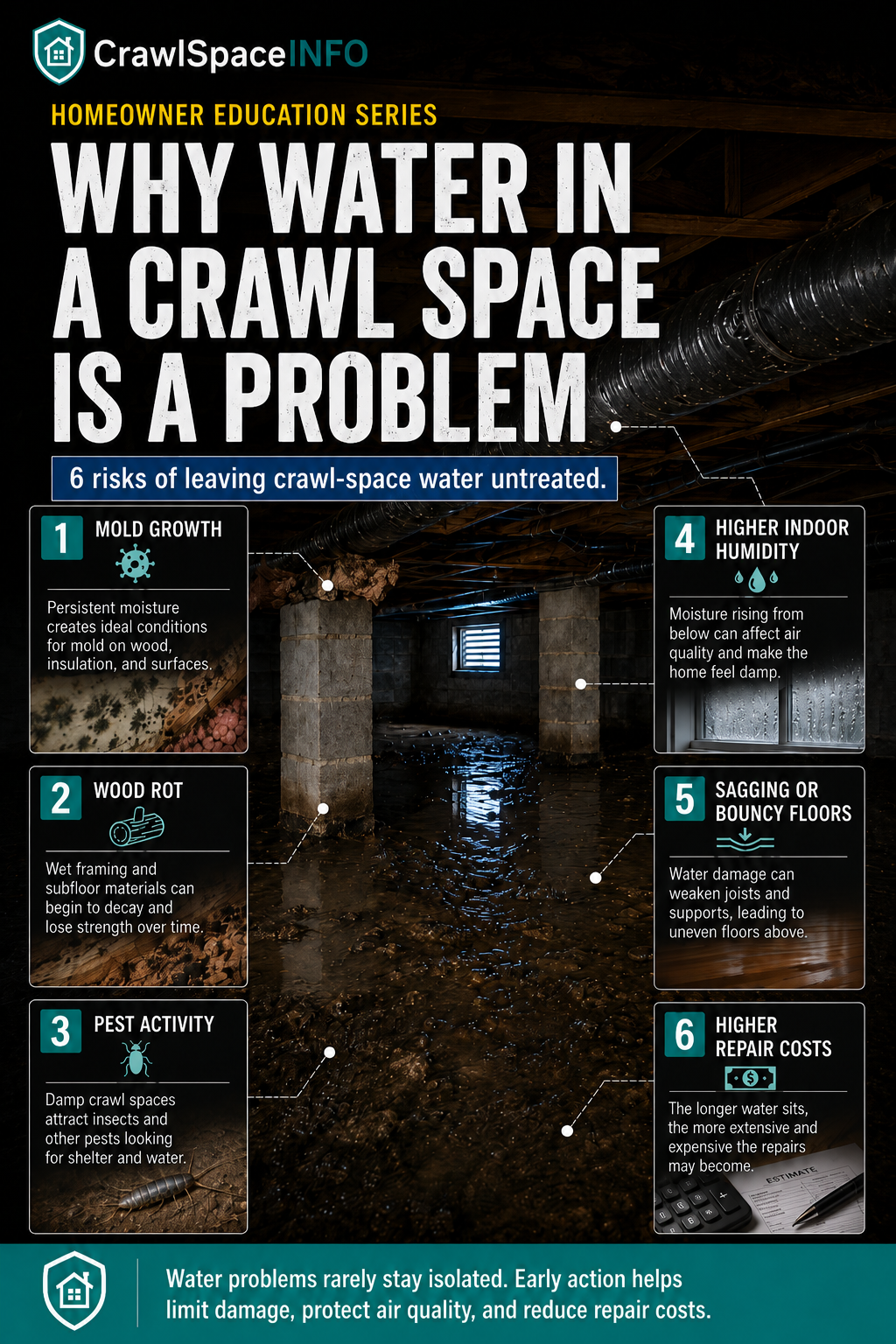
Water itself is only the beginning of the problem. Persistent moisture changes the environment beneath the house and can create conditions favorable to mold, fungal decay, corrosion, pests, and deterioration of insulation and finishes.
Moisture can also move from the crawl space toward the living space through air leakage and vapor movement. A wet crawl space may therefore contribute to musty odors and elevated indoor humidity even when no water is visible upstairs.
Mold and Microbial Growth
Mold requires moisture. When wood, paper-faced products, insulation debris, or stored organic materials remain damp, mold can colonize suitable surfaces. Visible growth is not the only clue; persistent musty odors can indicate a moisture problem even before a homeowner sees obvious colonies.
The durable solution is moisture control. Cleaning visible growth without fixing the water source allows the conditions that supported growth to remain.
Wood Rot and Structural Deterioration
Wood framing can tolerate short wetting events if it dries, but repeated or prolonged wetting increases the risk of fungal decay. Floor joists, beams, sill or rim areas, subflooring, and wood posts are especially important because they carry loads.
Soft wood, crumbling fibers, extensive staining, sagging floors, or movement should be evaluated by a qualified professional. Moisture correction and structural repair are separate tasks: stopping the water prevents additional damage, while compromised framing may still need reinforcement or replacement.
Pests, Corrosion, and Damaged Insulation
Damp crawl spaces are attractive to many insects and can support conditions favorable to termites, carpenter ants, cockroaches, and other pests. Metal hangers, fasteners, supports, and HVAC components may corrode in persistently humid conditions.
Fiberglass insulation can sag or fall when it becomes wet or when high humidity persists. Once insulation is contaminated, compressed, or damaged, replacement may be more practical than attempting to restore it.
Signs You May Have Water in Your Crawl Space
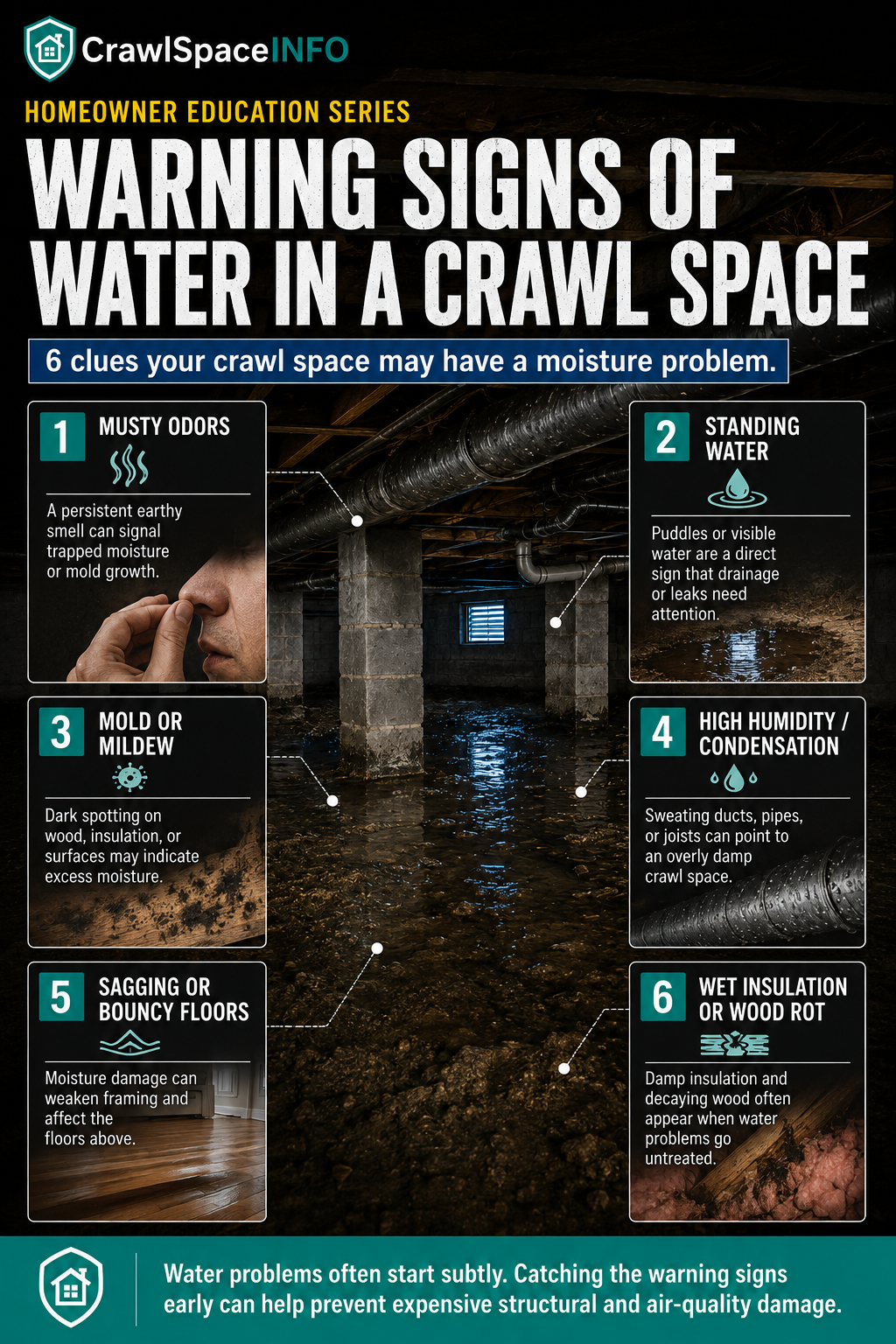
Homeowners often discover a crawl-space water problem indirectly. Warning signs include persistent musty odors, visible puddles, muddy or saturated soil, water stains or mineral deposits on masonry, wet or fallen insulation, condensation on ducts or pipes, mold-like growth, rust, pest activity, soft or bouncy floors, and unusually high indoor humidity.
One symptom alone does not identify the source. Several symptoms occurring together—especially after rain—make an inspection more urgent.
What Causes Water in a Crawl Space?
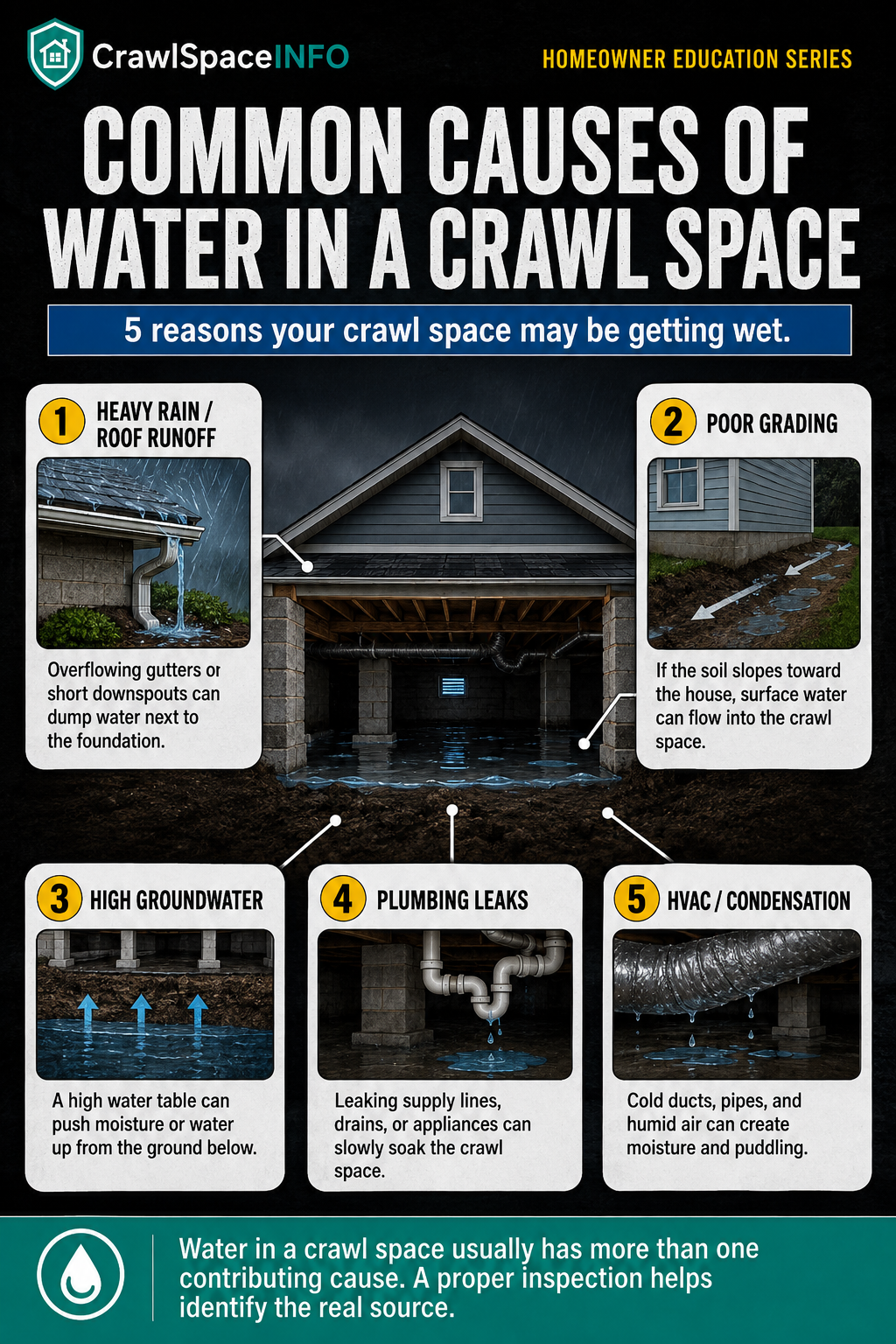
The most important diagnostic question is not “How do I dry this?” but “Where is the water coming from?” Installing the wrong system can be expensive and may leave the underlying problem untouched. Several sources can also occur at the same house.
1. Heavy Rain and Surface Runoff
During heavy rain, large volumes of water fall on the roof and the ground surrounding the home. If that water is not carried away efficiently, soil beside the foundation can become saturated and water can enter through openings, masonry, joints, or the crawl-space floor.
If the crawl space is usually dry but becomes wet after storms, start the investigation outside.
2. Poor Yard Grading
The soil around the home should encourage water to move away from the foundation. Settlement, landscaping changes, flower beds, patios, or poor original grading can create low areas that direct runoff back toward the house.
Look for puddles beside the foundation, erosion channels, depressions, and soil that visibly slopes toward the crawl space.
3. Gutters and Downspouts
A roof concentrates rainfall into gutters and downspouts. When gutters overflow or downspouts discharge beside the foundation, a large amount of water can be delivered to exactly the area you want to keep dry.
Clean blocked gutters, repair leaks, and route downspout discharge to a safe location away from the foundation while respecting local drainage rules and neighboring properties.
4. Groundwater and a High Water Table
Some crawl spaces become wet because water rises through the soil rather than entering from the sides. Seasonal groundwater can make the crawl-space floor wet even when gutters and grading are functioning properly.
Recurring groundwater problems often require a collection and discharge system, commonly an interior perimeter drain connected to a sump basin and pump. The design should account for where pumped water can legally and safely discharge.
5. Plumbing Leaks
Supply pipes, drain lines, fixtures above the crawl space, water heaters, and other plumbing can leak. A plumbing source is especially important to consider when the crawl space remains wet during extended dry weather.
Check the area directly below kitchens, bathrooms, laundry rooms, and mechanical equipment. An unexplained increase in water use can also justify a plumbing inspection.
6. HVAC Condensate and Duct Condensation
Air-conditioning equipment removes moisture from air and must drain that condensate correctly. A blocked, disconnected, or poorly routed condensate line can release water into the crawl space.
Separate from a drain leak, humid air can condense on cold ducts, refrigerant lines, or pipes. Condensation usually points to a humidity and air-sealing problem rather than bulk rainwater intrusion.
7. Foundation Openings, Cracks, and Penetrations
Water can exploit gaps around utility penetrations, access doors, vents, masonry joints, and cracks. Sealing an obvious opening can be part of the repair, but it should not be used to mask water pressure or drainage problems outside the foundation.
Water in Crawl Space After Heavy Rain
If your crawl space is dry during normal weather and wet after heavy rain, the timing is valuable evidence. Inspect gutters while it is raining if it is safe to do so, note where downspouts discharge, photograph exterior puddling, and look for water paths or fresh sediment inside the crawl space.
How to Find the Source of Water
Use a source-first inspection. Start outside because many of the least expensive fixes are there. Then inspect the crawl space only if conditions are safe.
Step 1: Record the Timing
Write down whether the water appears during rain, shortly after rain, seasonally, or even during dry weather. Note how long it takes to disappear. Photos taken from the same locations after different storms can reveal patterns that are easy to miss.
Step 2: Walk the Exterior
Inspect roof drainage, gutter overflow, downspout outlets, low spots, grading, patios, driveways, window wells where applicable, drainage swales, and visible foundation openings. Look for staining or erosion that shows where water repeatedly travels.
Step 3: Inspect the Crawl Space Safely
For a routine dry-enough inspection, use good lighting and appropriate protective equipment. Photograph water lines, wet areas, stains, insulation, pipes, ducts, foundation walls, and structural components.
Step 4: Trace the Wettest Area
Water follows gravity but can travel along framing, pipes, liners, and soil. The deepest puddle is not always the entry point. Compare the wettest areas with exterior conditions and plumbing locations above.
Step 5: Rule Out Plumbing and Mechanical Sources
If water continues during dry weather, plumbing and HVAC sources move higher on the list. A plumber or HVAC technician can isolate leaks that are difficult to confirm visually.
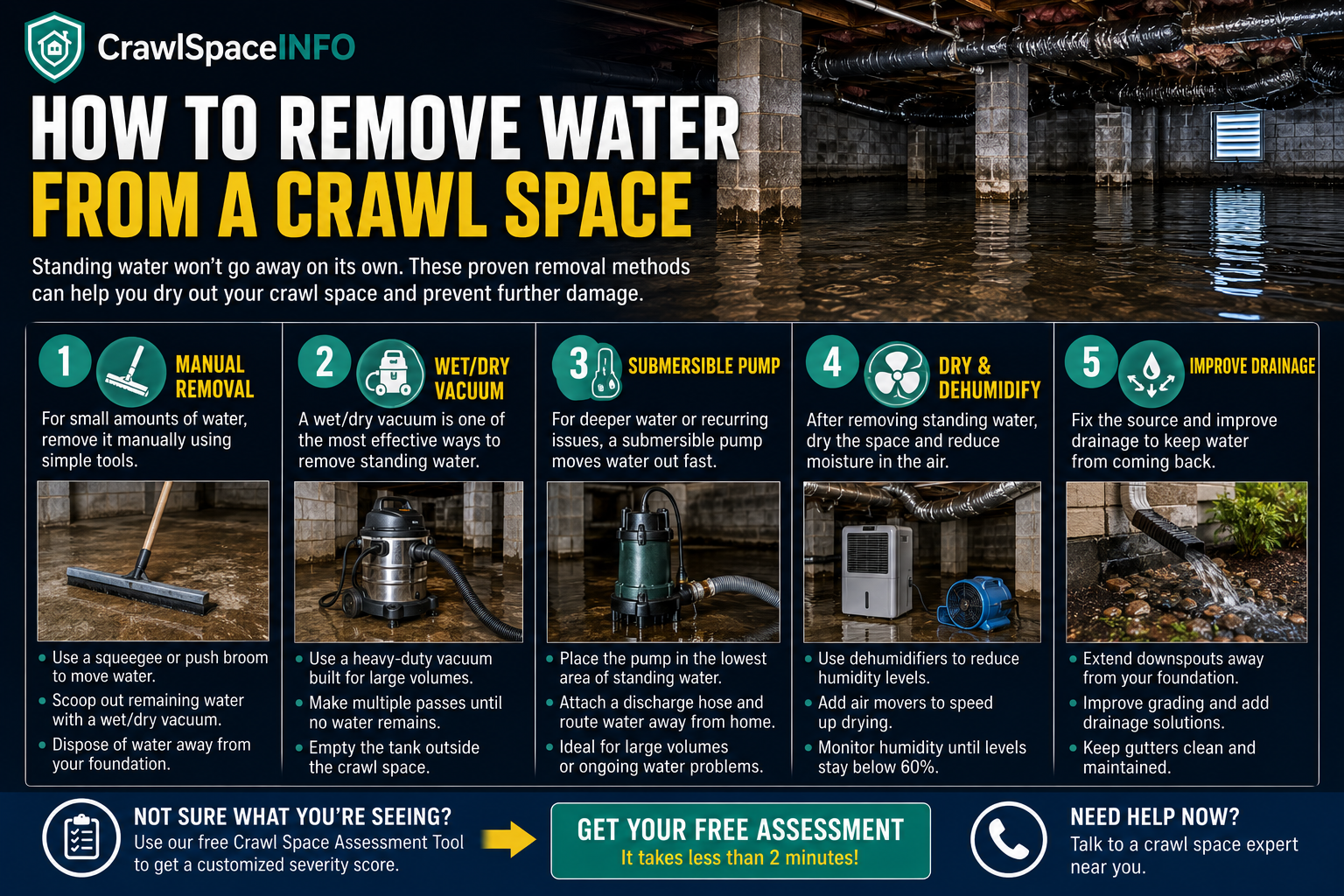
How to Remove Water from a Crawl Space
Removing standing water is an emergency response, not a complete repair. After extraction, the crawl space still needs to be dried and the source corrected.
Small Amounts of Water
For isolated clean-water puddles in a safe crawl space, a wet/dry vacuum or small utility pump may be sufficient. Remove soaked debris and wet insulation that cannot be effectively dried.
Moderate or Severe Flooding
Several inches of water, recurring flooding, contaminated water, or water around electrical and mechanical equipment warrants professional help. Water-removal contractors can use pumps, extraction equipment, air movers, and dehumidification while monitoring moisture in building materials.
If the water may contain sewage, fuel, pesticides, or other contaminants, treat the situation as a contamination problem rather than a simple drying project.
Drying After the Water Is Gone
Visible water can disappear while wood and masonry remain wet. Drying may require dehumidification, controlled air movement, removal of wet insulation, and moisture measurements over time.
A crawl space should not be encapsulated over actively wet materials or before the bulk-water source is controlled.
Permanent Solutions for Water in a Crawl Space
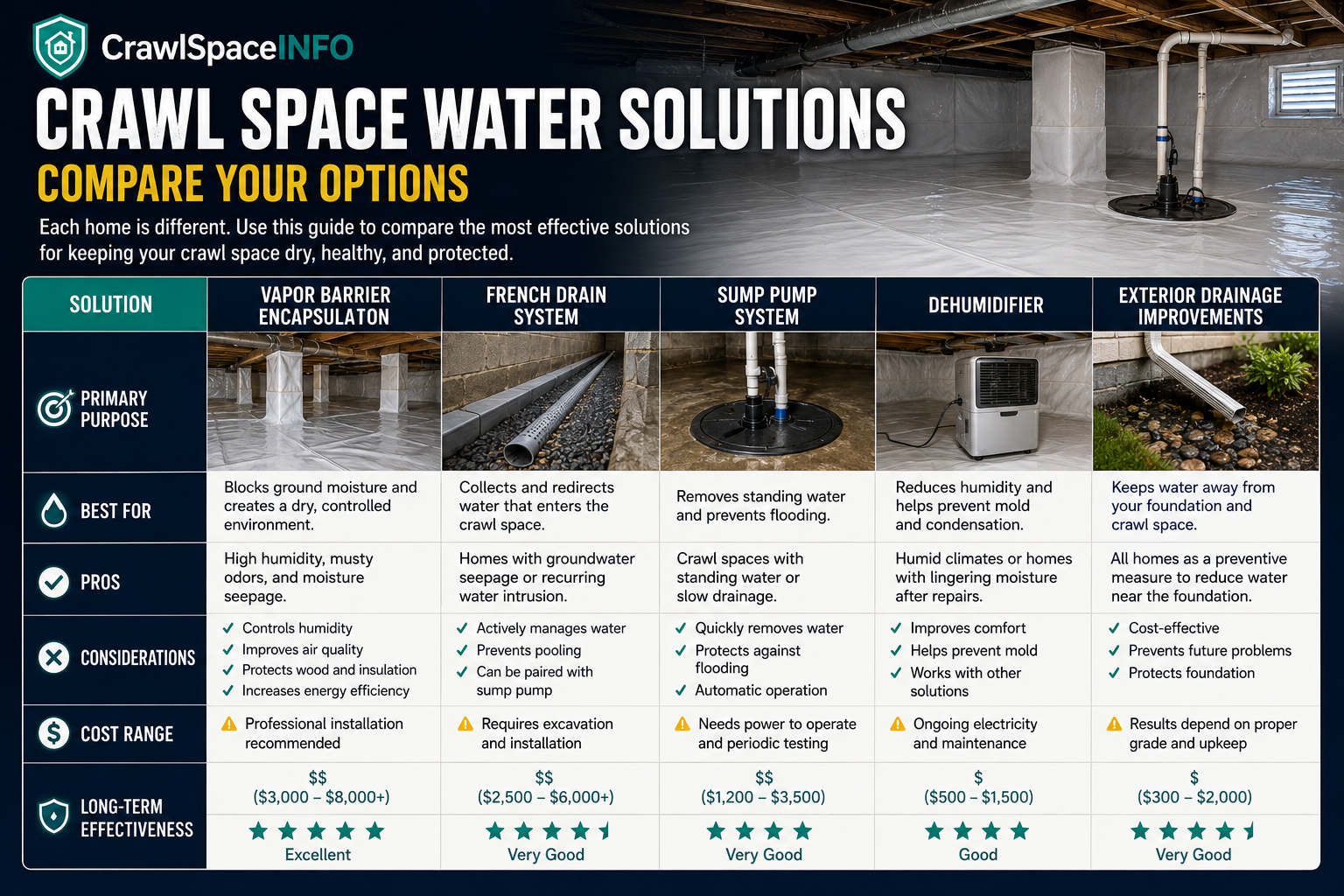
There is no single “best” crawl-space water solution. The best system is the one matched to the source. In some homes, several measures work together.
Improve Gutters, Downspouts, and Grading
For roof runoff and surface water, exterior corrections are often the logical first step. Clean and repair gutters, extend or properly connect downspouts, correct low spots, and restore positive drainage away from the home.
These improvements can be inexpensive compared with interior waterproofing and should not be skipped simply because a more elaborate system is available.
Interior Drainage and French Drains
An interior perimeter drain collects water that reaches the crawl-space perimeter and routes it to a sump basin or suitable gravity outlet. Contractors may loosely call these systems French drains, although construction details vary.
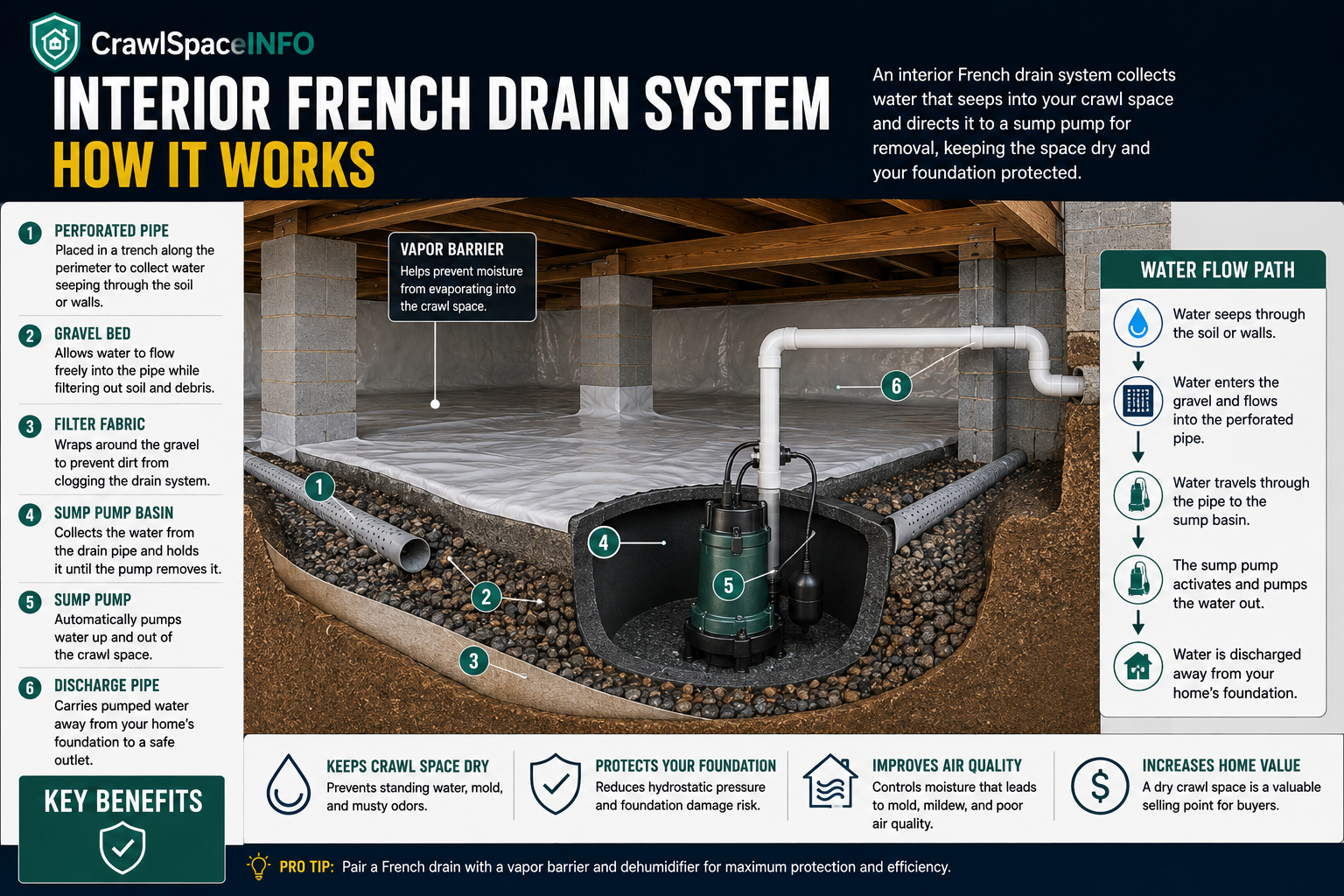
Interior drainage is commonly used for recurring groundwater or water entering along the foundation perimeter. It manages water after it reaches the foundation area; it does not replace sensible exterior drainage.
Sump Pumps
A sump pump removes water collected in a basin and discharges it away from the home. The system is only as reliable as its pump, power supply, discharge route, and maintenance.
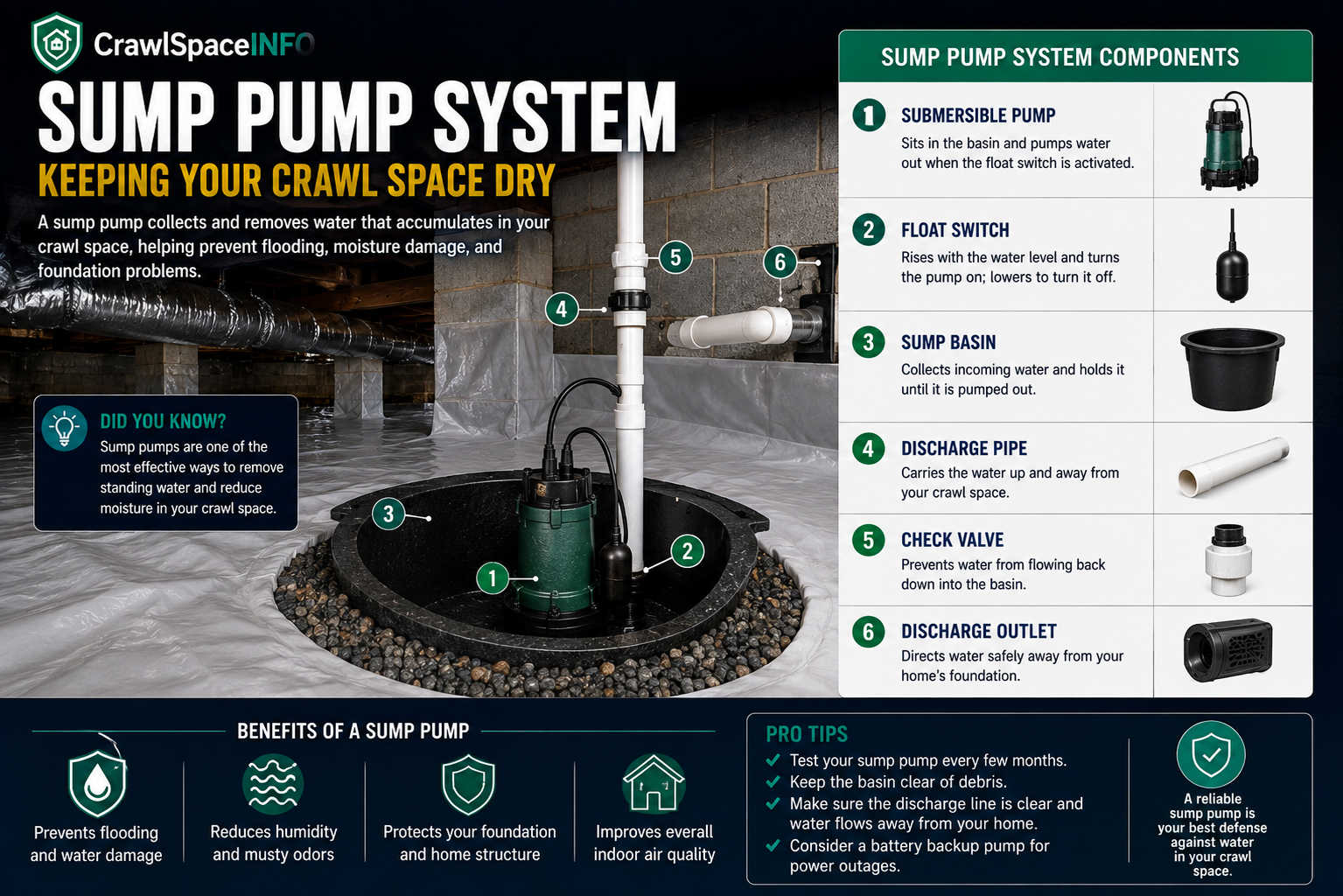
In homes where flooding would cause significant damage, a battery backup, secondary pump, or high-water alarm may provide additional protection. Discharge should not send water back toward the foundation.
Vapor Barriers
A ground vapor barrier reduces water vapor moving from exposed soil into the crawl-space air. It is valuable for moisture control but is not a drain.
If liquid water is flowing across the soil or rising from below, correct or collect that water before relying on a vapor barrier.
Crawl Space Encapsulation
Encapsulation creates a more controlled crawl-space environment by covering the ground and typically sealing the liner at walls, piers, and penetrations as part of a broader moisture-management strategy. Depending on the home and climate, the system may also involve air sealing, insulation changes, drainage, and dehumidification.
Encapsulation is not a substitute for repairing plumbing leaks or unmanaged bulk water. A well-designed system addresses drainage first and moisture control second.
Crawl Space Dehumidifiers
A dehumidifier removes moisture from crawl-space air. It can be extremely useful after bulk water is controlled, especially in a sealed or encapsulated crawl space.
A dehumidifier should not be expected to pump away standing water. If the unit is fighting an active leak or groundwater intrusion, fix the source first.
Which Repair Matches the Problem?
| Observed Pattern | Likely Direction | Common First Measures |
|---|---|---|
| Wet mainly after rain | Surface runoff / roof drainage | Gutters, downspouts, grading, exterior drainage |
| Wet seasonally from soil | Groundwater | Interior drainage and sump system evaluation |
| Wet during dry weather | Plumbing / mechanical leak | Plumber or HVAC inspection |
| No puddles but persistent high humidity | Vapor / humid air / condensation | Air sealing, vapor barrier, dehumidification as appropriate |
| Bulk water plus high humidity | Multiple sources | Drainage first, then encapsulation/moisture control |
Use the free assessment before comparing products or contractor estimates. It helps organize the symptoms, severity, and likely next-step path.
Water in Crawl Space Repair Cost
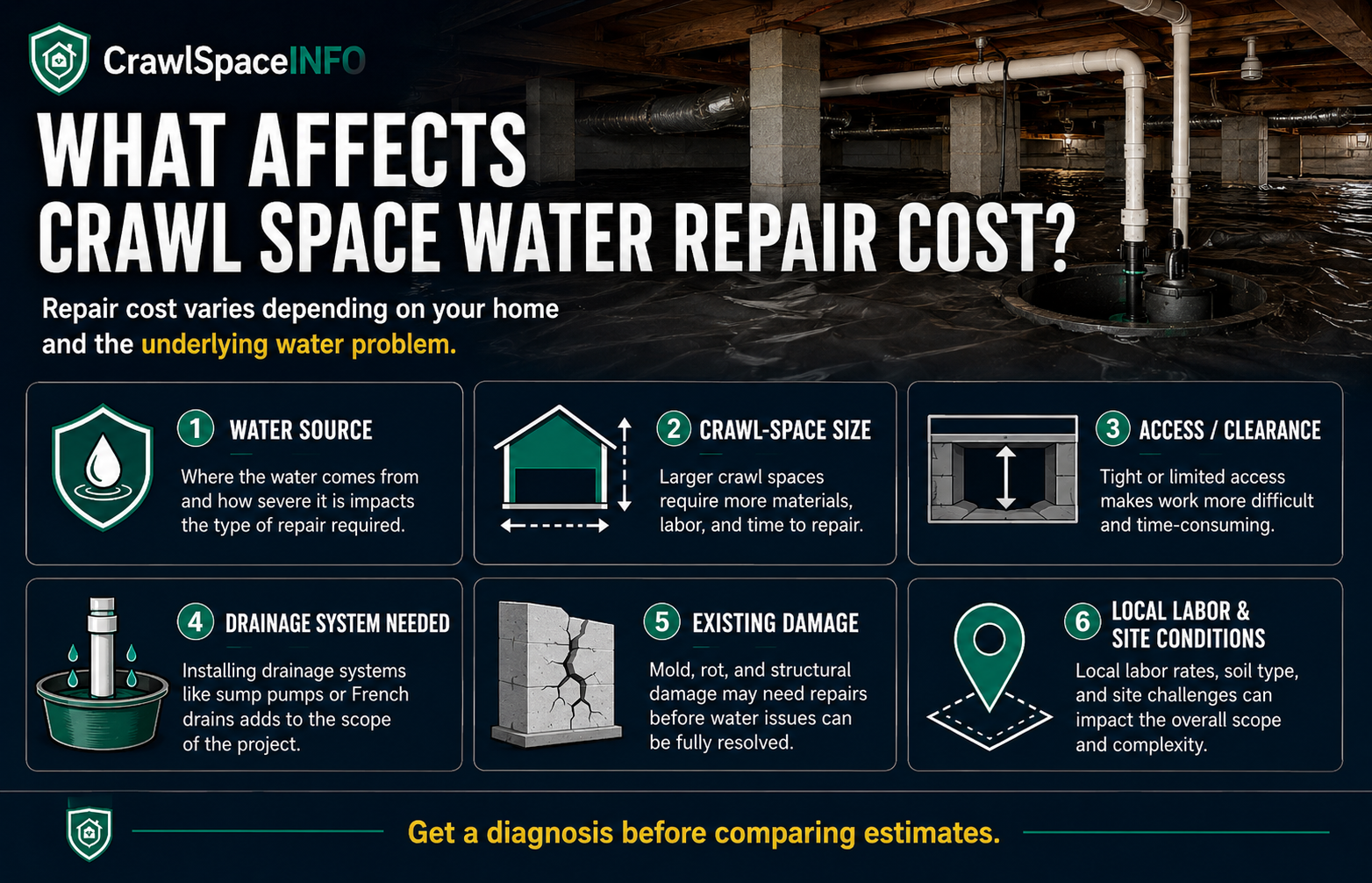
Repair cost depends on the cause, crawl-space size and access, local labor rates, system design, and whether mold or structural damage is already present. For that reason, a single national “average” can be misleading.
Use the ranges below as planning figures rather than quotes. Get written estimates based on your home before making a repair decision. If you are unsure which cost category applies, the free Crawl Space Assessment can help you organize the problem before you compare repair options.
| Repair / Improvement | Planning Range* |
|---|---|
| Gutter cleaning / minor downspout work | About $150–$500 |
| Minor grading / drainage corrections | About $500–$3,000+ |
| Plumbing repair | About $200–$2,000+ |
| Sump pump system | About $1,000–$3,500+ |
| Interior perimeter drainage | About $2,000–$8,000+ |
| Ground vapor barrier | About $1,200–$4,500+ |
| Crawl space encapsulation | About $5,000–$15,000+ |
| Crawl-space dehumidifier installed | About $1,200–$3,000+ |
| Mold remediation | About $1,500–$6,000+ |
| Structural wood repair | About $2,000–$15,000+ |
*Broad planning ranges only. Actual pricing varies significantly by location, home size, access, specifications, and damage.
What Makes the Repair More Expensive?
Larger crawl spaces require more material and labor. Low clearances and difficult access slow installation. Existing mold, damaged insulation, rotten framing, failed supports, or foundation movement add separate scopes of work. Drainage systems also become more expensive when discharge is difficult or backup protection is added.
The cheapest proposal is not necessarily the cheapest solution over time. Compare what each contractor believes is causing the water and exactly how the proposed work addresses that source.
DIY vs. Professional Repair
Homeowners can often handle routine gutter cleaning, simple downspout extensions, minor landscaping corrections, and basic observation. More complex work becomes appropriate for professionals when water is recurrent, the source is uncertain, groundwater is involved, electrical hazards exist, mold is extensive, or structural materials appear damaged.
A useful dividing line is consequence: if getting the diagnosis wrong could conceal a leak, worsen drainage, expose you to electrical or contamination hazards, or allow structural damage to continue, professional evaluation is justified.
When to Call a Professional Immediately
Depending on the cause, the appropriate professional may be a plumber, electrician, HVAC technician, drainage or waterproofing contractor, mold-remediation company, pest professional, structural contractor, or engineer.
How to Prevent Water from Returning
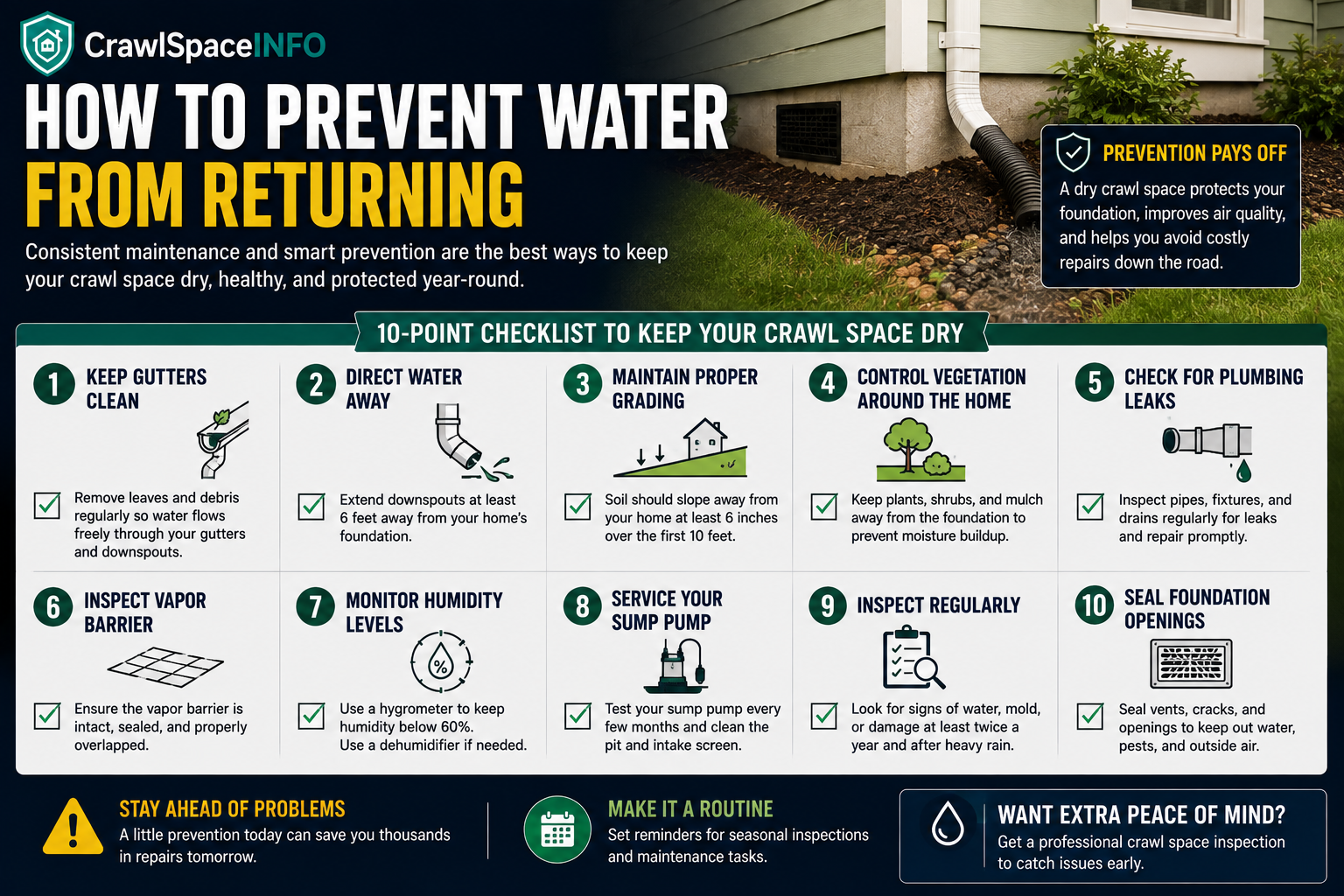
Prevention begins at the roofline and works downward. Keep gutters clear, verify downspouts discharge safely away from the foundation, maintain positive grading, avoid irrigation that saturates soil beside the house, and inspect crawl-space plumbing periodically.
After drainage is corrected, maintain the moisture-control system that fits your crawl space. That may include a ground vapor barrier, sealed or encapsulated construction, drainage, a sump pump, or dehumidification. Test pumps and alarms, keep discharge lines clear, and monitor humidity so changes are noticed early.
A Simple Homeowner Inspection Schedule
After major storms: look for exterior ponding, gutter overflow, and new crawl-space water if the area can be inspected safely.
Twice a year: clean gutters as needed, check downspouts and grading, inspect visible plumbing, and look for damaged insulation or pest activity.
Periodically in humid weather: check crawl-space relative humidity with a reliable hygrometer and investigate sustained high readings rather than relying only on odor.
Frequently Asked Questions
Is water in a crawl space normal?
Recurring standing water is not a condition to accept as normal. An isolated damp area after extreme weather may dry, but repeated water indicates a source that should be identified.
How long can water sit in a crawl space?
Remove standing water and begin drying as soon as it is safe. There is no universal countdown to damage, but prolonged wetting increases the likelihood of mold, corrosion, insulation damage, and wood deterioration.
Will water in my crawl space go away on its own?
It may evaporate or drain, but disappearance does not mean the cause is solved. If the water returns after storms or seasonally, the underlying drainage or groundwater problem remains.
Can a vapor barrier stop standing water?
No. A vapor barrier controls moisture vapor from soil; it is not designed to function as a drainage system for liquid water.
Will a dehumidifier remove standing water?
No. A dehumidifier controls moisture in the air. Standing water should be extracted or drained and its source corrected.
Does crawl space encapsulation fix water problems?
Encapsulation can be an important part of long-term moisture control, but bulk water and plumbing leaks should be addressed before or as part of the encapsulation design.
Do I need a sump pump?
A sump pump is most useful when water needs to be collected and mechanically discharged, particularly with recurring groundwater or an interior drainage system. Homes with only a downspout or plumbing problem may not need one.
Does homeowners insurance cover water in a crawl space?
Coverage depends on the policy and the cause. Sudden accidental plumbing damage may be treated differently from groundwater, flooding, seepage, or long-term maintenance issues. Review your policy and ask your insurer about the specific event rather than assuming it is covered.
Should I buy a house with water in the crawl space?
Water does not automatically make a home a bad purchase, but the cause, damage, and repair scope should be understood before closing. A qualified inspection and written repair estimates can help you evaluate the risk and negotiate appropriately.
How much does it cost to fix water in a crawl space?
Minor exterior drainage or plumbing corrections may cost hundreds of dollars, while drainage systems, encapsulation, mold remediation, or structural repairs can cost thousands to well over $10,000 when several problems occur together. Diagnose first so estimates are for the right repair.
Final Takeaway
If you find water in your crawl space, resist the urge to choose a product before identifying the source. Start with timing, roof drainage, grading, exterior ponding, plumbing, and groundwater patterns. Remove standing water safely, dry wet materials, and match the permanent repair to the cause.
That source-first approach helps avoid paying for a vapor barrier when you need drainage, buying a dehumidifier for an active leak, or encapsulating a crawl space that still floods.
Not Sure What’s Causing the Water?
Answer a few questions about when the water appears, how much you see, and what other symptoms are present. The CrawlSpaceInfo Free Crawl Space Assessment helps organize the likely severity, next steps, and cost considerations so you can make a more informed decision. If you have recurring flooding, electrical hazards, contamination, visible structural damage, or an uncertain source, contact an appropriate qualified professional.