

A source-first guide to crawl space foundation repair: how foundation walls, footings and piers support a home, what different cracks and settlement symptoms can mean, which repairs address which problems, what affects cost, and when qualified structural evaluation is appropriate.
Quick Answer
Crawl space foundation repair is not one procedure. It can involve foundation-wall repair, masonry repair, footing or pier work, structural stabilization, crack repair, drainage corrections, or repairs to the floor-support system above. A crack or uneven floor is a symptom—not enough information by itself to choose a repair. The first step is determining whether the condition is cosmetic, moisture-related, actively moving, structurally significant, or connected to soil, footing, pier or drainage problems.
Seeing Cracks, Settlement or Structural Movement?
Use the CrawlSpaceInfo Free Crawl Space Assessment to organize foundation, floor, water, moisture and structural symptoms before comparing repair options.
What Is Crawl Space Foundation Repair?
A crawl space foundation carries loads from the house into the ground while also forming the perimeter and support system around the under-floor space. Depending on the home, it may include continuous concrete or masonry foundation walls, stem walls, isolated piers, posts, beams, spread footings, strip footings or a pier-and-beam arrangement.
Foundation repair means correcting a problem in that support system or its load path. The appropriate repair depends on what has failed or moved—not on the name of a product being sold.
How a Crawl Space Foundation Supports the Home
The most useful way to understand foundation problems is to follow the load path from the house into the soil.
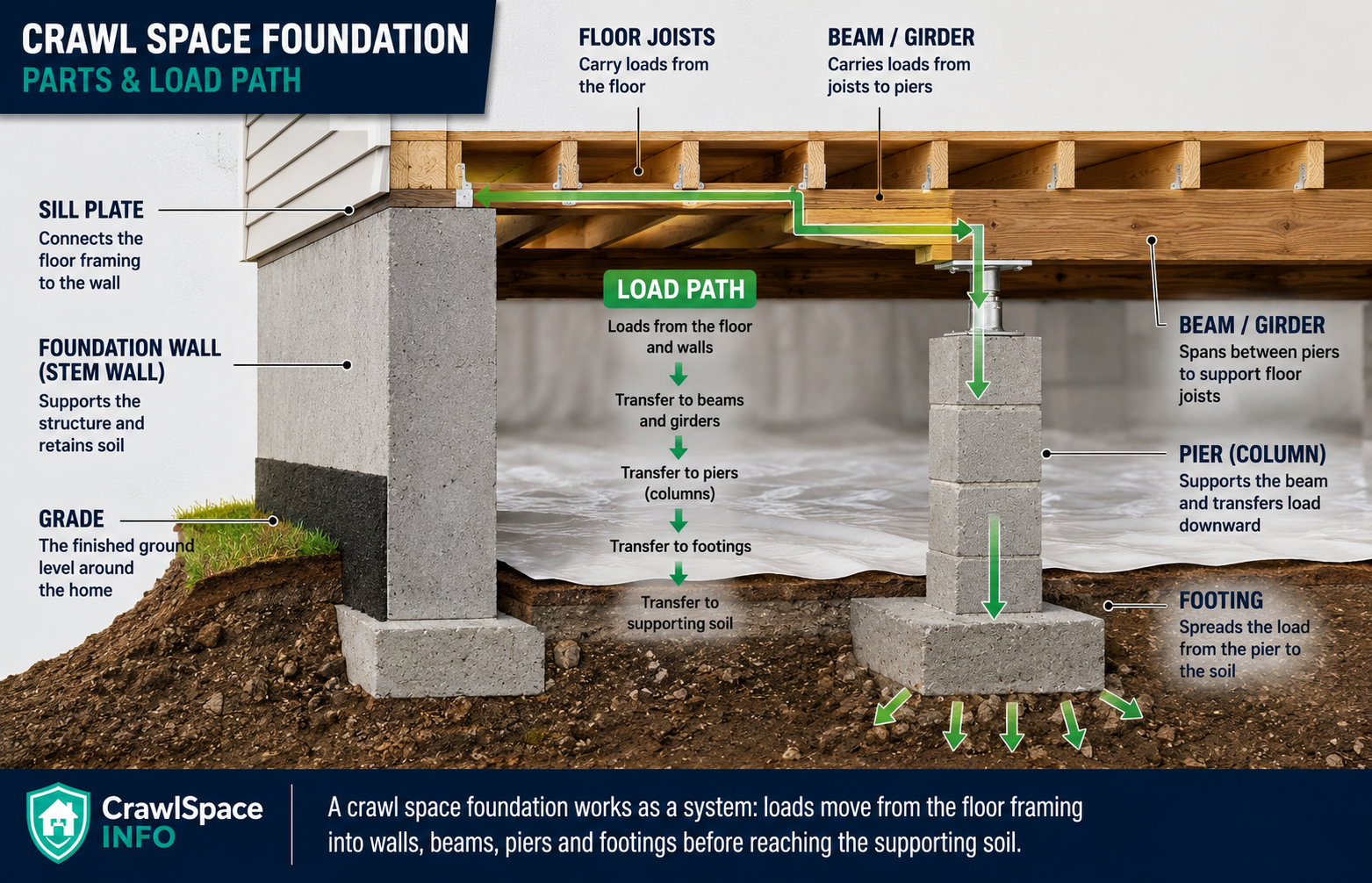
Common components include:
- Foundation wall or stem wall: the perimeter support beneath exterior walls.
- Footing: the widened base that spreads loads into the soil.
- Foundation pier: an isolated support that can carry beams or concentrated loads.
- Sill plate: the wood member anchored to the top of many concrete or masonry foundation walls.
- Beam or girder: a horizontal structural member that transfers floor loads to piers, posts or walls.
- Soil bearing surface: the material below the footing or pier that ultimately supports the load.
The 2024 IRC requires exterior-wall footings to be sized to accommodate loads and transmit them to supporting soil, with footings supported on undisturbed natural soil or engineered fill. Local adoption and amendments control the requirements for a specific property.
Warning Signs of Crawl Space Foundation Problems
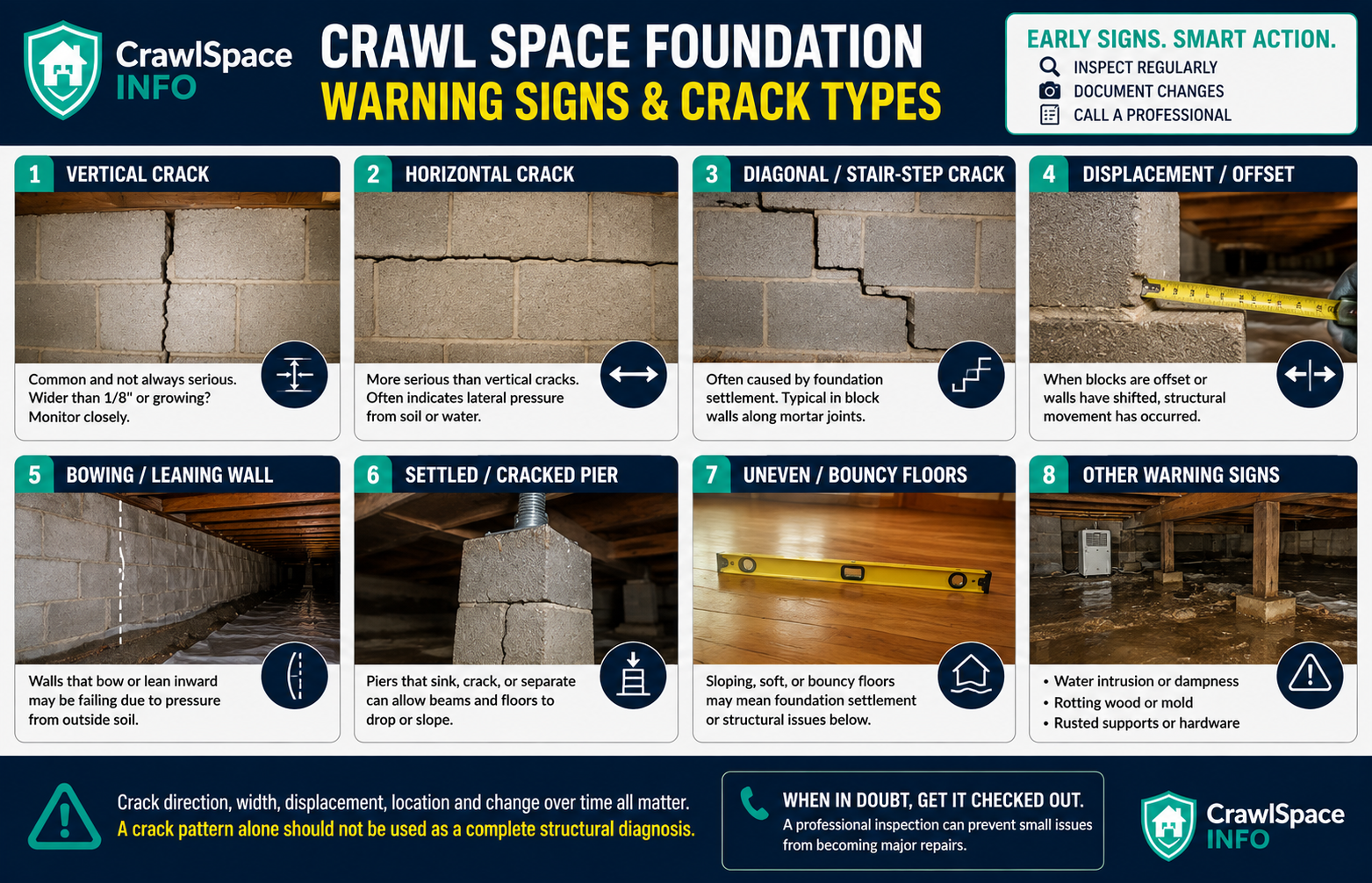
- New or widening foundation cracks
- Horizontal, diagonal or stair-step masonry cracking
- Visible displacement across a crack
- Bowing, leaning or rotating foundation walls
- Cracked, tilted or settled piers
- Gaps between beams and support points
- New sagging, sloping or uneven floors
- Doors or windows that begin sticking as movement develops
- Water entering through cracks or wall joints
- Soil erosion, washout or persistent saturation near footings
What Do Different Foundation Cracks Mean?
Your glossary correctly contains many distinct crack terms—including hairline, shrinkage, structural, active, dormant, horizontal, vertical, diagonal, stair-step and settlement cracks. Those labels are useful for describing what is visible, but they are not diagnoses on their own.
Vertical Cracks
Some vertical cracks are related to shrinkage or localized movement, while others can involve settlement or structural stress. Width, displacement, leakage and change over time matter.
Horizontal Cracks
Horizontal cracking in a foundation wall deserves careful attention because lateral soil or water pressure can contribute to wall distress. The 2024 IRC specifically requires engineered design for certain foundation walls subjected to hydrostatic groundwater pressure.
Diagonal and Stair-Step Cracks
Diagonal or stair-step cracking in masonry can accompany differential movement, but masonry units, mortar condition, openings, wall geometry and local loading also affect crack patterns.
Active vs. Dormant Cracks
An active crack is changing; a dormant or static crack appears stable. Monitoring can help document change, but suspected structural movement should not be managed solely by watching it indefinitely.
Because foundation crack repair is a large search topic in your keyword data, it should also receive its own dedicated supporting article rather than forcing every crack-repair question into this broad pillar.
Foundation Settlement and Differential Movement
Settlement occurs when the foundation or its supporting soil moves downward. Uniform settlement affects a structure more evenly; differential settlement means one area moves differently from another and can distort walls, floors and openings.
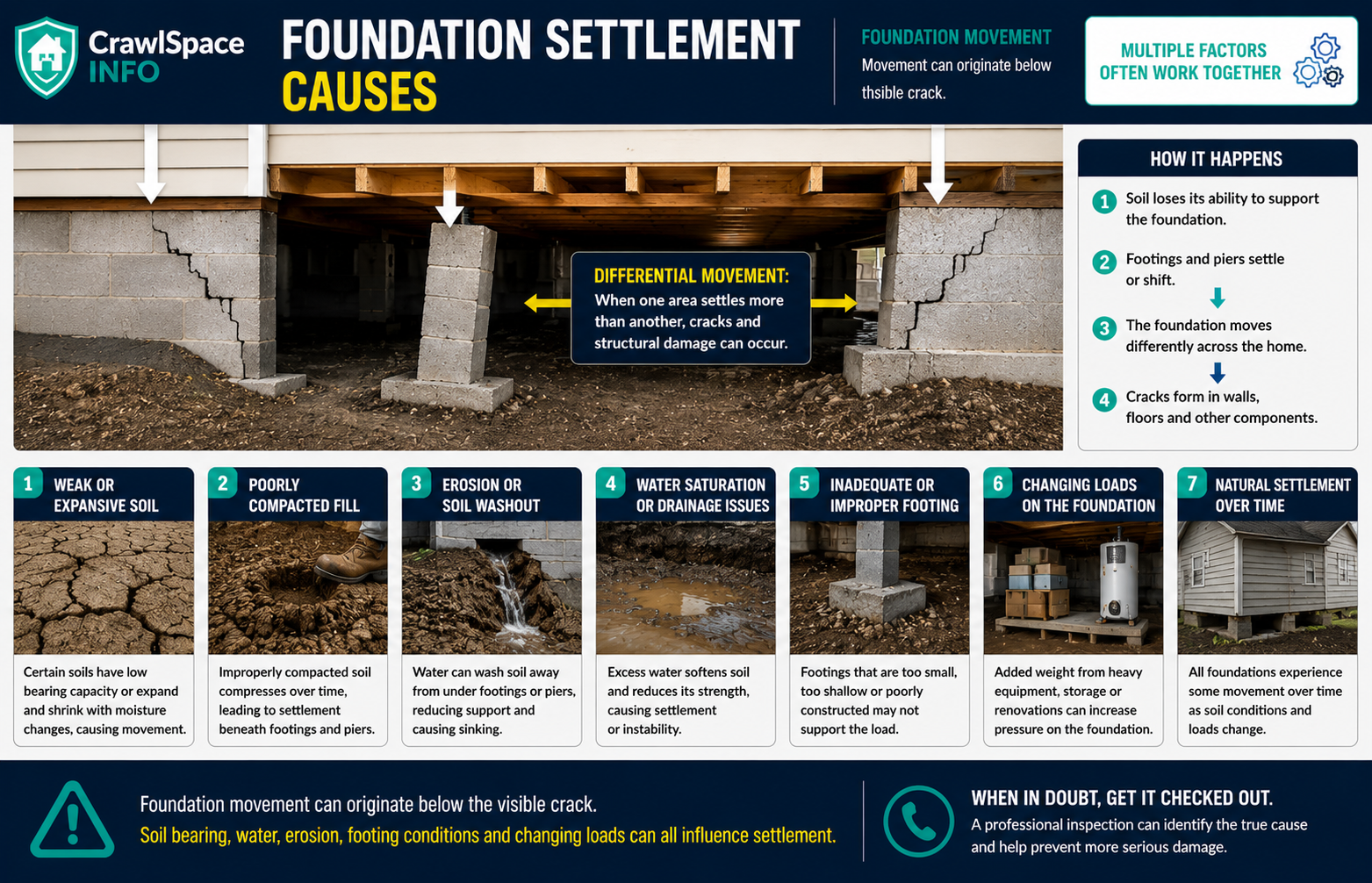
Potential contributors include:
- Weak or compressible supporting soil
- Poorly compacted fill
- Erosion or loss of support
- Persistent water saturation
- Changes in soil moisture
- Inadequate footing size or bearing
- Construction or excavation near the foundation
- Changes in structural loading
- Frost or expansive-soil conditions in applicable regions
A crack can be repaired cosmetically while the movement beneath it continues. When settlement is the cause, the repair strategy must address the support condition rather than only closing the visible crack.
Piers, Footings and Pier-and-Beam Crawl Space Foundations
Pier-and-beam and post-and-pier systems use concentrated supports to transfer loads toward footings and soil. Your glossary includes foundation piers, concrete piers, masonry piers, pier footings, pad footings, steel piers, helical piers and push piers—terms homeowners may encounter when comparing repair proposals.
Common problems include cracked masonry piers, insufficient bearing, settlement beneath a pier, tilted supports, deteriorated mortar, corrosion, erosion at the base and modifications that change the load carried by the support.
The correct solution depends on whether the problem is in the pier itself, the footing below it, the soil below the footing, the connection above it or the beam it supports.
Common Causes of Crawl Space Foundation Problems
| Cause | Possible Effect | What Needs Investigation |
|---|---|---|
| Water and poor drainage | Saturated soil, erosion, hydrostatic pressure, seepage | Grading, downspouts, groundwater, footing drainage and discharge |
| Weak or changing soil | Settlement or differential movement | Soil bearing, fill, erosion and movement pattern |
| Inadequate footing or pier | Concentrated settlement or loss of support | Size, bearing, depth, construction and load |
| Foundation-wall pressure | Cracking, bowing or displacement | Backfill, groundwater, drainage and wall design |
| Material deterioration | Mortar loss, spalling, damaged masonry or concrete | Extent of damage and moisture/freeze exposure |
| Structural alterations | Changed load path | Removed supports, added loads, openings and remodeling |
Crawl Space Foundation Repair Methods
Repair methods should be selected after the cause is understood. One home may need localized masonry repair; another may require foundation stabilization, drainage work or new engineered support.
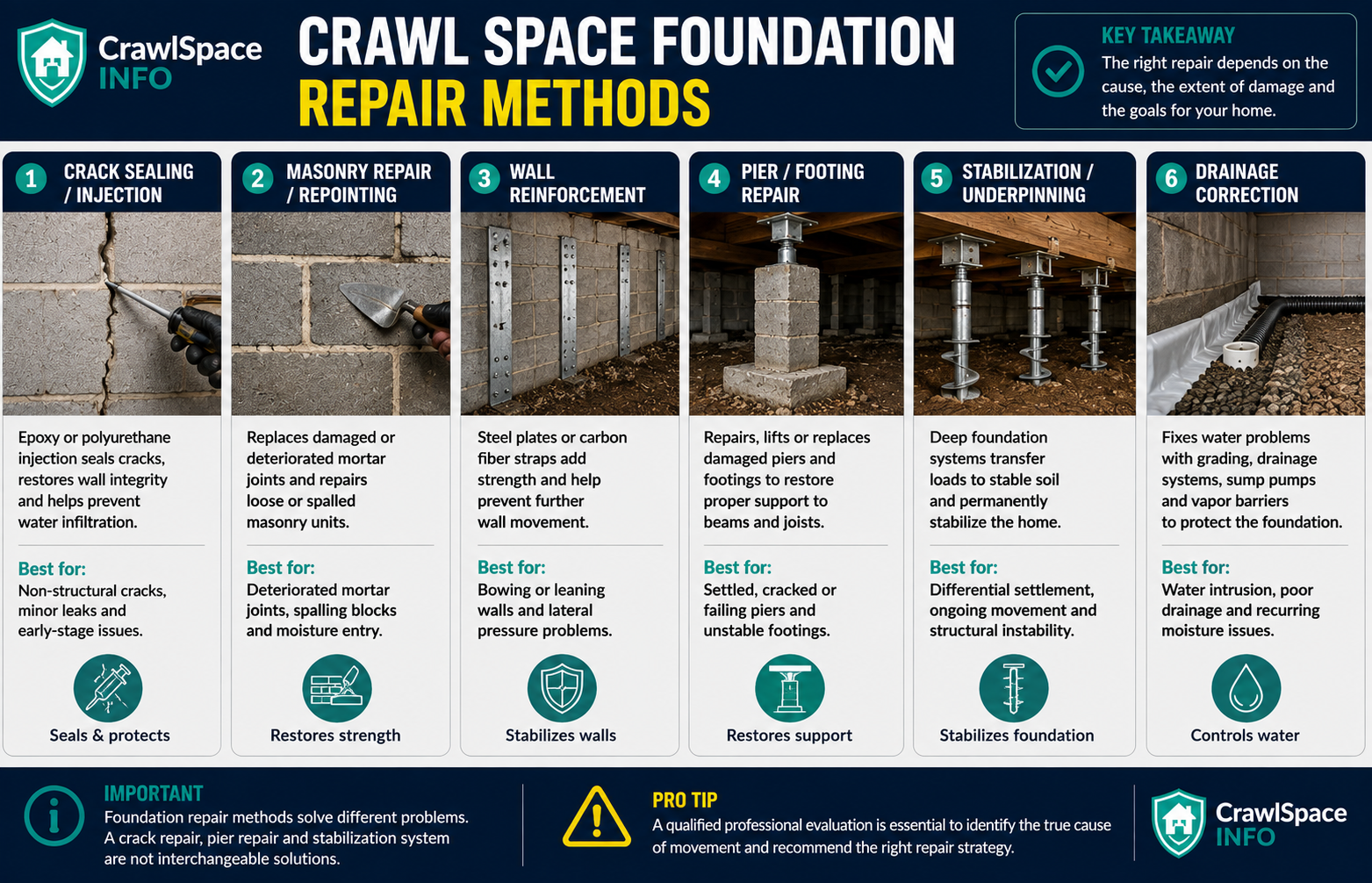
| Repair Type | Typical Purpose | Important Limitation |
|---|---|---|
| Crack sealing / injection | Seal or bond selected concrete cracks; control leakage in appropriate cases | Does not correct ongoing settlement or wall movement by itself |
| Masonry repair / repointing | Repair damaged mortar or localized masonry | Underlying movement must be addressed if active |
| Wall reinforcement | Increase resistance where a wall is distressed | System must match wall type and structural demand |
| Pier / footing repair | Restore an inadequate or failed support point | Soil and load path still govern performance |
| Foundation stabilization | Transfer or stabilize loads where settlement is occurring | Requires diagnosis, design and appropriate installation |
| Drainage correction | Reduce water pressure, erosion or saturation contributing to distress | Does not rebuild structurally damaged components |
Foundation Crack Repair: When Is Sealing Enough?
Crack repair can serve different purposes: reducing water entry, restoring continuity in appropriate concrete cracks, protecting exposed material or improving appearance. But a crack-repair product should not be confused with foundation stabilization.
Before selecting epoxy, polyurethane, mortar, sealant or another repair material, determine what the crack is doing. Questions include:
- Is the crack in poured concrete, block, brick, stone or mortar?
- Is it leaking?
- Is there displacement from one side to the other?
- Has it widened or changed?
- Is the wall bowing or leaning?
- Does the crack correspond with floor movement or settlement?
- Is groundwater or drainage pressure involved?
This topic deserves a dedicated supporting article targeting foundation crack repair, which your keyword sheet shows at 18,100 monthly searches.
Helical Piers, Push Piers and Foundation Stabilization
Specialty underpinning systems may be used when a foundation requires stabilization or load transfer to more suitable bearing material. Homeowners may hear terms such as helical pier, push pier, resistance pier and steel pier.
These are not universal remedies for every foundation crack. System selection depends on structure, soil, access, loading, movement pattern and the design/installation requirements for the project.
For crawl-space homes, the repair may also need coordination with beams, joists, interior piers and floor elevation. Stabilizing a perimeter foundation does not automatically correct every interior floor-support problem.
How Water and Drainage Affect Crawl Space Foundations
Water can contribute to foundation problems by saturating soil, eroding support, increasing pressure against below-grade walls, entering cracks and accelerating material deterioration.
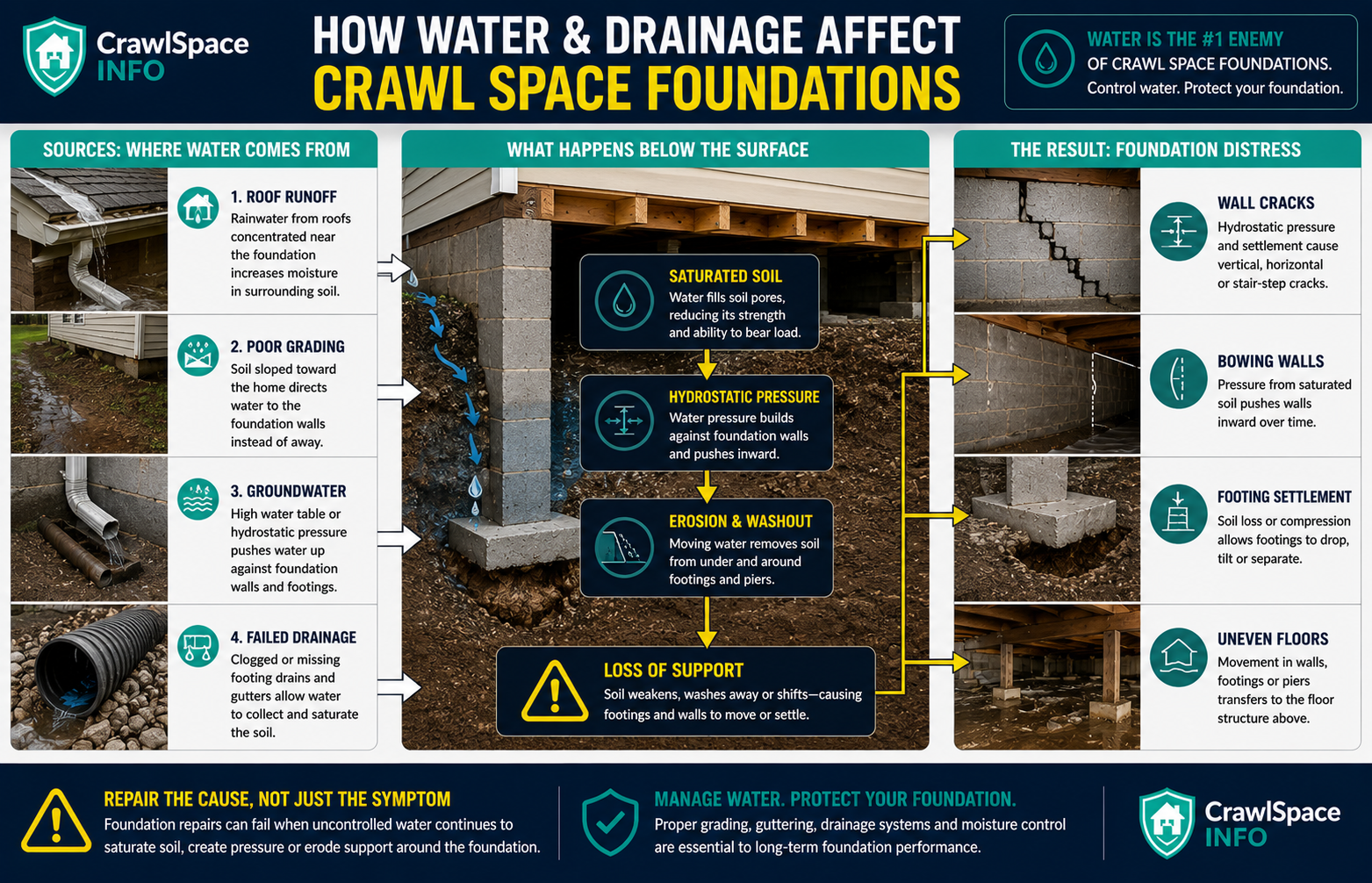
The 2024 IRC requires engineered foundation-wall design in certain conditions involving hydrostatic groundwater pressure. That reinforces an important homeowner principle: water pressure is not merely a cosmetic waterproofing issue when it is acting on structural walls.
If the foundation problem includes water, review our Crawl Space Waterproofing guide and Drainage & Sump Pumps guide.
How Much Does Crawl Space Foundation Repair Cost?
The phrase “foundation repair” covers too many scopes for one responsible universal price. Your own keyword data shows strong demand for crawl space foundation repair cost, so this should become a dedicated supporting cost article with current market research rather than relying on a static number inside the pillar.
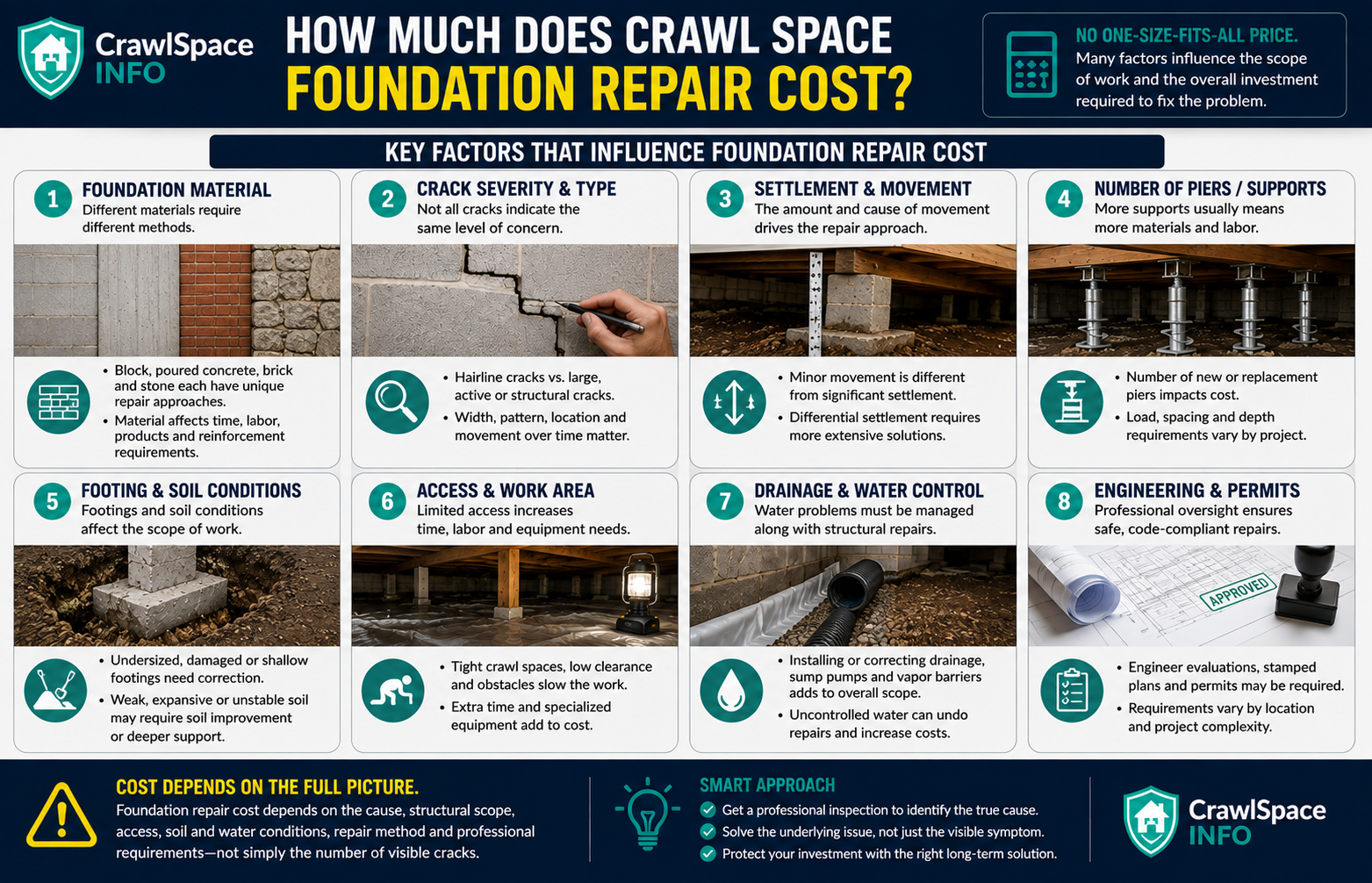
- Type of foundation and material
- Number, location and behavior of cracks
- Extent of settlement or wall movement
- Number of piers or support points involved
- Footing or soil work
- Need for underpinning or stabilization
- Crawl-space access and clearance
- Drainage or waterproofing work
- Engineering, permits and inspections
- Repairs to framing or finishes affected by movement
DIY Foundation Repair vs. Professional Evaluation
Homeowners can document cracks, photograph changes, track water patterns, clean gutters and correct simple exterior drainage issues. Structural repair, excavation and load transfer require a different level of care.
Reasonable Homeowner Tasks
- Photograph cracks with dates and scale
- Document whether water enters during rain
- Note floor, door and window changes
- Maintain gutters and downspouts
- Observe grading and erosion
- Collect previous repair and inspection records
Get Qualified Help Before
- Underpinning or pier installation
- Excavating below or beside footings
- Repairing a bowing or displaced foundation wall
- Jacking or moving load-bearing parts of the house
- Removing or rebuilding significant foundation sections
- Assuming a moving structural crack can be solved with sealant alone
How to Choose a Crawl Space Foundation Repair Contractor
- What is the diagnosed cause of the movement or cracking?
- Which foundation component has failed or moved?
- Is the crack active or believed to be stable?
- What evidence supports the proposed repair method?
- Does the repair address drainage or soil conditions contributing to the problem?
- If piers are proposed, how were their type, number and locations determined?
- Is engineering recommended or required?
- Are permits and inspections required locally?
- What measurements will document stabilization or correction?
- What does the warranty actually cover?
For significant settlement, wall movement, unusual construction, conflicting repair proposals or substantial structural work, an independent structural engineer can be especially useful before committing to a system.
Foundation Inspection and Maintenance Checklist
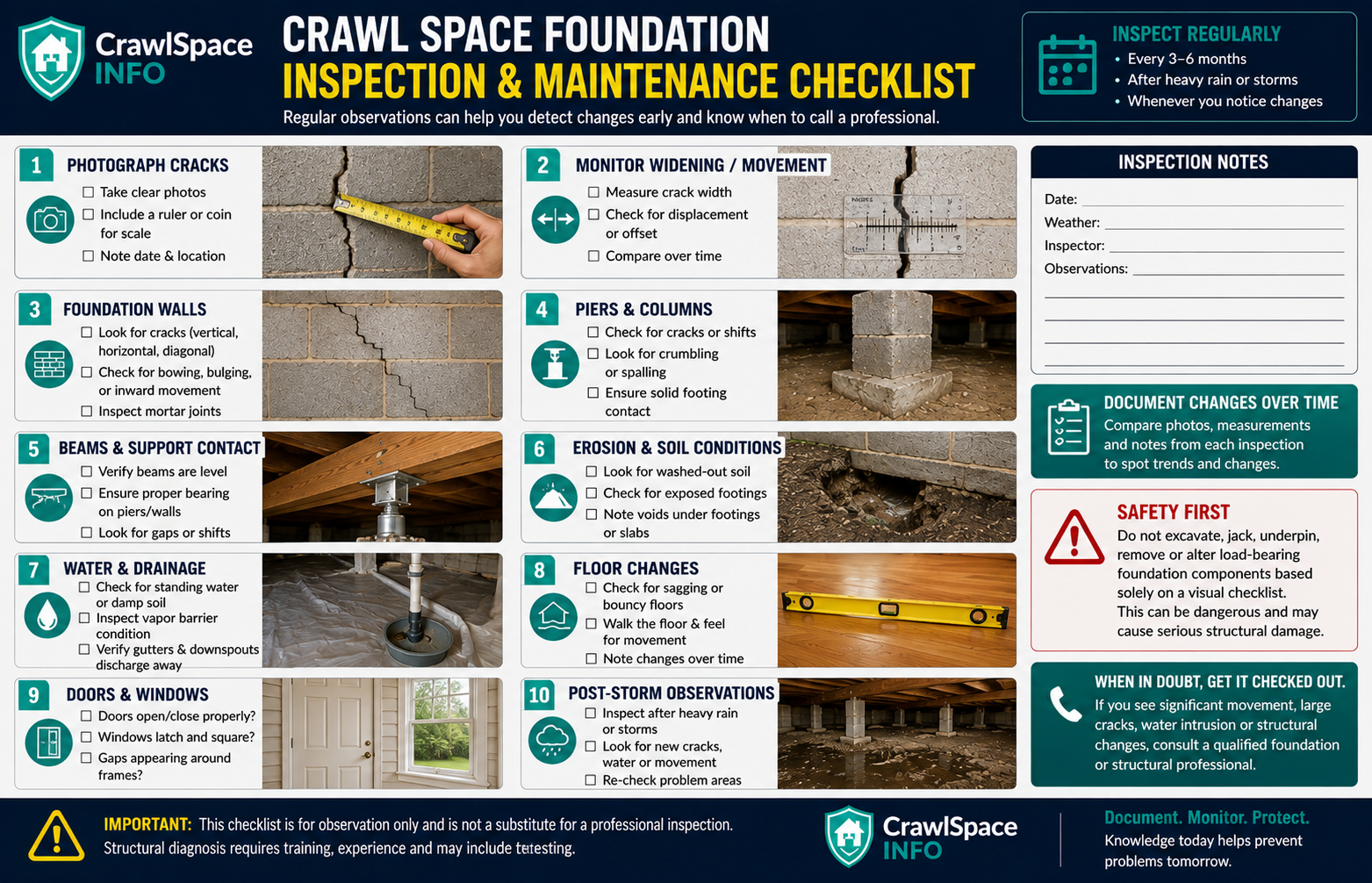
- Photograph new or changing cracks
- Watch for crack widening or displacement
- Look for leaning or bowing walls
- Observe piers for cracking, tilting or settlement
- Check for gaps between supports and beams
- Look for erosion or washed-out soil
- Check for recurring water near foundation walls and footings
- Observe changes in floor level or bounce
- Note new sticking doors or windows
- Inspect after major storms, leaks or nearby excavation when safe to do so
Crawl Space Foundation Repair FAQs
Are all foundation cracks structural?
No. Cracks can form for different reasons, including shrinkage, material movement, settlement and structural stress. Crack direction, width, displacement, location, leakage and change over time all matter.
What type of foundation crack is most concerning?
No single crack pattern can diagnose every foundation. Rapidly changing cracks, significant displacement, bowing or leaning walls, and cracks associated with settlement or other structural movement deserve prompt evaluation.
Can I repair a foundation crack myself?
Some stable, nonstructural cracks may be appropriate for limited sealing or maintenance, but a homeowner should not assume a crack is nonstructural solely from appearance. Active movement or structural distress needs diagnosis before cosmetic repair.
Does fixing a crack stop foundation settlement?
No. Closing or sealing a crack does not correct ongoing soil or footing movement. Settlement repair must address the support condition causing the movement.
What is the difference between a pier and a footing?
A pier is a vertical or concentrated support that transfers load downward. A footing is the base that spreads load into the supporting soil. Some repair systems use deep structural piers that transfer load differently from conventional shallow footings.
Can water cause foundation cracks?
Water can contribute indirectly through soil saturation, erosion, hydrostatic pressure, freeze conditions or material deterioration. The role of water depends on the site, soil, foundation type and drainage conditions.
Do sagging floors mean the foundation is failing?
Not necessarily. Sagging floors can result from joists, beams, posts, interior piers, moisture damage or foundation movement. The load path should be evaluated to locate the actual problem.
When should I call a structural engineer?
Engineering can be particularly useful for substantial movement, bowing walls, major settlement, unusual foundations, disputed contractor recommendations or repairs that materially alter load-bearing components. Local rules may also require engineered design.
Final Takeaway
Crawl space foundation repair should begin with diagnosis, not a product. Identify the foundation type, document cracks and movement, determine whether water or soil conditions are contributing, follow the load path from the house into the ground, and then select a repair that addresses the cause. Cracks, piers, walls, footings and floor framing are connected parts of the same structural system.
Not Sure What the Crack or Movement Means?
Use the Free Crawl Space Assessment to organize foundation, structural and moisture symptoms before comparing repair options.
Related Crawl Space Guides
Sources & Technical References
- International Code Council — 2024 International Residential Code, Chapter 4 Foundations, including R403 Footings and R404 Foundation and Retaining Walls.
- U.S. Department of Energy Building America Solution Center — crawl-space moisture, drainage and foundation guidance.
- Local building codes, engineering requirements, permits and manufacturer installation instructions should be verified for the specific repair and jurisdiction.