

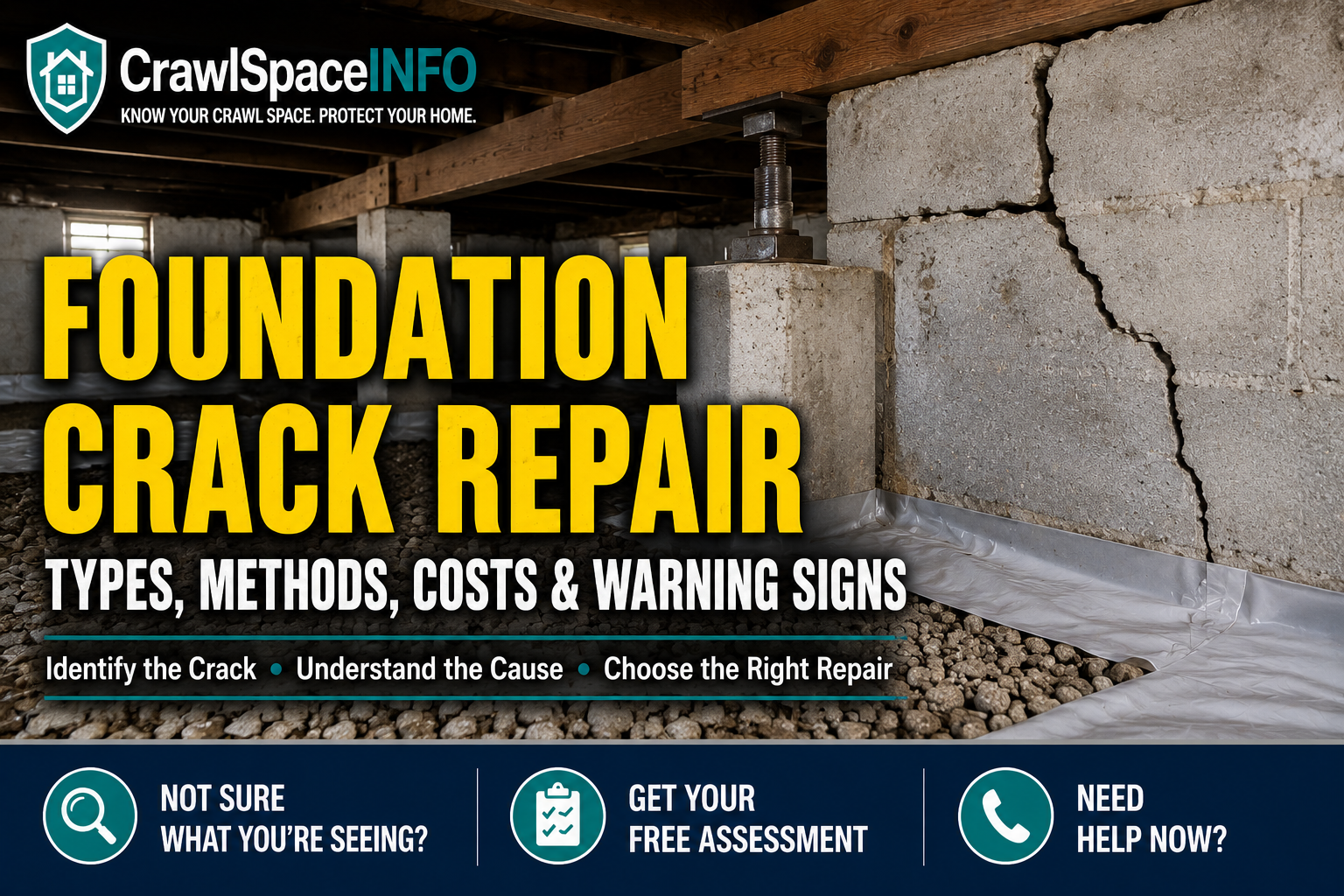
Foundation crack repair starts with understanding what the crack represents. Some cracks are stable and primarily involve sealing or masonry repair, while others are associated with settlement, wall movement, soil problems or water intrusion that must be addressed before the crack itself is repaired.
Quick Answer: Foundation Crack Repair Cost & Methods
A limited foundation crack repair may cost about $250–$800, while broader foundation repairs average about $5,175 nationally, with many projects falling between $2,225 and $8,135. The correct repair still depends on the cause, material, movement and location of the crack. Stable cracks may sometimes be sealed or injected, while cracks caused by settlement, bowing walls, failed supports or soil problems can require stabilization, reinforcement, underpinning, pier work or drainage correction. These are national 2026 planning figures—not a quote for a specific home.
Common Foundation Crack Types
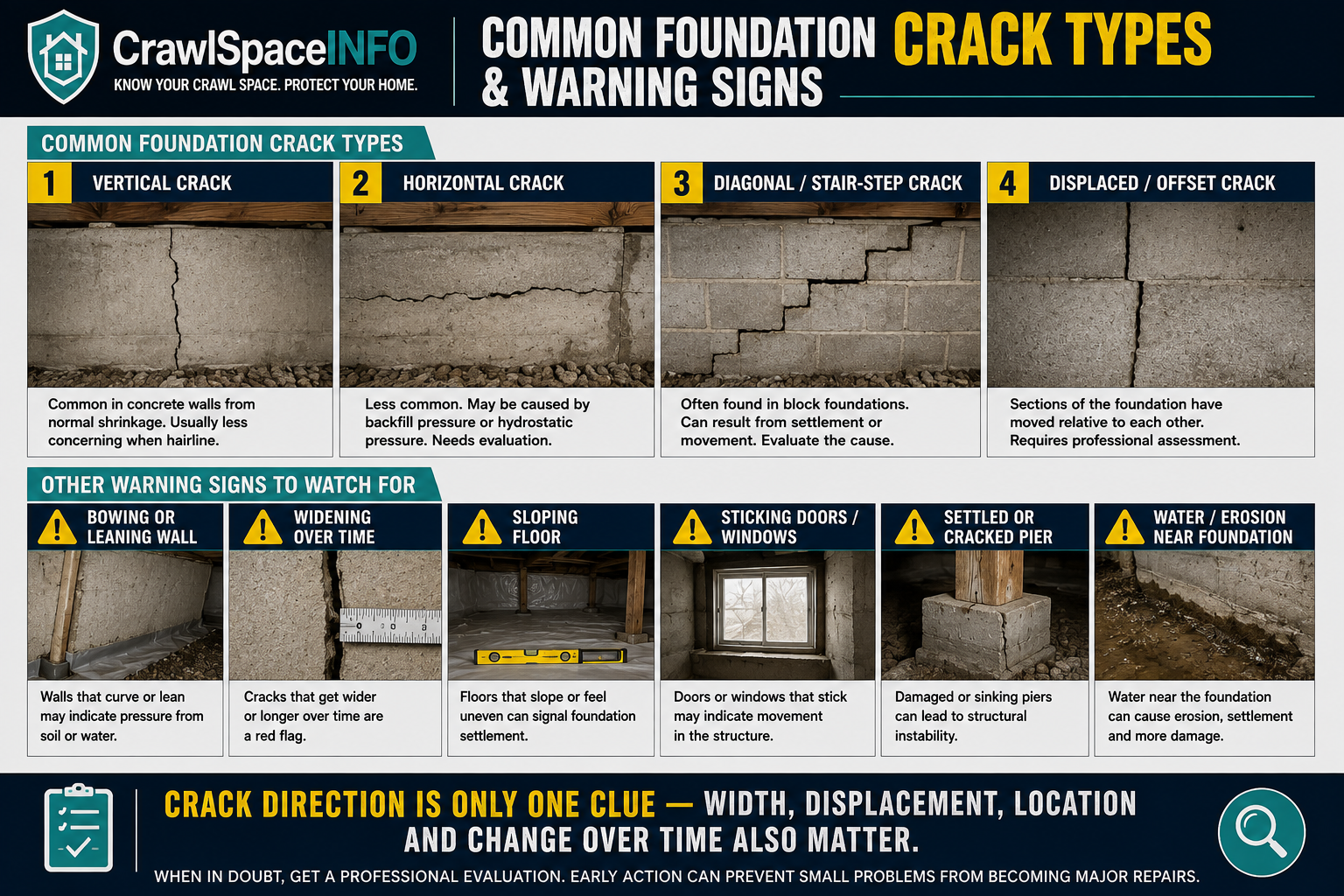
Vertical Cracks
Vertical cracks can occur for several reasons, including material shrinkage, localized movement or settlement. A narrow, stable vertical crack may be less concerning than one that is widening, displaced or associated with other movement, but appearance alone should not be treated as a diagnosis.
Horizontal Cracks
Horizontal cracking in a foundation wall can be associated with lateral pressure, wall bending or other structural distress. If the wall is also bowing, leaning or displaced, the condition deserves prompt professional evaluation.
Diagonal and Stair-Step Cracks
Diagonal cracks through concrete or stair-step cracks through masonry joints can be associated with differential movement, settlement or localized stress. What matters is whether the crack is stable, how much displacement exists and whether other symptoms appear elsewhere in the building.
Cracks With Displacement
A crack where one side is visibly offset from the other provides different information than a hairline surface crack. Displacement can indicate movement that may require structural evaluation rather than cosmetic patching.
Foundation Crack Warning Signs to Take Seriously
Foundation cracks become more meaningful when they occur together with other changes in the building. Conditions such as large exterior cracks, sloping floors, sticking windows, doors out of plumb and other signs of settlement deserve closer investigation.
| Observed Condition | Why It Matters |
|---|---|
| Crack is widening over time | Change suggests the condition may still be active rather than an old stable crack. |
| Visible offset or displacement | Movement across the crack can indicate more than simple surface shrinkage. |
| Bowing or leaning wall | Wall geometry has changed and may require reinforcement or stabilization. |
| Stair-step cracking in masonry | Can be associated with movement across multiple masonry units or joints. |
| Uneven or sloping floors | May indicate foundation, pier, beam or soil movement elsewhere in the load path. |
| Doors or windows suddenly sticking | Changes in openings can accompany building movement, although they can have other causes. |
| Cracks after erosion, flooding or drainage failure | Water can alter soil support, contribute to erosion or increase pressure around foundations. |
What Causes Foundation Cracks?
Concrete or Masonry Shrinkage
Materials can shrink as they cure or dry, producing cracks that may remain stable. These still need evaluation when they leak, widen, show displacement or occur with other movement.
Soil Settlement
Foundation loads ultimately transfer into supporting soil. Settlement occurs as soil or rock deforms under load, and excessive or uneven movement can damage the supported structure.
Weak or Poorly Compacted Fill
Fill that was not adequately compacted or soil with inadequate bearing capacity can allow footings or piers to move. The correct repair may need to address the support condition below the visible crack.
Water, Erosion and Drainage Problems
Roof runoff, poor grading, leaking drainage systems, groundwater and erosion can change the moisture and support conditions around a foundation. Water management is therefore part of many foundation investigations, even when the visible symptom is a crack.
Changing Loads or Structural Alterations
Removed supports, altered beams, added loads or poorly executed repairs can change how forces travel through the structure. The crack may be a symptom of a broader load-path problem.
Foundation Crack Repair Methods
There is no single “best” crack repair because different methods solve different problems.
Crack Sealing or Injection
Some stable cracks in concrete can be sealed or injected to reduce water entry or restore continuity, depending on the crack, material and selected repair system. Injection should not be confused with stabilization: sealing a moving crack does not stop settlement or wall movement.
Masonry Repointing or Local Repair
Deteriorated mortar joints or localized masonry damage may require removal of unsound mortar and repointing with a compatible material. Repair materials should match the characteristics of the masonry rather than simply being the strongest available mortar.
Wall Reinforcement or Stabilization
Bowing or laterally distressed foundation walls may require structural reinforcement or stabilization. The method depends on wall material, movement, available access, soil pressure and local engineering requirements.
Pier or Footing Repair
When a crack is related to a failed, undersized, settled or eroded support, repairing the crack without correcting the pier or footing may leave the underlying cause unchanged.
Underpinning or Deep Foundation Support
Some settlement problems are addressed by transferring loads to deeper or more competent material. These are structural systems that require appropriate design, installation and verification rather than a cosmetic crack patch.
Drainage Correction
If water saturation, erosion or drainage failure contributes to movement, drainage work may be necessary alongside structural repair. See our Crawl Space Waterproofing guide and Drainage & Sump Pumps guide.
How Much Does Foundation Crack Repair Cost in 2026?
Foundation crack repair can range from a relatively small sealing or injection project to a much larger structural repair. Angi’s 2026 foundation-repair data places a straightforward foundation crack repair at roughly $250 to $800. When the crack is connected to settlement, wall movement, drainage problems, failed supports or other structural conditions, the project can become much more expensive.
For broader context, Angi and HomeAdvisor currently place many professional foundation repairs between $2,225 and $8,135, with a national average around $5,175. These are national planning figures, not estimates for a specific property.
| Repair Situation | 2026 Planning Range |
|---|---|
| Limited foundation crack repair | About $250–$800 |
| General professional foundation repair | About $2,225–$8,135 |
| Reported national average foundation repair | About $5,175 |
| Foundation leak repair | About $2,000–$7,000 |
| Foundation reinforcement | About $1,000–$5,000 |
| Bowing-wall repair | About $4,000–$12,000 |
| Settlement-related repair | About $5,000–$25,000 |
These ranges show why the visible crack alone does not determine the price. A contractor may be able to repair a stable crack for hundreds of dollars, while a crack caused by active settlement or wall movement can require thousands of dollars in stabilization work.
What Changes the Cost?
- Foundation material: Poured concrete, block, brick and stone require different repair approaches.
- Crack severity: Width, displacement, leakage and whether the crack is still changing affect the repair.
- Underlying movement: Settlement or bowing may require stabilization rather than sealing alone.
- Piers and footings: Damaged or settled structural supports can greatly increase the scope.
- Soil conditions: Weak soil, erosion or poorly compacted fill may require work below the visible foundation.
- Water management: Drainage, grading, sump-pump or waterproofing work may be needed when moisture contributes to the problem.
- Access: Tight crawl-space conditions and difficult excavation can increase labor.
- Engineering and permits: Significant structural repairs may require professional design, permits or inspections.
Should You Monitor a Foundation Crack or Repair It?
Documentation can be useful when the crack is not an emergency condition. Take clear dated photographs, note approximate dimensions, and record related changes such as floor slope, sticking doors, water entry or wall movement.
Monitoring is not a substitute for evaluation when there are significant warning signs. Rapidly changing cracks, visible displacement, leaning or bowing walls, substantial settlement, unstable supports or major water-related soil loss deserve prompt professional attention.
When Should You Call a Foundation Professional or Structural Engineer?
Professional evaluation becomes especially important when the repair involves load-bearing components or when the cause is uncertain. Cracks, erosion and differential settlement can point to underlying soil or structural conditions that should be understood before major repair work proceeds.
- The crack is widening or changing quickly.
- The wall is bowing, leaning or displaced.
- There are large cracks together with sloping floors or sticking openings.
- A pier, post or footing has moved or deteriorated.
- Soil has washed out or eroded around the foundation.
- Multiple contractors recommend very different structural solutions.
- The repair involves underpinning, new structural piers or major wall reinforcement.
For the broader structural system, see Crawl Space Foundation Problems & Repair and Sagging Floors & Crawl Space Structural Repair.
Not Sure What the Foundation Crack Means?
Use the CrawlSpaceInfo Free Crawl Space Assessment to organize crack, floor, moisture and support symptoms before comparing repair options.
Foundation Crack Repair FAQs
How much does foundation crack repair cost?
A limited crack repair may cost roughly $250–$800 according to Angi’s 2026 data. Broader foundation repairs commonly fall between $2,225 and $8,135, averaging about $5,175 nationally. Settlement, bowing walls, failed supports and drainage problems can push the cost much higher.
Can every foundation crack be repaired with epoxy or polyurethane?
No. Injection and sealing products address specific crack conditions. They do not correct settlement, bowing walls, failed footings or other active structural movement.
Are vertical foundation cracks always harmless?
No. A vertical crack can be stable or it can be associated with movement. Width, displacement, leakage, location and change over time should be considered rather than direction alone.
Is a horizontal foundation crack serious?
Horizontal cracks can be associated with wall bending or lateral pressure, especially when accompanied by bowing or displacement. Those conditions warrant professional evaluation.
Can water cause foundation cracks?
Water can contribute indirectly by saturating soil, changing support conditions, causing erosion or creating pressure against below-grade walls. The role of water depends on the site and foundation system.
Can I monitor a small crack instead of repairing it immediately?
Some stable cracks can be documented and monitored, but monitoring is not appropriate when there is rapid change, significant displacement, bowing, settlement or other structural distress.
Does repairing the crack stop foundation settlement?
Not by itself. If settlement is the underlying cause, the support or soil condition must be addressed. Closing the visible crack alone does not stop movement.
Sources & Technical References
- Angi — How Much Does Foundation Repair Cost? [2026 Data], including crack, leak, settlement, reinforcement and bowing-wall cost ranges.
- HomeAdvisor — How Much Does Foundation Repair Cost in 2026?, including the national average and common project range.
- Federal Highway Administration — Soils and Foundations Reference Manual, including shallow-foundation bearing and settlement principles.
- Federal Emergency Management Agency — Foundation Issues and Pre-Existing Damage, including observable settlement and cracking indicators.
- Federal Emergency Management Agency — FEMA P-1100, Vulnerability-Based Seismic Assessment and Retrofit of One- and Two-Story Dwellings, foundation-condition and soil-instability considerations.
- National Park Service — Preservation Brief 2: Repointing Mortar Joints in Historic Masonry Buildings.
- International Code Council — 2024 International Residential Code, Chapter 4 Foundations. Verify adopted local code requirements for the project jurisdiction.